How university hopes new campus will be 'UK first'

 Royal Agricultural University
An extension to a university campus, that is claimed to be a "UK first", has been given the green light.
The Royal Agricultural University hopes its Innovation Village will help develop sustainable solutions to food production.
The extension to the university's current campus in Cirencester, Gloucestershire, which will bring researchers, food producers, farmers, and landowners under one roof. But what could the new development bring to the town?
How will it be a 'UK first'?
The Innovation Village will researchers from the university under the same roof as industry members, food producers, farmers, and landowners, McCaffery said, describing the hub as a "nucleus"
He claimed these people have "not been brought together in any other nucleus form anywhere in the UK".
However, it is not the only upcoming project to be called an "innovation village" in the UK.
Last year, The Leeds Teaching Hospitals unveiled plans for its Innovation Village, which would see Leeds General Infirmary linked to the city's two universities.
But the Royal Agricultural University appears to have coined the phrase first when it announced the expansion in January 2023.
How will it work?
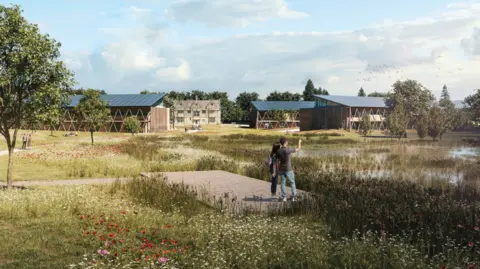
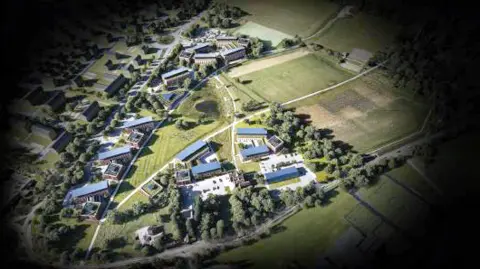
The Innovation Village - on a 12-hectare university-owned site next to its main Cirencester campus – will be a 24,000 sq metre multi-use development of laboratories, office space, and event and hospitality facilities.
As the hub will focus on developing sustainable solutions to food production and biodiversity recovery, the university said the site will be carbon neutral and its buildings "will achieve the Passivhaus Plus Standard".
The standard is achieved by buildings if the energy they generate comes from renewable sources and provide enough energy to operate the building throughout the whole year.
The site will be surrounded by fields and net-zero building materials will be used - this often includes things like timber.
Who will work there?
The site will be made up of a number of areas including a research and innovation centre, live and work residential units, business start-up and support spaces and business conference spaces.
Prof Peter McCaffery, Vice-Chancellor of the RAU, said 85 investors had already been sourced and claimed the university's current £50m contribution to the regional economy would double once the Innovation Village was up and running.
"We want it to be a first for the UK and bring in international researchers, be a magnet for UK and international businesses to address and champion regenerative agriculture," he said.
"Our international partners will also play an active part in the ecosystem of organisations that we are helping to convene at our Cirencester campus - alongside small and medium-sized enterprises, industry research and development, government agencies, charities, community bodies, and other UK universities.
"Since launching the proposal, we have been in contact with many potential investors and funders and, following today's decision, we are now in a position to move forward with those discussions."
The university also hopes the Innovation Village and future businsses working there will boost its appeal to students and indirectly increase numbers.
 Royal Agricultural University
Graham Pollard, chief operating officer for the university, said organisations will rent space in the Innovation Village but "we won't be looking for purely transactional arrangements".
"The success will be built on active partnership between the university and those organisations and will ultimately be judged upon the scale of innovation and outputs that provide real world solutions to food security and sustainable land use," Pollard said.
When will the Innovation Village open?
Outline planning permission for the expansion has been granted by Cotswold District Council's planning committee.
"I think it'll take up to five years to be fully fledged but we want to move quicker because we have international university partners who want to join us on site as well," McCaffery said.
"So, we have momentum and we're going to push forward as quickly as possible," he added.
Tristan Wilkinson, Cotswold District Council's cabinet member for economy and council transformation, said the Innovation Village would contribute towards "a more diverse, resilient and sustainable economy".
"It has the potential to support green growth and agri‑tech innovation, attract high-value, low-carbon businesses, and create skilled jobs that strengthen the Cotswolds beyond its world-renowned visitor economy," he added.
Follow BBC Gloucestershire on Facebook, X and Instagram. Send your story ideas to us on email or via WhatsApp on 0800 313 4630.
