Where, why and how the South caught fire this summer?

 Island Echo
Major wildfires and outdoor blazes have scorched southern England during the recent heatwaves.
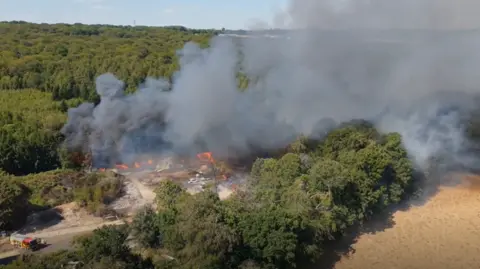
From woodland in the New Forest, Hampshire, and crop fields in Berkshire to heathland in Oxfordshire, Dorset and on the Isle of Wight, the scorching temperatures have made large parts of southern England vulnerable to fire.
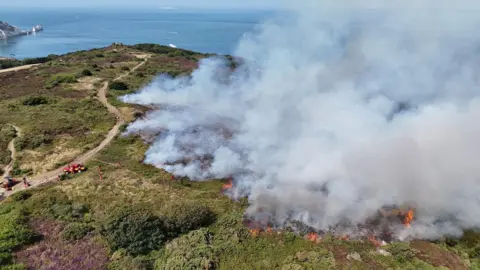
Recently, a large fire at Headon Warren on the Isle of Wight burned for five days and required a major response, involving firefighters, specialist vehicles and helicopter water drops.
Climate change is driving up temperatues and has created conditions that make wildfires more likely, posing a threat to life, harming the environment and putting pressure on emergency services.
Resource strain
 Dorset and Wiltshire Fire and Rescue Service
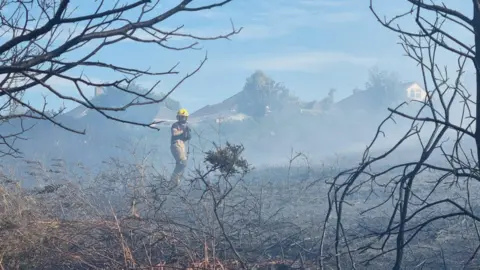
With blazes breaking out across large swathes of the South, fire services have felt the pressure.
Royal Berkshire Fire and Rescue Service said it has responded to more than 250 fires in the open this year, including a large fire in a crop field near Hungerford Park on 10 July.
On Monday, Berkshire crews were called to neighbouring south Oxfordshire to assist with a fire on Goring Heath.
Oxfordshire Fire and Rescue Service said there were 14 fire engines and a number of specialist appliances required at the scene.
The recent Isle of Wight blaze needed support from 80 firefighters at its peak and fire engines were ferried across the Solent from fire stations on the south coast mainland.
A helicopter was deployed to drop water on areas inaccessible to the crews on the ground battling the flames.
Under pressure
BBC South environment correspondent Jon Cuthill said: "For services across the South, the recent spate of wildfires increases financial pressures and demands on resources.
"Recent investment has seen Dorset and Wiltshire Fire & Rescue Service upgrade to a £500,000 off-road Unimog, based at Wareham, to tackle fires in hard-to-reach rural locations - and a new specialist fire engine for the Hampshire service, based at Rushmoor.
"But the biggest resource is firefighters.
"Fires in the open are labour intensive but not just at the incident. As resources are drawn to the area, others are brought in to backfill and provide cover.
"For any service, the costs of a protracted incident can quickly escalate."
Causes
 DWFRS
DWFRSWhile extreme heat and dry weather play their part, so does human activity.
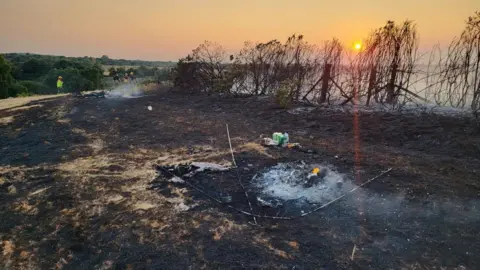
Hampshire and Isle of Wight Fire and Rescue service firefighters found the remains of a campfire while tackling the incident on the Isle of Wight but stated they do not yet know the cause of the fire.
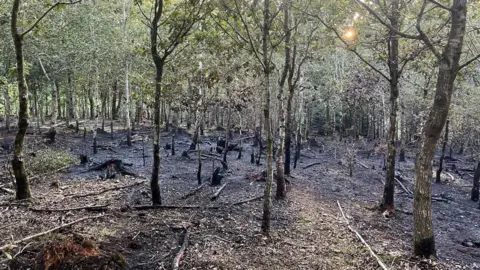
There has been evidence of human carelessness leading to fires in the New Forest, with more than 60 firefighters called to a blaze between Ashurst and Deerleap on 19 July, where a number of discarded disposable BBQs were found throughout the area after about five hectares were severely damaged.
The Rustic Stomp music festival site near Wareham, Dorset, was destroyed by a fire on 17 July that started when a camping stove set fire to a tent, leading to one person needing treatment for slight smoke inhalation.
Machinery can also play a part. On 27 July, crew from across Hampshire responded to a fire near Titchfield, that broke out in a combine harvester and spread across two fields.
Not all fires appear to have been accidental. On 6 July, in Poole, Dorset, part of Bourne Valley Nature Reserve was destroyed, in what fire crews believe was a deliberate act.
Environmental impact
 Hampshire and Isle of Wight Fire and Rescue Service
The risk of wildfires remains high, as the warm and dry weather is expected to continue.
The environmental impact of these outdoors fires can be huge, with about three hectares (7.5 acres) of heathland destroyed at the Dorset nature reserve.
Nine hectares (22.2 acres) of gorse heathland, equivalent to 12.6 football pitches, were ravaged by the fire on the Isle of Wight, close to The Needles.
The National Trust, which owns the land, said the damage would affect habitats for nest birds, invertebrates and other wildlife and would take time to recover.
The trust said it was "likely that many pairs of birds associated with heathland were lost".
Why are there so many?
 Josh Corrie
Fire services say warm, dry weather has left vegetation across much of southern England vulnerable to ignition.
During heatwaves, grass, crops, gorse and heathland can dry out quickly, allowing fires to spread rapidly once they start.
While the weather creates the conditions for wildfires, emergency services say many incidents still begin with human activity, including discarded cigarettes, campfires, barbecues, machinery and deliberate fire-setting.
Fire chiefs have repeatedly urged people to take extra care outdoors as periods of hotter and drier weather become more common.
Climate change is also driving up temperatures, particularly in Europe, resulting in more summer heatwaves and intense wildfires.
