The battle to stop illegal e-bikes 'faster than cars'

 BBC
BBCThe popularity of e-bikes and e-scooters has vastly increased in recent years, helping more people travel cheaper and greener, reducing reliance on cars.
But amid this rapid rise, retailers and police forces say there is also widespread confusion about what is legal and what is not.
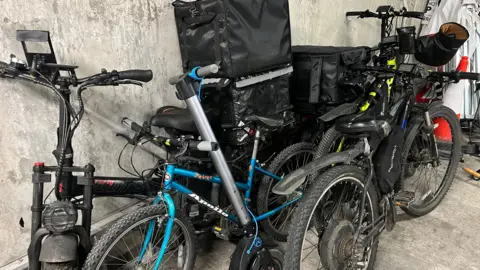
Some were capable of speeds far beyond those allowed by law, including one converted mountain bike officers said could travel at more than 70mph (112.6 km/h).
What began as targeted days of action has now become part of everyday policing, with officers actively looking for offences while on routine patrols across the city.
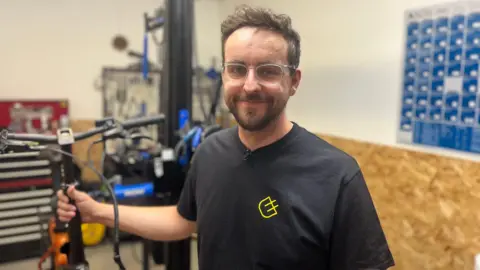
However, a bike mechanic has told the BBC that education is just as important as police enforcement - and he is taking it upon himself to educate people about the legal use of such vehicles.
Kurt Davison, from The Electric Bike Shop in West Bridgford, said the company saw one to two illegally modified e-bikes each day - and refuses to work on them.
So what exactly makes an e-bike legal - and when does it cross the line?
What is a legal e-bike?
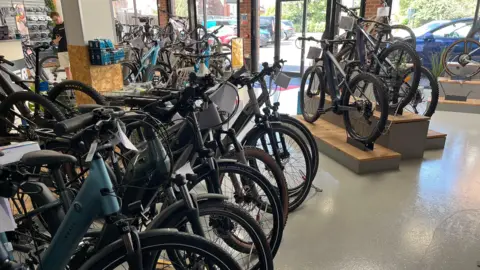
Under UK law, most road legal e-bikes are classed as electrically assisted pedal cycles (EAPCs).
To qualify, they must:
- Have pedals that can propel the bike
- Have a motor rated at no more than 250 watts
- Stop providing electric assistance above 15.5mph (25km/h)
If a bike meets those requirements, it can generally be ridden without a licence, insurance or vehicle tax.
"It becomes illegal when it's over 250 watts of power and it allows electric assistance above 15 and a half miles an hour," said Lee Kidger, managing director of The Electric Bike Shop.
"You can pedal over 15 and a half miles an hour, but the bike will only assist you under that speed."
Once a bike no longer meets the legal definition of an e-bike, it can be treated as a motor vehicle under road traffic law. That means riders may need insurance, a driving licence, vehicle registration and an approved helmet.
Electric motorbikes and electric mopeds also fall into the motor vehicle category and are subject to the same requirements, despite often being marketed alongside e-bikes.
An illegally modified e-bike is typically a bike that started life as a legal EAPC, but has been altered to travel faster than 15.5mph under electric power, without pedalling.
How are bikes being modified?
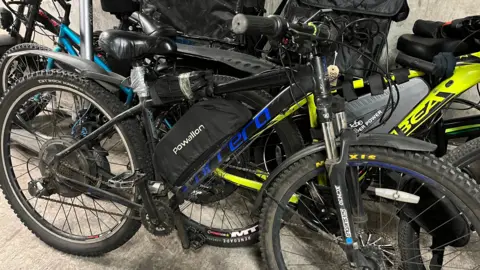
Many illegal e-bikes start life as legal ones before being altered. Others are ordinary bicycles that have been fitted with motors, batteries and throttles - often using conversion kits bought online.
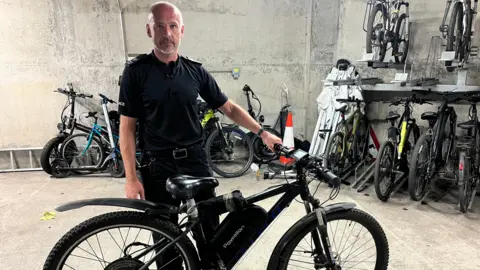
Sgt Dan Butler, from Nottinghamshire Police's city centre neighbourhood policing team, said the most common bikes officers encountered were converted mountain bikes.
"Somebody will take hold of that bike, order a kit online, add a battery, add a motor, add a control unit and add some form of throttle," he said.
"That bike then becomes able to be self-propelled over the 15 and a half miles an hour limit."
At The Electric Bike Shop, Davison - who is also the firm's head of retail - said the firm was seeing more and more people bringing modified bikes in for repairs.
"We now typically get around one or two illegal bikes brought into our workshops every single day, which we point-blank refuse to work on," Davison said.
He added there were typically three warning signs.
"The first thing we look for is whether the bike has a throttle. It makes the bike go without pedalling," he said.
"Other things we look out for are the motor - anything above 250 watts is illegal - and the speed that they go to.
"Our e-bikes limit to 15 and a half miles an hour. Anything past that, it's illegal."
Davison said many riders were simply unaware their bike no longer complied with UK law.
Why are police concerned?
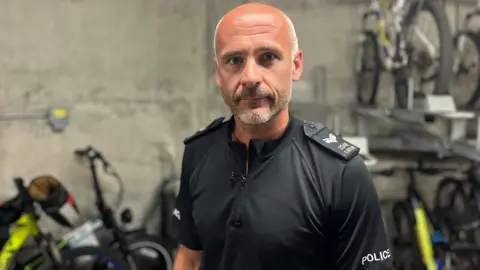
Police are also worried about the safety risks posed by modified bikes.
Sgt Butler said the speed, weight and size of modified bikes could cause serious accidents, "especially in busy areas like city centres".
Safety concerns around e-bikes have been highlighted by a number of serious incidents in Nottingham and beyond.
Last year, an 18-year-old student died after a collision involving an e-bike on a University of Nottingham campus.
Butler said many had not been designed to cope with increased power.
"A lot of the bikes we see are standard mountain bikes that have just been adapted with a motor and a battery," he said.
"But there's usually been no upgrade on the brakes to allow the bike to stop safely against increased speed."
He added officers had seen bikes "capable of travelling in excess of 70mph", which were "held together with plastic tape and cable ties, without any working brakes".
What happens if you're caught?
Nottinghamshire Police's enforcement operation has already led to dozens of prosecutions.
"There's been over 70 successful seizures of illegal bikes," Butler said. "So far we've issued around £11,000 worth of court fines to riders.
"Numerous fixed penalty points have gone on to driving licences and some individuals have even been disqualified from driving."
The force said the work was now being adopted more widely across the county.
Officers from Mansfield's policing team have already been out with city centre officers to learn from the operation, with training and support also being provided.
Are the rules clear enough?
Despite the legislation being well-established, both police and retailers believe public understanding remains patchy.
"I think there needs to be more awareness," Kidger said. "A lot of people don't know the bikes they own are illegal.
"We have actually just started using a new E-Bike Positive safety trust mark on all our products to make it clearer for the public what to look out for when buying a bike."
The scheme has just been launched by the two main cycle industry bodies - the Bicycle Association and the Association of Cycle Traders - with the goal of helping people buy safe and legal e-bikes with confidence.

Butler agrees awareness is key and says the focus is increasingly on education as well as enforcement.
"This is something which has become a very fast-paced issue," he said.
"We need to educate buyers and users around the safe use of these vehicles because they've clearly got a place in society with green travel."
Both men stress that legal e-bikes continue to offer significant benefits.
"It allows people to do things that maybe they wouldn't be able to do otherwise," Kidger said. "A lot of our riders say it makes them feel 30 or 40 years' younger.
"Those are the positives you should be getting from an e-bike - not bikes whizzing down the road faster than a car."
Butler said Nottinghamshire had become a "country-leading" force in tackling illegal e-bikes.
"A number of forces from throughout the UK have reached out to learn from us," he said.
"Some have visited Nottingham city centre to look at our approach and the equipment we use, so they can take that back into their cities and force areas."
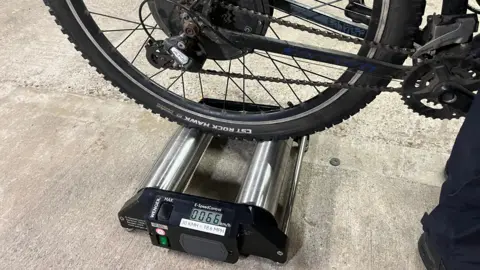
A key piece of technology the force uses is a "compact dynamometer", which tests the top speed of e-bikes.
The device is made by a Swiss company and can measure the peak speed of an e-bike or e-scooter without needing a full test track or laboratory.
Ultimately Butler hopes that with better education and proactive enforcement, Nottinghamshire's roads and towns can be welcoming to e-bikes - but also safe.
Listen to BBC Radio Nottingham on Sounds and follow BBC Nottingham on Facebook, on X, or on Instagram. Send your story ideas to eastmidsnews@bbc.co.uk or via WhatsApp on 0808 100 2210.
