Are e-scooters safe and what are the rules?

 Getty Images
E-scooters are a common sight in towns and cities across the country, but are not without their critics, with some calling for greater regulation on their use.
Earlier this month, a five-year-old boy in Northamptonshire was left with a hole in his head after one of the two-wheeled vehicles, alleged to have been ridden illegally, struck him in a reported hit-and-run.
It is one of many such incidents reported to the BBC, but how big is the issue and does more need to be done to improve safety?
What does the law say?
 Neuron Mobility
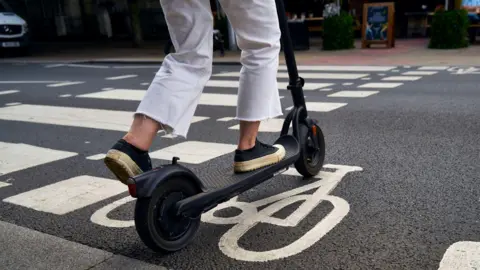
It is illegal to ride a privately owned electric scooter in public, for example on pavements, on roads or in parks.
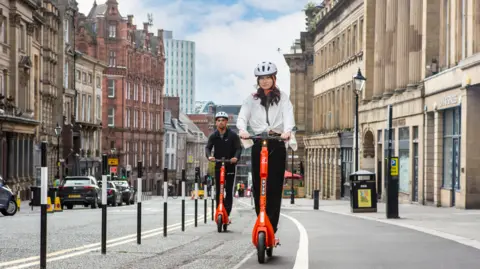
However, scooters rented out by government-backed operators including Voi, Bolt and Neuron can be used on public roads or cycle lanes, subject to age restrictions.
The rental scheme operators provide third-party motor insurance, but wearing a helmet while riding an e-scooter – while highly recommended – is not a legal requirement.
Rental e-scooters must also only be used by one person at a time and riders must be at least 18 and hold a provisional licence.
A private scooter can only be used on private land with the explicit permission of the landowner.
According to the government, anyone flouting the rules can be fined and may have their e-scooter seized by police.
How common are collisions?
There were 1,312 collisions involving e-scooters in England, Scotland and Wales in 2024, compared to 1,292 in 2023.
Of all collisions involving e-scooters in 2024, 306 included only one e-scooter with no other vehicles involved, compared to 284 in 2023.
There were 1,390 casualties in collisions involving e-scooters in 2024, compared to 1,387 in 2023, while of all casualties in collisions involving e-scooters, 1,096 were e-scooter users, compared to 1,117 in 2023.
Six people were killed in collisions involving e-scooters in 2024, five of whom were e-scooter riders, compared to six in 2023.
Government figures, compiled using reports from police forces, stated that there were 444 people seriously injured and 940 "slightly injured" in collisions involving e-scooters in 2024.
Hired e-scooters in the UK can travel at speeds of up to 15.5mph (25km/h), though "go slow" zones – where their speed is automatically reduced – have been introduced in some busy areas to improve safety.
Are rules being enforced?
Police forces insist that they are.
As well as issuing fixed penalty notices, they have the power to seize and crush any e-scooters being used illegally.
Last month, Thames Valley Police, which covers Buckinghamshire, Oxfordshire and Berkshire, said it had seized 1,200 scooters since the start of the year.
In February, Transport Secretary Heidi Alexander said the government was looking to introduce new rules to regulate e-scooters' use.
She said regulations covering speed limits and safety requirements, like lights and working brakes, would be introduced as soon as possible.
 Family handout
But others say enforcement is not always carried out.
The family of five-year-old Henry said they regularly saw older children riding hired scooters illegally, sometimes with as three passengers piled on.
Henry's brother said he knew of children using their parents' provisional licences to access hired scooters.
Police in Derbyshire previously said they received complaints from the public about antisocial use of e-scooters, but admitted it was a "difficult issue to tackle" due to the large number in use.
Are e-scooters the problem?
Despite their critics, e-scooters remain a popular and convenient mode of urban transport.
In London alone, demand for rental e-scooters grew by more than 50% in 2025 compared with 2024, according to Transport for London data.
According to its report, more than two million e-scooter trips were made between September 2024 and September 2025, up on 1.3 million in the same period the year prior.
Trials for hired e-scooter schemes have been running for several years in a number of locations across the country.
They provide a green commuting alternative to petrol and diesel cars and are seen as a way for local governments to lower pollution levels.
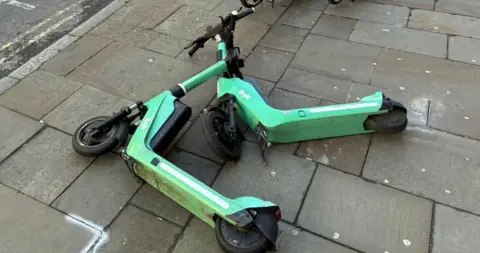
But even when they are not being used, they can pose a risk to pedestrians.
A group representing partially sighted people in Liverpool said the vehicles were often being left "wherever people choose" and creating trip hazards.
But local hire operator Bolt said that 98% of e-scooters were parked in designated bays at any time.
Do you have a story suggestion? Contact us below.
Follow East of England news on X, Instagram and Facebook: BBC Beds, Herts & Bucks, BBC Cambridgeshire, BBC Essex, BBC Norfolk, BBC Northamptonshire or BBC Suffolk.
