'Overlooked cancer makes me fear for my daughters'

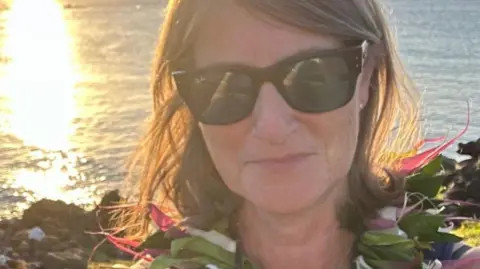 Suzanne Harper
Suzanne Harper considers herself "lucky" that she noticed an "overlooked" strain of breast cancer that does not show up on mammograms.
When she spotted "puckering" on her breast, a decade-long journey with the disease followed which took her to some "dark places", the 66-year-old said.
"It makes you assess things very differently," she added, saying that it sparked fears for her three daughters.
Harper is one of 22 women who have been affected by lobular breast cancer - representing the number diagnosed each day in the UK - who staged silent vigils outside Westminster on Wednesday to demand government funding into "urgently needed" research.
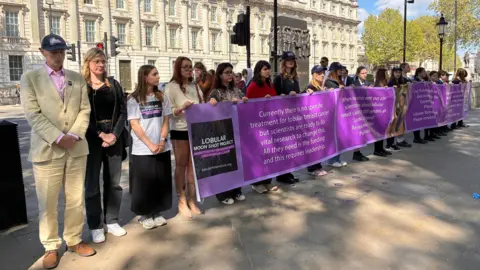 Chrissie Reidy/BBC
Lobular breast cancer makes up 15% of all breast cancer cases, but campaigners say it is under-studied and rarely recognised due to rarely forming a lump in the same way as other breast cancers.
It differs from more common forms of breast cancer in that it begins in the milk-producing lobule glands, as opposed to 70-80% of breast cancers.
Harper, from Tunbridge Wells, Kent, thought the changes to her body were down to stress, menopause and caring for her children.
But during a chance check of her body she spotted "puckering" on her breast.
The former carer said she had no lump, the disease did not show up on mammograms and it may have been growing for years before it was discovered.
"I consider myself lucky it hadn't spread and because I had seen the puckering before, I recognised it," she said.
"That's the thing with this form of cancer - it is hard to detect. That is why it needs direct research."
'Deeply frustrated'
Tanya Hutson, 55, from Guildford in Surrey, was diagnosed in 2022 - by luck.
A second tumour was only discovered after she insisted on a double mastectomy, describing that as "the best decision of my life".
She said the disease's tendency to evade scans made targeted research essential, adding that thousands of women were being let down.
"You have all this treatment - I've had a mastectomy, chemotherapy and hormone blockers - but are they the right thing for lobular when there's no research into it?" she asked.
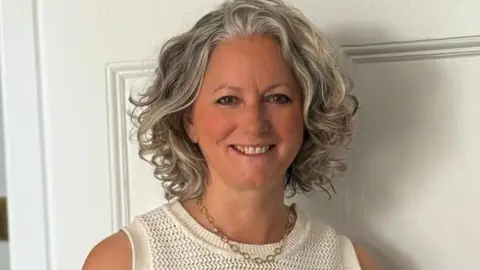 Tanya Hutson
Hutson said the side effects of her treatment had been "pretty awful", adding that she was "gobsmacked" to learn that about 15% of breast cancer patients have lobular disease but there was no dedicated research funding for it.
She had been forced to give up her "dream job" and was still trying to rebuild her strength, describing the diagnosis as something that "turns everything upside down".
"I want something positive to come out of this. I have friends who are now stage four as it wasn't picked up," she said. "We urgently need change."
 Chrissie Reidy/BBC
The vigils took place simultaneously outside Downing Street, the Department of Health and Social Care (DHSC) and the Department for Science, Innovation and Technology from 10:30 BST.
The women were joined by schoolgirls to symbolise future generations.
The Lobular Moon Shot Project is calling on ministers to commit £20m over five years.
The DHSC said research funding was allocated through expert‑led processes to support the best science.
The campaign was co-founded by Tristan Loraine, from Horsham in West Sussex, whose wife, Dr Susan Michaelis, died from lobular breast cancer last year.
She would be "devastated to see that little progress has been made", he said.
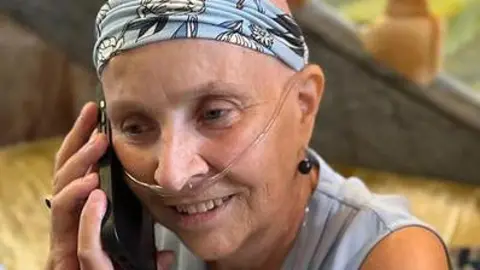 Lobular Moon Shot Project
"We met Wes Streeting five days after Susan died and were told the Government supported this vital funding, yet thousands of women are still waiting," Loraine said.
"The current one-size-fits-all approach to treating lobular breast cancer is failing patients."
The government recently published its national cancer plan, which campaigners say does not address the specific research needs of lobular breast cancer patients.
Campaigners say their plan has the support of 463 MPs but that no ring‑fenced funding has been committed.
A government spokesperson said: "Lobular breast cancer goes undetected in too many women and we are determined to back research that could transform outcomes for patients.
"Last week, Lord Vallance and Minister Hodgson - alongside government research funders - met with the Lobular Moon Shot Project to discuss how best to progress research in this vital area.
"More broadly, our National Cancer Plan puts research at the heart of improving outcomes - helping to bring the latest scientific breakthroughs into the NHS faster so that patients benefit from earlier diagnosis, more effective treatments, and better quality of life."
A documentary featuring women affected by the disease will be broadcast on Together TV on Wednesday evening.
Follow BBC Surrey on Facebook, on X. Send your story ideas to southeasttoday@bbc.co.uk or WhatsApp us on 08081 002250.
