Cloudy skies lead to mixed fortunes for Scotland's eclipse hunters

 BBC Weather Watchers/Mrs Brown
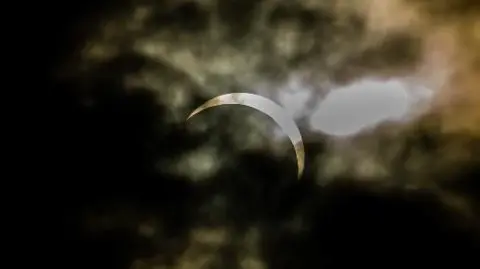
Across Scotland, lucky skygazers have caught glimpses of the eclipse - despite cloud covering much of the view.
The Sun disappeared almost entirely behind the Moon, in what was the most dramatic solar eclipse visible from the UK since August 1999.
The spectacle started just after 18:00 on Wednesday evening, and lasted about two hours, with the Sun setting about 21:00.
At the beginning of the eclipse, heavy cloud cover across much of Scotland left visibility poor. But as the phenomenon progressed, cloud in some areas cleared at least partially, offering glimpses of the rare celestial event.
Parts of Spain and Portugal witnessed the phenomenon of a total eclipse, but in Scotland the eclipse shadow meant that up to 95% of the sun was obscured by the Moon.
At its peak, only an arc of the Sun was visible in Scotland. In areas where the clouds obscured the view, some viewers reported that it temporarily got a little darker than it otherwise would have been, as the Moon blocked the light from the Sun.
While there will be smaller solar eclipses over the next few years, the next total eclipse will not take place until 23 September 2090.
The view from the west
Experts had suggested that west was best for those hoping to see the eclipse.
They had advised eclipse watchers to find a spot in an elevated location with unobstructed views west.
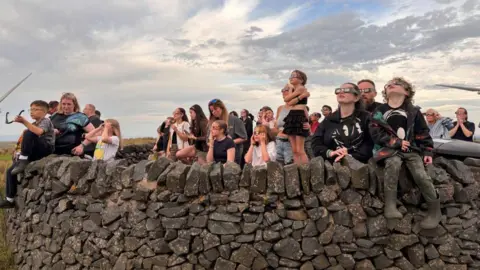
Whitelee Windfarm at Eaglesham in East Renfrewshire hosted one of the biggest eclipse events in Scotland.
BBC Scotland's Selena Jackson said 50-60 people had gathered there to watch the spectacle.
She said that cloud cover scuppered the view for most of the time, but about 19:00 the clouds parted and a sliver of the sun was visible from behind the moon.
Some of the crowd gasped as the sight came into view.
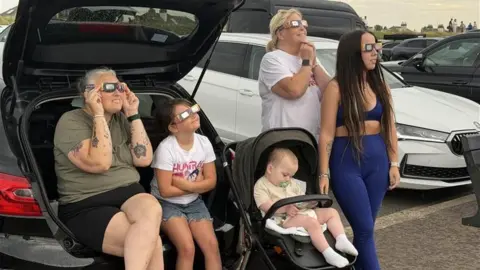
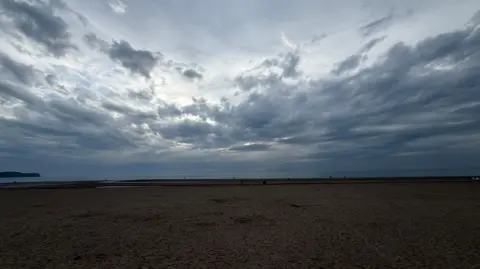
At Ayr Beach, the BBC's Ben Philip said it temporarily felt darker, cooler and eerily quiet during the eclipse.
But he felt the dozens who had gathered to witness the eclipse left disappointed not to have got a better view.
On a few occasions, the odd break in the cloud gave a glimpse of the Sun and the Moon for a few seconds.
One member of he public who came to the beach to see the eclipse said: "The cloud just wasn't on our side."
Calton Hill 'busier than Hogmanay'
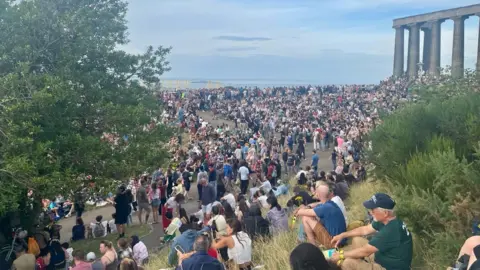
Edinburgh saw some of the biggest crowds as the east of the country started to look more promising for the skygazers.
One member of the public who had travelled up the capital's Calton Hill told the BBC that the view point was busier than it usually was on Hogmanay.
Hundreds of people had gathered there for the eclipse.
Neil Martin, president of the Astronomical Society of Edinburgh, described the vista as "pretty incredible", saying: "You never get bored of this view."
BBC News's Lorna Gordon said the moon came across from the right, eating into the sun, and left a crescent at the top.
A large cloud momentarily covered the sun entirely, but when it cleared ahead of the maximum eclipse a cheer erupted from the crowd.
At the point the light became muted and subdued, and the noise from the crowd softened as they took in the spectacle.
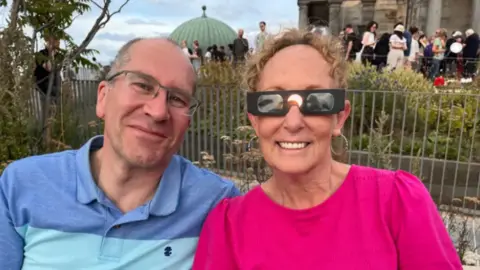
Sandy and Nick Burgoyne were meant to be heading home to the USA on Wednesday morning but decided to delay their flight so they could catch the eclipse.
They had been in Edinburgh for a week to see some shows.
From their vantage point on Calton Hill the eclipse took place right above the Edinburgh skyline.
It was, they both said, much better than the one they saw in New York back in April 2024 - and well worth delaying their journey home for.
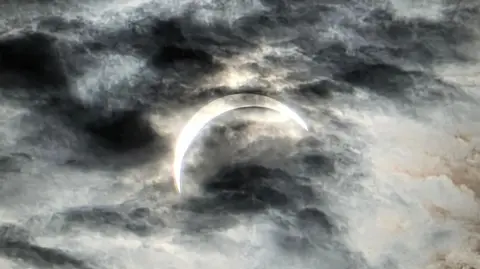 BBC WeatherWatchers/SkyWatcher
Members of the public sent in their pictures from around the country, but here's a selection of some of the best pictures from around Scotland.
Some of the best pictures of the eclipse came from the north, where cloud cover was lower and therefore allowed for better viewing.
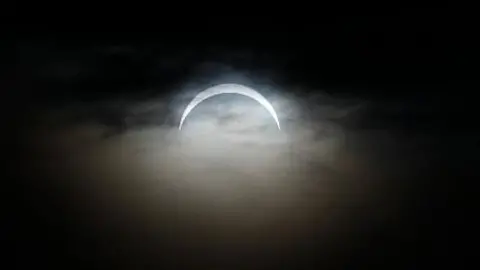 BBC WeatherWatchers/KnottSam
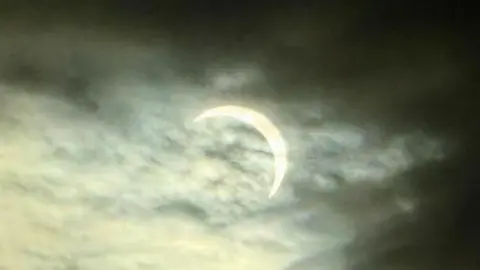 BBC Weather Watchers/Anne's World
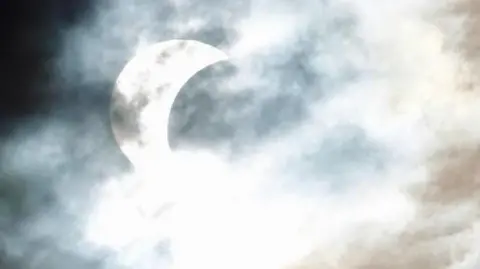 BBC WeatherWatchers/20vtmacd
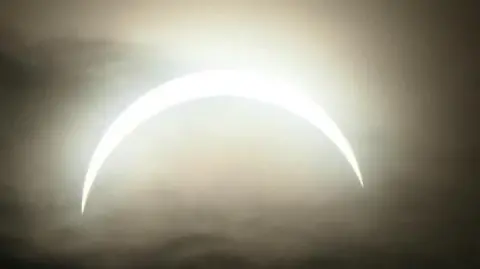 BBC WeatherWatchers/Wellies Full of Water
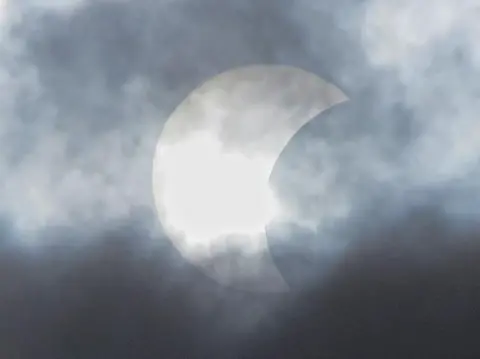 BBC Weather Watchers/Jack March