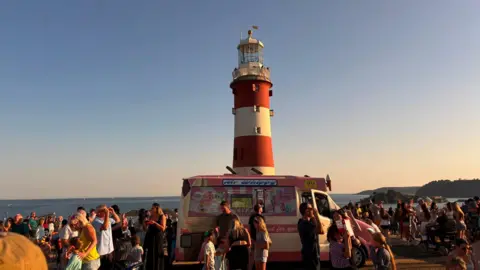
Thousands turn out to watch solar eclipse

 Getty Images
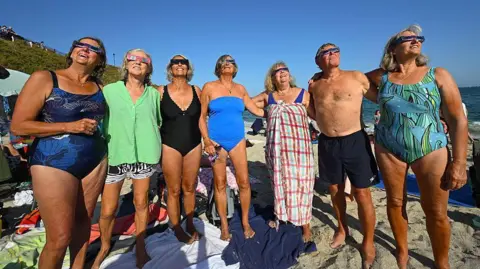
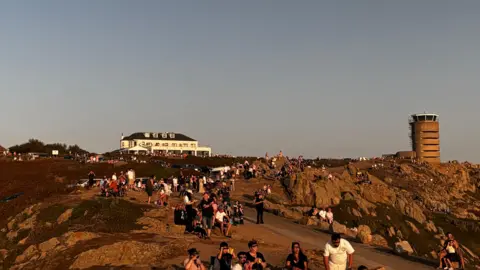
Thousands of spectators have turned out to watch the partial solar eclipse across the South West and Channel Islands.
About 94% to 96% of the Sun was covered by the Moon across Devon, Cornwall, Jersey and Guernsey when the eclipse peaked at 19:15 BST.
More than 90% was covered for most of the rest of the UK.
The spectacle lasted about one hour and 50 minutes - starting at about 18:20 and finishing by 20:10.

'Great to watch and witness'
Spectators gathered across Cornwall to view the eclipse, with big crowds seen in Falmouth.
One eclipse enthusiast said: "It's a weird sort of thing to see because, well, you don't see it every day, but it's a great thing to watch and witness.
"Lots of people come out here, [it's] a great thing to be part of."
Another person watching in Sidmouth added: "It's a great thing to watch and witness.
"Lots of people have come here, it's a great thing to be a part of."
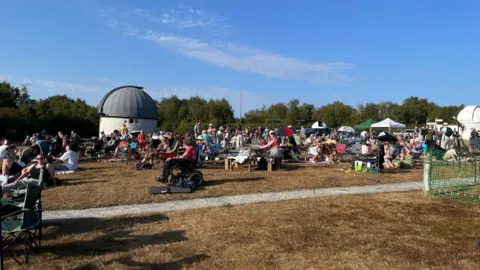
During the spectacle, Alan Smith, chief astronomer at Norman Lockyer Observatory in Sidmouth, Devon, said: "What we're seeing is the dark side of the Moon, which isn't illuminated by the Sun, gradually crossing the solar disk.
"After a few minutes, you begin to see that it is progressing slowly.
"For a moon moving at 2,000 miles an hour, it doesn't look like it is shifting quickly.
"We get two solar eclipses every year, but a good eclipse in any one place - you could be waiting a long time, 100 years or more."
'Sharing the spectacle'
BBC South West's Clare Ainsworth watched the event unfold at Churchtown Farm nature reserve in Saltash, Cornwall.
She said many people did not have eclipse glasses, so some lent theirs to others and "shared the spectacle".
"It's a lovely community event," she said.
BBC Guernsey reporter Perisha Kudhail, who was reporting from Cobo Bay, described the rare event as "breathtaking".
"All day today I've been speaking to families, tourists and visitors who have all come here to see the eclipse," she explained.
"They are all very excited."
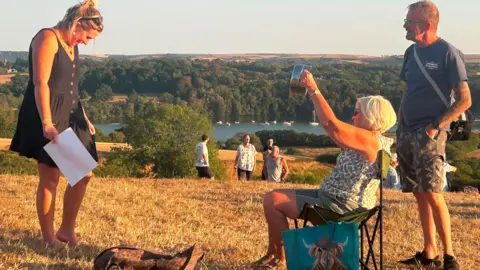
Western parts of Pembrokeshire in Wales also saw the eclipse at its fullest.
The rest of Wales, Northern Ireland, parts of the West Midlands and other parts of the South West, including Bristol, as well as the westernmost parts of Scotland saw 92% to 94% solar coverage.
The event also coincided with the UK's fifth heatwave, with temperatures on Wednesday breaking the 30C (86F) threshold.
The 1999 total solar eclipse was the last of the 20th Century, when the focus was again on Cornwall and the Channel Islands as they were the only parts of the British Isles to witness totality - the full blacking out of the Sun by the Moon.
The next solar eclipse will take place in 64 years on 23 September 2090.