The man who was celebrated for 'restoring' King George

 Getty Images
He was the longest-reigning British king and ruled over the country during a time of great upheaval that included the American War of Independence and the French Revolution.
But George III is also remembered for the mental health condition that affected his later years.
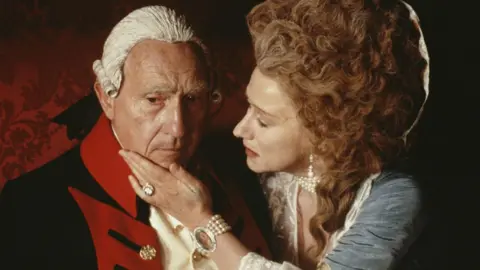
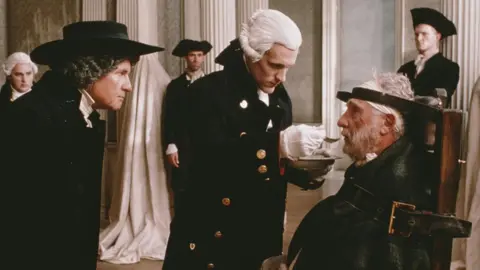
The story was told in an award-winning film, The Madness of King George, starring Helen Mirren, Nigel Hawthorne and Ian Holm.
As the Secret Lincolnshire podcast has been hearing, the real story behind attempts to "cure" the king involved a pioneering practitioner of talking therapy.
Francis Willis, from Lincolnshire, was called in to help in 1788.
Willis was a former priest who had become known for treating patients at his private asylum in Greatford, near Bourne.
George is said to have told him: "You have quitted a profession I have always loved and you have embraced one I most heartily detest."
Diz Lamb, who researches local history in Bourne, says Willis is seen as one of the first people to treat the symptoms of mental illness, rather than looking for physical causes.
He used holistic methods such as engaging patients in activities like gardening, improving their diets and "using his version of talking therapies".
"It was about giving structure to people's days and his version of how people's minds would be working," she says.
George was thought to have been suffering with a condition known as porphyria, which is the name given to a group of very rare metabolic disorders.
According to the British Liver Trust, acute porphyrias are characterised by attacks of pain and other signs of neurological distress.
However, more recently it has been suggested that George may have had bipolar disorder.
Following Willis's work, it was declared that George's "madness", as it was then characterised, was cured and Lamb says the whole country celebrated.
"I know from my own village there was a song that was composed in a marching band and everybody went to the local inns, the rich went to one inn, they even put on food for the poor at the other inn and so there was massive celebrations throughout the country," she adds.
Medals were also issued with an image of Willis and the slogan, "Britons Rejoice, Your King's Restored".
 Getty Images
The king rewarded Willis with a substantial pension and he went on to treat Queen Maria I of Portugal.
Whether his treatments were effective is another matter.
According to Diz: "It may well be that just the withdrawing of some of the treatments that were being given by other doctors may well have helped the king to become more stable."
Prof Jaspreet Phull, a consultant forensic psychiatrist who works at the Francis Willis ward in Lincoln, says that while Willis's methods were progressive for the time, they were "quite coercive in nature" when compared with today's methods.
"I think that was how mental health sadly was delivered in the 18th century and I absolutely think that we wouldn't have any place for the types of treatments that we've described in the 18th century or even beyond that," he explains.
Although modern treatment for mental health conditions is very different today, Phull says Willis should be remembered as a pioneer.
"I like to think of Francis Willis as someone who moved things in the right direction under the conditions of society that he was in.
"I think we're very lucky in Lincolnshire that we have such a history and ancestry.
"Lincolnshire has really been a pioneer in mental health.
"I hope ultimately we continue to deliver the best possible care for those in Lincolnshire, which I know was the ambition for Francis Willis."
Listen to highlights fromLincolnshire on BBC Sounds, watch thelatest episode of Look North.
Download the BBC News app from the App Storefor iPhone and iPad orGoogle Play for Android devices
