A desperate ride to save a man from execution

 Getty Images
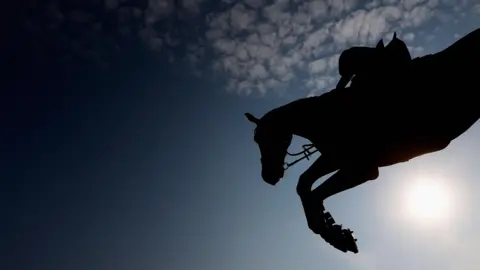
The man rode hell for leather, urging his horse on.
As he galloped towards London, he knew a young man's life was hanging by a thread.
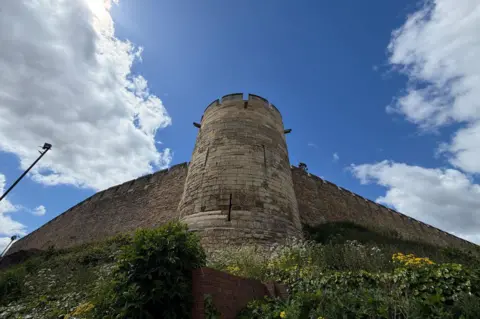
For at that moment, Amos Gilbert was sitting in a cell in Lincoln Castle, preparing for his execution.
His only hope was for the rider to reach the capital and present a petition to the authorities, pleading for mercy.
But the hanging was scheduled in two days' time and the clock was ticking.
The journey to London on horseback would take a whole day. It was going to be a close-run thing.
One year earlier, close to Christmas time, Amos had found himself standing by a gate on his employer's farm, near Bourne, in the middle of the night.
He had been convinced to go along to keep a look-out for his brother-in-law, John.
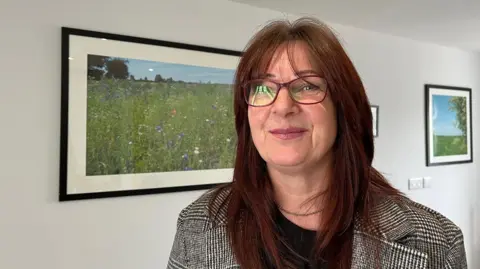
Theresa Workman, a heritage consultant in Lincoln, has been researching Amos's story.
"He hadn't got a clear idea what his brother-in-law's intentions were," she tells the Secret Lincolnshire podcast.
"He understood that he was keeping watch, but he didn't know what [he] was about to do."
When Amos saw flames burning from the farm and its haystacks, he panicked and ran to free the animals.
John had launched an arson attack.
"Once the stacks were alight, you can only imagine how huge the fire would have been. It would have lit up the entire sky. It would have alerted people," Theresa says. "They both ran for it."
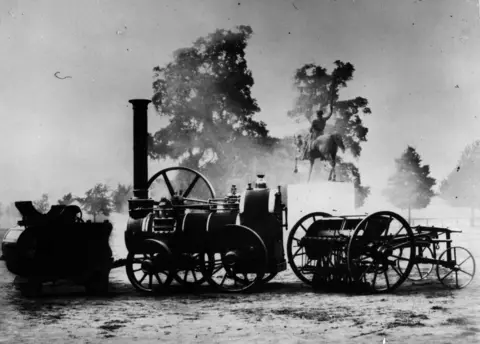
The attack was one of many during the Swing Riots, a series of uprisings by labourers protesting against poor living conditions, wages and the mechanisation of farming.
The riots began in the south of England in the summer of 1830 and reached Lincolnshire in the early winter, causing "widespread panic among the farming community and the landowners", according to Theresa, who worked on the project with researcher Andy Briggs.
Amos was in his mid-20s and worked as a labourer for a local farmer called Mr Hardwick.
He was newly married and his wife was a month away from giving birth to their first child.
So what persuaded him to become involved in the Swing Riots?
"Somebody like Amos wouldn't have been able to afford the new baby. He's the lowest in the pecking order and they were in a desperate position," Theresa explains.
"It was very late at night, which makes you think [they] had stayed up, had a little bit of beer and had a very bad idea that went horribly wrong."
 Hulton Archive via Getty Images
At first, it looked like the men might have got away with it. Amos went back to work and the baby was born.
It wasn't until about a year later that the events of that night began to catch up with them.
According to Theresa, an informant came forward claiming to have seen the two men running away.
A warrant was issued for their arrests, but John had vanished, leaving Amos to take the blame.
"The weight of the law fell entirely on him," she says.
Amos told the truth, apparently believing that he would not get into too much trouble.
He was very, very wrong, for the judge quickly sentenced him to be hanged at Lincoln Castle.
"The judge called his crimes wicked and evil," Theresa says.
"He was 25 years old, he'd got a newborn child and a wife depending on him."
Theresa believes such a harsh punishment was designed to deter others from rioting.
But while executions were not uncommon in 1830, the sentence shocked the community.
According to Theresa, even the jury – all of whom were farmers – asked for leniency, but the judge held firm.
With the days counting down towards the execution, the victim himself, Mr Hardwick, started a petition calling for clemency.
"He clearly understood that Amos was not a criminal character, and I guess, coming from the victim, this held a lot of sway with the other gentlemen of Lincolnshire," Theresa explains.
The petition was signed by 1,000 people and the next step was to secure an emergency hearing in London, but by now just two days remained before the execution.
"It would have involved one of the local gentry, who was part of the legal system, making an absolute hell-for-leather dash to get to London on horseback."
'Prepared for execution'
On the morning of Amos's execution, the rider with the petition was still making his way back from London towards Lincoln.
The question was, would he get there in time?
It must have been a terrible time for Amos as the clock ticked down.
At the time, hangings were carried out on the roof of Cobb Hall tower, where a gallows was built on the flat roof, and often watched by large crowds.
"He had already been prepared for the execution," says Theresa.
Then, at the last moment, came the news that Amos's life was to be spared.
The sentence had been "mercifully commuted" to transportation to Australia for the rest of his life.
It was still a severe punishment, for Amos would never see his wife and daughter again.
"We've got no evidence that either was able to get a letter to the other," says Theresa.
She believes Amos never remarried, but after 11 years in Australia he was freed from the penal colony and allowed to work for himself.
"We see the Amos that Mr Hardwick had seen, ended up being the Amos that carried on his life out in Australia.
"He was a decent young man who had just made this one terrible decision one December night.
"Amos had been ripped away from his brand-new family, his new wife, his little daughter and put through the ordeal of that prison sentence.
"But he managed to make something of it and I love a story with a positive ending. I'm not sure about happy, but certainly positive."
The story of Amos Gilbert was researched by volunteers within the Town Hall Histories project, for the Old Town Hall in Bourne, a project funded by The National Lottery Heritage Fund.
Listen to highlights fromLincolnshire on BBC Sounds, watch thelatest episode of Look North.
Download the BBC News app from the App Storefor iPhone and iPad orGoogle Play for Android devices
