French political row over calls for overhaul and €1bn cuts at public broadcaster

 Reuters
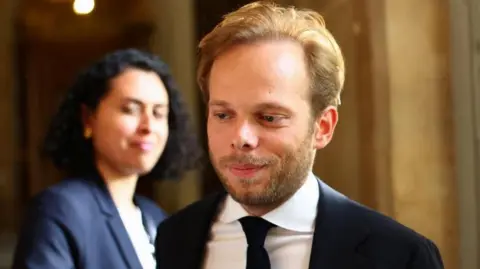
France's public sector broadcasters have been lambasted by a parliamentary committee of enquiry, which recommends closing several channels and cutting their budget by a total of €1bn (£863m).
The committee, which held six months of at times acrimonious hearings, levelled charges of left-wing bias at state-owned France Télévisions and Radio France, as well as gross financial waste.
But the findings were immediately dismissed as politically motivated and impractical by industry insiders, who said that the committee's rapporteur, Charles Alloncle, had a far-right agenda to prepare state TV and radio for privatisation.
Criticism has also come from the prime minister and the head of the committee.
Alloncle, 32, is an MP for the small Union of the Right for the Republic (UDR) party, an ally of Marine Le Pen's populist-right National Rally (RN). The RN – the biggest party in France – has long claimed to be the victim of state media prejudice.
In an online petition calling for privatisation, the party says that "public broadcasting is no longer a space of impartial information, but a tool of influence in the service of a particular camp".
The heated French debate reflects similar tensions in other countries over the future of tax-funded "legacy" broadcasters, whose declining audiences leave them dangerously exposed to attack.
In France, the cost to the state of public broadcasting amounts to nearly €4bn every year. Up until 2022, this was mainly financed by a television licence fee, but it now comes from VAT receipts. Unlike the BBC, for example, French state broadcasters also take advertising.
For their money, tax-payers receive a panoply of television and radio stations - nearly 100 if local, overseas and foreign language channels are included - as well as France 2 and France 3, two parliamentary channels, two television news channels, the European channel ARTE, and the archives of the National Audiovisual Institute (INA). That is not to mention accompanying websites.
 AFP
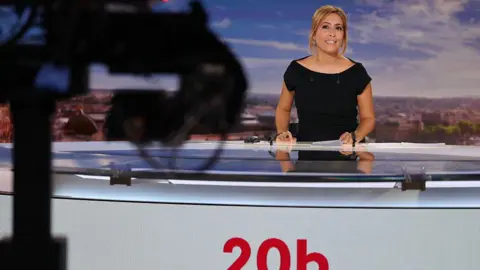
AFPIn the introduction to his report, Alloncle says: "To sum up, our public audiovisual system is ill-adapted to the challenges of the modern era", and he calls for "a total or partial overhaul of the way the sector operates".
Among his 69 recommendations are a cut by one third in television's sports budget, and a big reduction in the number of game shows; and abolishing the youth channel France 4, as well as digital channel Slash and the radio station Mouv' – both also aimed at the young.
He wants to conduct a number of mergers: the mainstream television station France 2 with the less-watched France 5; the two news channels France 24 and France Info; and overlapping local radio and television networks.
 EPA
EPAAlloncle also calls for greater diversity among radio and television "editorialists" – commentators called on to express daily opinions on current affairs, who are regularly accused by the right and far-right of being from the same Paris-based left-wing mould.
In an exhaustive text justifying his views, Alloncle cites numerous examples of what he claims is left-wing bias at public broadcasters.
Most famous is a conversation – eavesdropped by a reporter last year – in which two well-known editorialists appeared to tell Socialist Party officials that they would do their best to stop the Paris mayoral campaign of right-winger Rachida Dati.
He also quotes editorialist Natalie Saint-Cricq, who was caught recently off-camera referring to Eric Ciotti, Alloncle's party chief, as "alias Benito (Mussolini)".
On financial waste, Alloncle attacks the outsourcing of production work worth hundreds of millions of euros to outside companies, some of which are run by well-known TV personalities who are themselves on the public pay-roll.
He also cites an overall €3.8m taxi bill for 2024, and hotel fees of €110,000 for covering the Cannes film festival in 2023.
Alloncle's aggressive interrogation style during the hearings was widely criticised, and his committee's report came under immediate attack when it was made public Tuesday.
Delphine Ernotte, the president of France Télévisions, said: "You have to look at the report for what it is. It's not just a document about public broadcasting. It's become a kind of political trial, where everyone is trying to impose their own ideological interpretation on a public service."
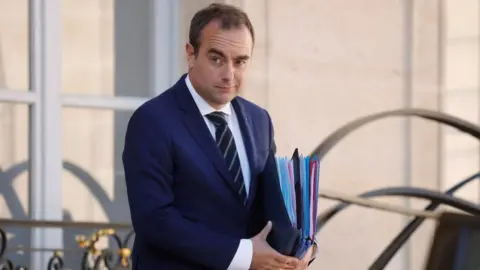
Prime Minister Sébastien Lecornu said the "report unfortunately avoids the essential. It is a missed opportunity".
Jérémie Patrier-Leitus, the centrist president of the parliamentary committee, criticised his rapporteur colleague for using the enquiry "as a political project" aimed at "weakening public broadcasting with a view to its privatisation".
Over the weekend Alloncle was the subject of a judicial complaint over claims that he was fed questions at the hearing by the Lagardère news group. The group – which includes Europe 1 radio station and the JDD newspaper – is run by billionaire and right-wing media mogul Vincent Bolloré.
