Weak hands and blurry vision: Is your tech giving you 'phone body'?

 BBC/ Serenity Strull/ Getty Images
Your devices are changing your body in ways you might not realise. It's not too late to do something about it.
When we worry about the effects our screentime might have on us, we tend to focus on the mind. But recently, I looked down and noticed a little calloused bump on my pinky finger. It's exactly on the spot where I prop up my phone. It got me thinking: what's my phone doing to the rest of my body?
I called some experts to find out. The answer – maybe you saw this coming – is not encouraging.
The latest science suggests your phone and its digital comrades may be altering the shape of your neck, hurting your vision, affecting your motor skills and reducing your muscle strength. People even worry our tech-driven lives are causing more wrinkles. And some of these physical issues could in turn lead to cognitive decline or other more serious problems.
I don't know about you, but I'm not ready to take all that sitting down (especially because all the sitting is part of the problem). Fortunately, if you don't want technology ruining your body, there are a few things you can do about it.
Deformed spines
If you're reading this on a phone, chances are you're tilting your head to look down at it.
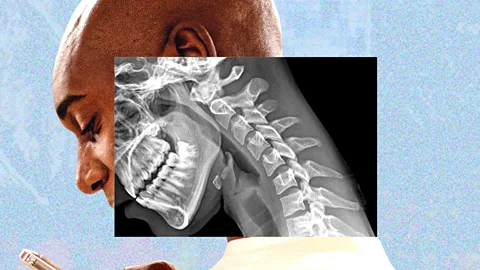
This "forward head posture" can put up to 60lbs (27kg) of pressure on your neck. Over time, that can damage the discs in your spine, degenerate joints and muscles and even reduce your lung capacity. It even has a nickname: "tech neck".
It can also permanently change the way your body looks.
Special exercises can help correct the problem, with the approval of a doctor. But there are simpler changes you can start right now: lift your phone up higher.
Position the screen at eye-level, ideally around arm's length away from your face. The same advice applies to computer monitors. Some experts say taking screen breaks can help. Try a 20-minute break every half hour.
Irritated skin and wrinkly necks?
Recently a new worry has emerged – is tech neck causing neck wrinkles?
"It makes sense, in theory," says Justine Hextall, a consultant dermatologist and fellow of the Royal College of Physicians in the UK. Repetitive stress causes wrinkles, so leaning forward and folding your neck up all the time could be a problem, she says.
But there haven't been any good studies proving the link, Hextall says. She advises against buying any special "tech neck" skin products that have showing up online.
There are other skin problems to worry about though, particularly for smart watch devotees who never take them off.
"A dark, damp environment [like the area under your watch] is great for yeast, so you might get irritation or even eczema," she says. And because this can damage the skin barrier, Hextall says it could also lead to sensitivities to some of the ingredients in tech products, including nickel, rubber, latex and a group of chemicals called acrylates.
The solution there is simple: take off your smart watch more often and wash your skin. She also recommends wearing a barrier cream if you're going to have a watch on all day.
Keeping Tabs
Thomas Germain is a senior technology journalist at the BBC. He writes the column Keeping Tabs and co-hosts the The Interface podcast. His work uncovers the hidden systems that run your digital life, and how you can live better inside them.
Decaying vision
Rates of myopia (near sightedness) have been skyrocketing for decades. If you consider what's changed, it's easy to blame technology.
That may be true, but not in the way you might think, according to Donald Mutti, a professor of optometry at Ohio State University in the US.
"We did an over 20-year longitudinal study of kids' eye development, looking at risk factors for the onset and progression of myopia," Mutti says. A key question was whether there's a connection between myopia and "close work", tasks that keep you focused on something close to your face like a phone. "The answer was 'not really'," he says.
But the study uncovered something else: time spent outdoors seems to have a protective effect. "The idea is the bright light of the outside stimulates a release of dopamine from the retina," Mutti says, and it appears that could affect the way your eyes develop.
Technology is part of a global shift towards more of our time spent indoors. In that sense, Mutti believes, your devices may have an indirect negative effect on your eyes.
The solution here is a simple one, says Mutti – you just need to spend more time outside. It's not just good for your eyes, it can also help you sleep better. Just make sure to wear sunscreen and sunglasses to avoid the harmful effects of sunshine. (Find out if you're applying sunscreen correctly in this article by my colleague Jessica Bradley.)
Weak hands
Grip strength is increasingly recognised as a key marker for your overall health.
One study found it predicts early death better than blood pressure. And grip strength is on the decline in many countries, especially among younger people.
"A generational decline isn't just about weaker hands, it may be an early warning sign about the future health of younger cohorts," says Johannes Beller, a professor of medical sociology at the Medical University of Lausitz, Germany.
"There's a reasonable case that the shift toward computer-based, sedentary work is contributing to declining physical fitness," and it's plausible that would affect grip strength too.
You should be able to squeeze a tennis ball as hard as you can and maintain it for 15-30 seconds. If you can't, this article by my colleague David Cox has advice for special wrist curls. But this is about more than grip, it's also about improving your overall fitness. In other words, hit the gym.
Hand-eye coordination
It seems technology affects motor skills, abilities that tie the mind and the body together for precise movements.
It could make you better at stuff like clicking and swiping, says Sebastian Suggate, a professor of developmental psychology and education at the University of Regensburg, Germany. "But if you look at broader motor skill development, particularly fine motor skill development, the evidence converges on a negative effect."
We know a lot more about the effects on children than adults. Suggate's own research shows an association between more screen time and worse motor skills.
That's especially alarming because there's a correlation between motor skills and cognitive and academic development in children and adolescents.
His advice isn't to panic or ban screens. Instead, consciously introduce hands-on activity in daily life.
More like this:
Sustained hands-on tasks such as preparing a meal or physical arts and crafts can help. Suggate does wood working, but you could learn an instrument or even just write by hand.
"It's not the end of the world. These are subtle effects," Suggate says. "But even if the effects are moderate to small at the individual level, collectively, across generations, we're talking about a potential dumbing down of society, and an inability to think in reality, because the hands are such a central point of contact we have with the world."
--
For more insights, sign up to our Tech Decoded newsletter, where Thomas and Lily Jamali break down the biggest stories of the tech world, and help you live a better digital life. Sign up for free here.
