'I felt lighter, more open': Why you are never too old for therapy

 Serenity Strull/ BBC/ Getty Images
We assume therapy belongs to youth, yet older people may be particularly likely to benefit from psychological support.
Maurizio is 70. He recently began therapy in the hope of better understanding a physical pain he had carried since childhood. He has suffered migraines since the age of seven and wanted to explore what might lie behind them.
Over the years he had consulted different doctors and sought multiple opinions – therapy was another attempt to trace the origins of the problem. But he continued even after realising he might never find a single cause. "The process itself became something meaningful, a space for introspection that helped me understand my life more clearly," Mauizio says. (We have omitted the surnames of the therapy clients quoted within this piece to preserve their privacy.)
Antonio, 73, and his wife Gigliola, 68, turned to therapy hoping to save their relationship after years marked by disappointments and unspoken tensions. "After some time, I realised I felt lighter, more open," Antonio says.
"Looking within ourselves and bringing out what we could never say before perhaps helped us," Gigliola adds.
Their stories challenge a common assumption: that therapy is only for the young. And a growing body of evidence suggests that many older people could benefit from the same kind of help.
Therapy in later life
The potential for therapy to treat mental illness and enhance our overall wellbeing is now well-established, yet it is relatively rare for older people to access these services.
According to the World Health Organization, around 14% of people over 70 live with a mental health disorder, most commonly anxiety and depression, and 17% of all suicides occur in people of in this age range. A study published in 2024, however, found that only around 4% of US adults aged 65 and over received psychological therapy, compared with 12% of those aged 18-24 and 8% among those aged 35-64.
This is despite there being no evidence that therapy is any less effective or useful as we get older, according to Pim Cuijpers, professor of clinical psychology at the Vrije Universiteit Amsterdam in the Netherlands. "Therapies work across the whole adult age," he says.
Cuijpers recently published a review on psychotherapy for depression across different age groups. "What surprised me is that there is quite a lot of research in older people who are above 75 and we didn't find any indication that psychotherapies differ in that age group either," he says.
 Getty Images
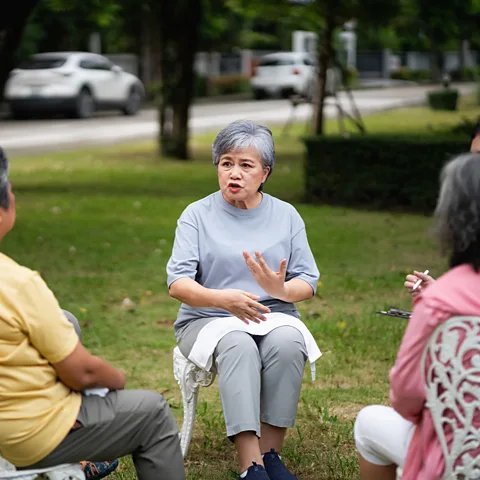
Older people may find that therapy helps to target some of the specific concerns that come with ageing, including social isolation and chronic illness, with widespread benefits. Many report improvements in overall wellbeing, renewed motivation and increased social participation. In this way therapy can function as a bridge: helping older adults reconnect with themselves and the wider world. The strongest responses, according to a 2025 review, may be found in group-based interventions, which makes sense, since they offer a structured means of relating with others.
And despite lower levels of initial access, completion rates among older participants can reach up to 54%, often surpassing those of younger adults. This demonstrates that older patients are frequently highly committed to therapy and capable of sustaining the work required for meaningful change.
"We don't know the reasons but we could imagine that when older adults are willing to seek help, they are also more motivated to do that," says Cuijpers.
Barriers to care
Financial difficulties help explain part of the gap in older people beginning therapy in the first place: their health insurance may not cover therapy, and they may not be able to afford to pay for it independently.
A world of therapy options
Therapy comes in many different forms and can be tailored to different needs. A few that may be worth considering trying are:
• Cognitive behavioural therapy (CBT) focuses on identifying and changing unhelpful thought patterns.
• Psychodynamic therapy has an emphasis on how past experiences shape present emotions and behaviours.
• Family therapy is for those who want to work beyond an individual focus (such as in Antonio and Gigliola's case) and looks at relationships and dynamics within the family as a whole.
• Group therapy creates opportunities to share experiences with people facing similar medical diagnoses and to feel more understood and less alone.
But another barrier can arise within the healthcare system itself. The journey into therapy often depends on a referral from a primary care physician, yet some research suggests that older adults are referred to psychological treatments less frequently, even when they present with symptoms of anxiety or depression. Their distress may be seen as a natural response to ageing or physical decline, rather than as a mental health condition that warrants treatment.
Part of this prejudice comes from Sigmund Freud, the founder of psychoanalysis, who argued that therapy stopped working after 40 or 50 years, says Rossana De Beni, professor and senior researcher in experimental psychology at the University of Padua, Italy. In On Psychotherapy (1905), a brief technical paper on the practice of psychoanalysis, Freud noted that above a certain age "the elasticity of the mental processes, on which the treatment depends, is as a rule lacking".
 Getty Images
But that is "absolutely not true", says De Beni. In fact, "studies show the opposite".
Clinicians need to see the older person for who they truly are, De Beni points out, not simply as "an old person", but as a multi-faceted individual. Unfortunately, our ageist prejudices are often "deeply entrenched", she says.
Some of the ageism may be internalised by the potential patients themselves. Beliefs such as the idea that mental health problems are simply a normal part of ageing are among the most frequently cited obstacles to accessing care. This is especially problematic, since ageism can itself predispose someone to greater anxiety and depression.
More like this:
The simple truth is that positive transformation is possible across the lifespan. "Ageing, right to the very end, is a stage of life marked by change," De Beni says. "People become more fully themselves in a process of continuous transformation, learning and flexibility that never truly ends."
 Getty Images
Maurizio certainly identifies with this sentiment. "There are three moments when therapy helped me: in dealing with my marital separation, in working through certain conflicts with my children, and in navigating the transition from active work to a pre-retirement phase, where I had to find new ways to socialise," Maurizio says. "I never thought it could be too late for anything."
He hopes that he has set an example for others to follow. "I think it may have planted a small seed: not today, not tomorrow, but perhaps the day after, they will bring it out and water it," he says.
--
For trusted insights on health and wellbeing, sign up to the Health Fix newsletter by senior health correspondent Melissa Hogenboom who also writes the Live Well For Longer and Six Steps to Calm courses.
