'A distinct Canadian character': The 1920s paintings that changed how the world saw Canada

 Alamy
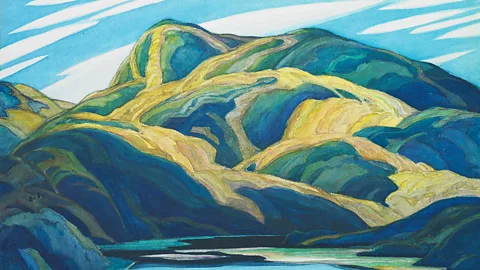
AlamyThe Group of Seven was Canada's first internationally recognised national art movement, and they helped create a distinct, modern Canadian identity in the 1920s. As the official Group of Seven Day is celebrated in Canada, what is their legacy – and are their ideas in harmony or conflict with the so-called "Indian Group of Seven", founded later in the 1970s?
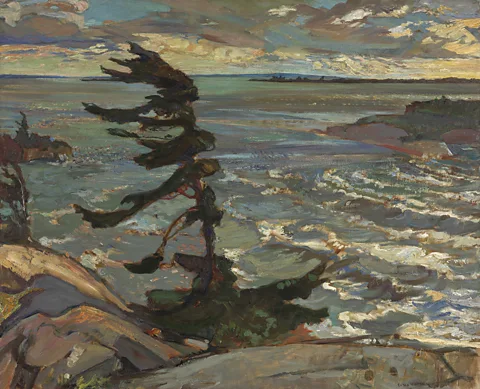
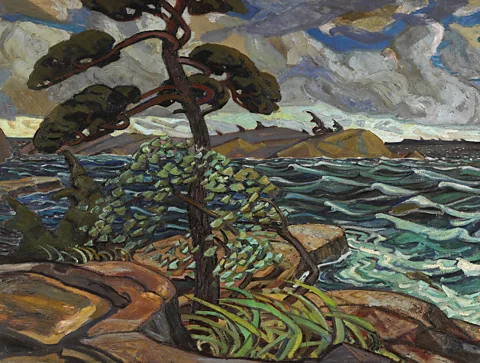
In the 1921 painting Stormy Weather, Georgian Bay, a lone tree perches perilously between a rocky outcrop and a vast, churning lake, buffeted by the elements yet refusing to yield to their force. Executed in rough brushstrokes and simplified lines, it celebrates not only the resilience of Canadian settlers and their ability to survive against all odds, but also the dramatic, untamed landscapes with which they joyfully communed.
The painting by FH Varley is one of the most iconic works by The Group of Seven, a groundbreaking art collective who broke with the dominant tradition of European academic painting to create a uniquely Canadian style that revelled in the country's vast natural beauty.
The group's most celebrated works are "almost like what the Statue of Liberty is for the United States," says Katerina Atanassova, senior curator of Canadian art at The National Gallery of Canada. So beloved are they that 7 July is now celebrated as Group of Seven Day. What is it about their paintings that, for many, embody the Canadian spirit and identity? And where does the group's work stand in relation to the country's Indigenous art?
 National Gallery of Canada
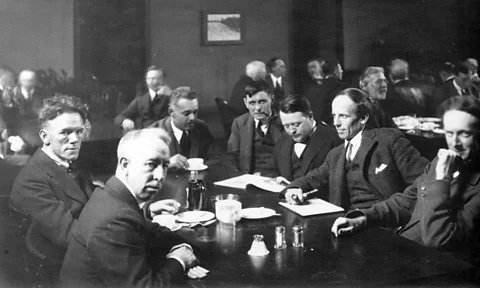
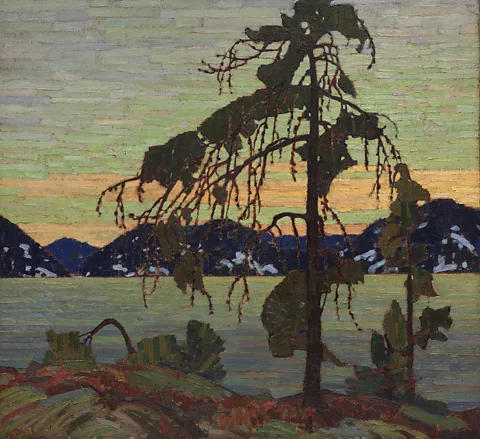
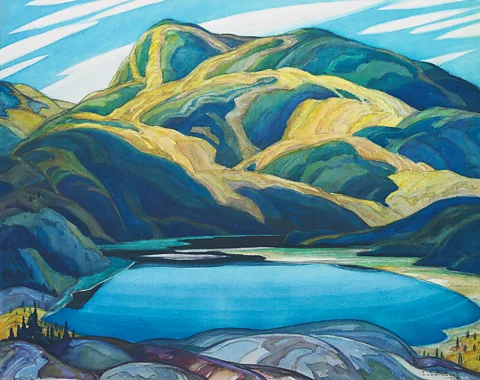
The group which – in addition to Varley – comprised Franklin Carmichael, Lawren Harris, AY Jackson, Franz Johnston, Arthur Lismer and JEH MacDonald remains hugely popular today, as does Tom Thomson, a major influence, who died before its official formation. Their most acclaimed paintings, which include Thomson's The Jack Pine, The West Wind and Harris's North Shore, Lake Superior, have become, for many, the national paintings of Canada – embodying the country's spirit.
A turning point
They began painting in the 1910s, an era when Canada – a self-governing dominion of the British Empire since 1867 – was beginning to find its own social and political identity, but had yet to find an artistic voice. The nascent group was intent on providing just that. A turning point occurred when MacDonald and Harris visited a landmark exhibition of contemporary Scandinavian art in Buffalo, US, in 1913. Norway, Sweden and Finland were all forging their own independent paths at the time. In their sparse landscapes, vividly depicted in flat, bright colours, the two artists saw an expression of national identity that was unequivocally modern.
The aesthetic and intellectual inspiration they took from the Scandinavians was strengthened by the influence of Thomson, a self-taught artist and graphic designer who frequently embarked on lengthy trips into the wilderness, often by canoe, to paint and sketch. "He embodied that ideal, that direct experience that every artist wants to have," Atanassova tells the BBC. It was Thomson who "started the images of the solitary tree", and inspired the future Group of Seven artists to see that the Canadian wilderness "can be viewed as modern and painted as modern", says Atanassova.
 Alamy
AlamyThomson's death in 1917, at the age of only 40, turned him into a cultural legend, and when the group officially formed in 1920, "the goal was defined that they ought to follow in his footsteps," says Atanassova. Their intention "was not to portray what nature looked like, but how it made them feel, the emotional state created by the starry sky, the windswept pine or the barren coastal line on the north shore of Lake Superior." The initial response to their innovative approach was anything but favourable. One review of their first exhibition compared their work to "the contents of a drunkard's stomach".
Somewhat ironically, it would take the approval of the very people from whom they were trying to distance themselves to change public opinion. The group's work was selected for the British Empire Exhibition, held at Wembley in 1924, where it received a rapturous response with the British press praising its "distinct Canadian character. " Recognition abroad meant that it "suddenly became popular in Canada", explains Atanassova.
The fact that this "distinct Canadian character" excluded the Indigenous population has led to criticism of the group in some quarters, although Atanassova feels that this is unfair. "You don't see any signs of civilisation in [the Group of Seven's] paintings," she says. They were "looking for untamed nature in the tradition of modern Scandinavian art", which meant that they also excluded any sign of industrialisation.
 National Gallery of Canada
While that may be true, we are now painfully aware that in the areas the group were travelling to, they could not have painted Indigenous populations if they had wanted to. The government's brutal policies, begun in the late 19th Century, had seen them forcibly removed to reservations or residential schools where their movement was restricted and their cultural practices suppressed.
'The Indian Group of Seven'
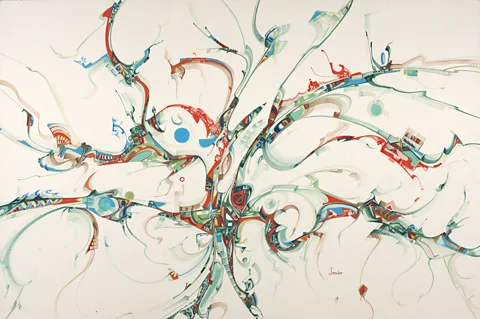
These policies had a devastating effect on all aspects of Indigenous life, including artistic production and recognition, a fact that led to the formation of another group of seven in the early 1970s, the Professional Native Indian Artists Incorporated (PNIAI). Jackson Beardy, Eddy Cobiness, Alex Janvier, Norval Morrisseau, Daphne Odjig, Carl Ray and Joseph Sanchez first started meeting in Odjig's craft shop in Winnipeg.
"They were quite distinct in that they were the first self-organised Indigenous-artists-run arts advocacy group that was formally incorporated that ever existed in Canada," says Michelle LaVallee, Director of the Indigenous Ways and Decolonization Department and Curatorial Initiatives of the National Gallery of Canada. She herself is Ojibway and a member of the Chippewas of Nawash Unceded First Nation.
 Courtesy Dr Luigi Rossi/ Don Hall/ Alex Janvier
Although they all had different styles and opinions, they wanted to band together to support other artists and challenge exclusionary practices and the narrow view of what "native" art actually was. "We had no one to show our work, so we had to do it ourselves. We acknowledged and supported each other as artists when the world of fine art refused us entry… Together we broke down barriers that would have been so much more difficult faced alone," Odjig later said.
"At that time, there were no Indigenous curators, no Indigenous people working in institutions," LaVallee tells the BBC. And where Indigenous art was collected it tended to be relegated to ethno-centric galleries rather than the contemporary fine art collections in which the artists felt they deserved to be exhibited. "It really wasn't held in the same esteem as [work by their] non-Indigenous peers, even though it is the first and the most authentic art that can be and should be called Canadian," says LaVallee.
Although the media soon dubbed them "the Indian Group of Seven", LaVallee isn't sure they would have appreciated the name. "They were very intentional about what they called themselves," she says. It was very important for them to have "Professional" and "Native Indian" present in the name of the group.
 National Gallery of Canada
While LaVallee herself likes the paintings of the Group of Seven, she points out that their approach to landscape is vastly different to the PNIAI. "A lot of the PNIAI's works you would look at and not necessarily call it a landscape." They are different ways of referencing the land". Alex Janvier often incorporated maps in his works, while Norval Morrisseau "draws those connections between land and animals and spirits". It is art by "somebody from the land versus settlers coming and appreciating the land", she says.
Even if the Group of Seven weren't conscious of doing so, they "would have contributed to the circumstances around how Indigenous people were being perceived and treated", says LaVallee. This was largely down to the way their art was used to "create this popular narrative of Canada" which was picturesque but "excluded the Indigenous populations", she says.
More like this:
The PNIAI played a vital role in correcting that, and LaVallee credits her own position – as one of the senior management of the National Gallery of Canada – to their activism. "For me to get to a place like that would not have happened had these earlier artists not fought for these types of rights and opportunities and created avenues of support and camaraderie between Indigenous peoples," she says.
 Alamy
AlamyThe National Gallery now displays Indigenous and non-Indigenous art side by side in the same galleries. LaVallee emphasises that this is not meant to "erase or discredit any existing histories".
"Part of the change we're trying to assert is the idea that, yes, within Canada, it's very multicultural, but the first art of this land was Indigenous, and the first people of these lands were Indigenous, and that needs to be acknowledged and respected and recognised."
In the 1970s, the Group of Seven's work may have been interpreted by some as exclusionary and colonial, but in the 21st Century it is largely viewed differently. For today's outdoor-loving Canadians, the group's art is a celebration of the country's outstanding natural beauty. It embodies, says Atanassova, "that raw connection with nature – and it's exactly the nature you see [in the paintings]. The lakes are the same, the skies are the same. It's an expression of your own experience. What you see and what you feel and what you live."
--
If you liked this story, sign up for The Essential List newsletter – a handpicked selection of features, videos and can't-miss news, delivered to your inbox twice a week.
