'Created amid high drama': The animals that symbolise pain and passion in a Frida Kahlo self-portrait

 Nickolas Muray/ Collection of Mexican Art
A hummingbird, a spider monkey, a black cat and dragonflies – what the animal imagery in an iconic 1940 painting tells us about the artist's trauma, resilience and defiant desire.
"Fridamania" is in full force. Mexican painter Frida Kahlo's superstardom was sealed after her death (in 1954, aged 47), and she remains an unmistakably present cultural figure today. Her imagery – bold, sensuous, immediate yet fabulously intricate – inspires modern artists and activists, and adorns copious merchandise.
Kahlo's tumultuous life story – including her catastrophic injury, lifelong disability, her rocky marriage to painter Diego Rivera, and her many affairs with men and women – is evident in her powerful self-portraits. Her art helped revolutionise the genre: transforming the self-portrait from formal pose to fluid expression, revealing unapologetic beauty, raw trauma and defiant desires.
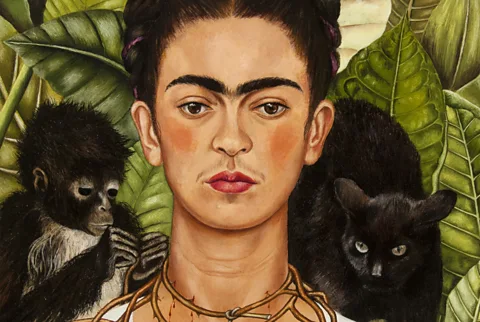
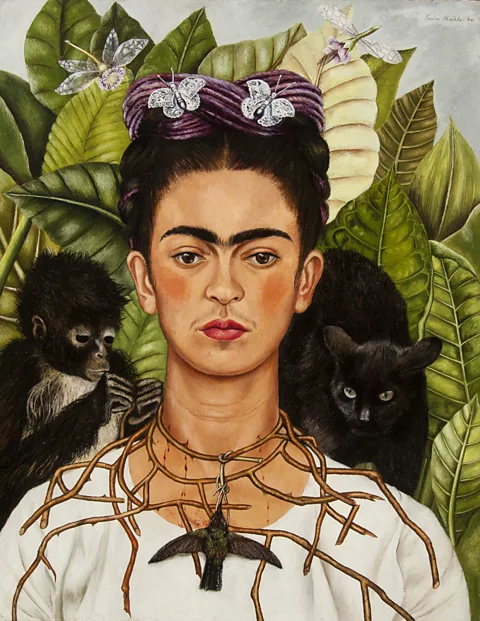
Of the 55 self-portraits she painted, a significant majority also feature animals – a lifelong love of the artist. The lead image of a new exhibition at Tate Modern, Frida: The Making of an Icon, is an arresting 1940 masterwork, Untitled Self-Portrait with Thorn Necklace and Hummingbird.
Within this powerful painting there is a wealth of information about Kahlo and her life, and by exploring its nuanced animal imagery it's possible to unlock the artist's most intimate vulnerabilities, strengths and passions. At the same time, the portrait is a glimpse into the important role that her own beloved creatures played in her life.
The painting's dense, verdant foliage backdrop seems to emit a tropical heat; the lush green leaves contrast with the darker hues of the animals around Kahlo, though these, too, are astonishingly detailed – the cat's glinting eyes and arched back with raised fur, the monkey's look of engrossed mischief. We are up close and personal with Kahlo herself: her cheeks and lips flushed; the trickles of darkening blood seeping down her collar; her expression stoical in her suffering.
 Nickolas Muray/ Collection of Mexican Art
This particular painting was created amid high drama. Kahlo had just divorced Rivera (they would remarry later that year), and her long-standing affair with US photographer Nickolas Muray was also ending.
'Ready to pounce'
She is depicted as the central figure in a scene that is densely loaded with symbolism. Around her neck, Kahlo wears a hummingbird (a creature traditionally associated with freedom, as well as the Aztec god of war, seemingly lifeless here); at her right shoulder, her pet monkey (gifted to her by Rivera) toys with her thorny necklace, drawing blood; at her left looms a portentous black cat.
"The way that she stares at the viewer directly: not confrontationally, but without any resistance or reticence, is quite striking," Tate Modern curator Tobias Ostrander tells the BBC. "There's also a folklore reference to the hummingbird itself: a tradition of wearing a hummingbird as a talisman, to get a lost love back." He also points out that the hummingbird's shape echoes that of Kahlo's distinctive "monobrow": "it's bringing this dialogue between that object and her own face."
Ostrander says, "She lived with a lot of animals, so it's her daily life. The monkey is the symbol of the suffering that she was emotionally feeling from Rivera, but then the cat is ready to pounce." Rather than a bad luck omen, this sleek feline arguably represents Kahlo's guardian animal, poised with latent power. "There's that sense of vulnerability, but also the strength, or a protector spirit next to her.
"Her hair is braided with this beautiful purple yarn, and silver butterfly pins that she actually owned," says Ostrander. "Above them are what look like dragonfly flowers: a more metaphoric or magic realist reference in the top of the painting. They're a fantastical hybrid that couldn't exist in reality, and there's symbolism from different cultural contexts [in Indigenous Mexican culture, both dragonflies and butterflies are associated with the rebirth of the soul]. It shows the sophistication of her references."
 Julien Levy/ Courtesy Philadelphia Museum of Art
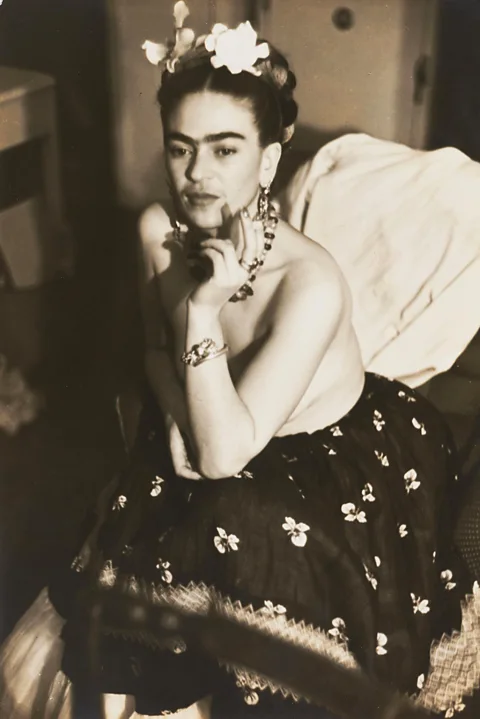
These rich details also reflect Kahlo's own mestiza (mixed Indigenous and European) heritage. In pre-Hispanic cultures, the spider monkey represented irrepressible creativity, playfulness and fertility. At the same time, Kahlo's thorny attire alludes to religious martyrdom and Mexican colonial religious paintings. "For a woman artist to show herself as Christ is kind of wild at the time," Ostrander says, pointing out that she created some of her most ambitious paintings during 1939 and '40.
What Kahlo's animals mean
Kahlo's use of animals in her artworks is often regarded as "exotic" or surreal. Arguably, though, they heighten the relatability of her work. In a 1953 interview with Time magazine, Kahlo explained: "They thought I was a Surrealist, but I wasn't. I never painted dreams. I painted my own reality."
She grew up surrounded by animals at her home of Casa Azul, on the outskirts of Mexico City. They provided companionship and solace, when she was bedridden with childhood polio (which left her permanently disabled), and at 18, when she experienced a devastating bus crash (which shattered her spine, and left her in long-term pain). In adulthood, she kept many beloved pets, including spider monkeys, birds, Mexican hairless dogs and a fawn, and Rivera built a pyramid structure to house her menagerie.
Kahlo regularly portrayed herself alongside her animals – in lush works such as Self-Portrait with Monkey (1938) and the serene Me and My Parrot (1941). Occasionally, their identities become entwined; in The Wounded Deer (1946), Kahlo appears in the form of a woodland stag, her body brutally pierced with hunters' arrows. The word "carma" (karma) is at the base of the scene: the fundamental notion of suffering as fate (Kahlo once declared that "pain, pleasure and death are no more than a process for existence".
 Private collection
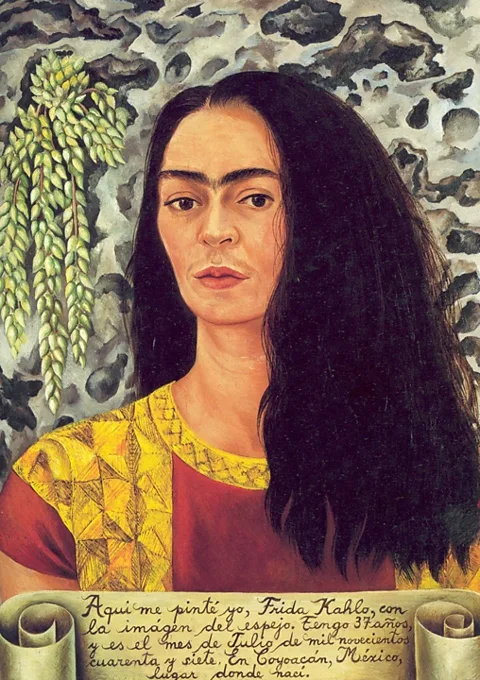
In an essay for the exhibition, Beatriz Garcia-Velasco notes that Kahlo's depicted wounds evoke "the style of a painting of Saint Sebastian, alluding to her lifelong disability and suffering but finding strength and healing in her connection with nature."
As with all Kahlo's work, her animals invite multilayered interpretations. Saatchi Art's Megan Wright observed that Kahlo regarded her pets as "soulful and insightful creatures" but also suggested that "Kahlo's fluid sexuality... resonated with that of her pet monkeys due to their rambunctious and unapologetically sexual nature, which might also explain why she had depicted them as her equals." A different perspective appears in the 2017 children's book Frida Kahlo and Her Animalitos by Monica Brown, which shows Kahlo's pets as empowering friends.
Surrogate children or sites of affection
Often, it's argued that Kahlo's animals represented the children she longed for. Certainly, her artworks deal candidly with trauma including child loss, but this also seems like an over-familiar assumption around a childless woman.
In Kahlo's hypnotic 1949 painting The Love Embrace of the Universe, The Earth (Mexico), Myself, Diego, and Señor Xólotl, it's actually her husband who appears as a man-baby, nakedly cradled in Kahlo's arms. Her splendidly named dog Señor Xólotl – Xólotl is a figure from Aztec mythology – is a tender, protective presence at her feet.
More like this:
"Kahlo had lots of animals that were sites of affection for her," says Ostrander. "She was very confined to her house, and so her house became kind of a world – it's more of a Noah's Ark situation than something sad. I don't want to simplify that they're like children, but they sometimes stood in for children or a representation of youth around her."
Our appreciation and understanding of Kahlo continually expands, and her bond to animals and nature feels timeless. She would face intense challenges throughout her life; in 1953, when her right leg was amputated following a bout of severe gangrene, she wrote in her diary: "Feet, what do I need them for if I have wings to fly?".
Kahlo's most heartbroken self-portraits ultimately resound with vivacity. As she declared: "I am not sick. I am broken. But I am happy to be alive as long as I can paint."
Frida: The Making of an Icon is at Tate Modern London until 3 January 2027.
--
If you liked this story, sign up for The Essential List newsletter – a handpicked selection of features, videos and can't-miss news, delivered to your inbox twice a week.
