'I didn't think of stopping at any time': A US physicist's inside account of Nagasaki's atomic bombing in WW2

 Getty Images
On 9 August 1945, a plutonium bomb was dropped on the Japanese city of Nagasaki, bringing an end to World War Two. In an interview with the BBC 30 years later, a US physicist who helped to assemble the bomb revealed why the blast couldn't be stopped – and the plans for more.
"It was not for lack of concern for humanity – it was because of a concern for humanity. Perhaps that was the sin."
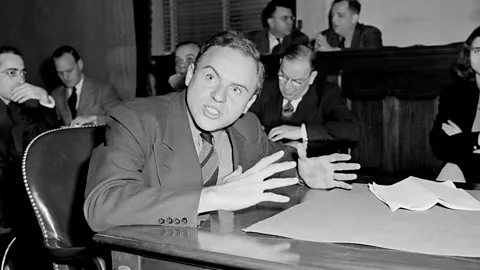
Thirty years after he took part in the atomic bombing of Nagasaki on 9 August 1945, the US physicist Philip Morrison spoke frankly to the BBC about the decisions that were taken in the days and weeks before the unprecedented nuclear blast.
Morrison had played a key role in the Manhattan Project, the top-secret Allied programme to develop the first nuclear weapons, working at the Los Alamos laboratory. The lab was directed by his former teacher J Robert Oppenheimer. Present at the Trinity test of the first atomic bomb on 16 July 1945, Morrison carried its plutonium core on his lap in the car to New Mexico. He then travelled to the small island of Tinian, just south of Saipan, to help assemble the "Fat Man" plutonium bomb used on Nagasaki, overseeing its loading onto a B-29 aircraft on 9 August, just three days after the bombing of Hiroshima.
It was on Tinian that the US forces built what Morrison described as the "largest airport in the world". "A great coral ridge was half-levelled to fill a rough plain, and to build six runways… each almost two miles long," he said in his in a testimony to a Senate Committee in December 1945.
The scale of destruction
Morrison also revealed the scale of preparations for the fire-bombings of Japanese cities in his testimony. "In the harbour every day rode tankers, laden with thousands of tons of aviation gasoline… Down the great runways would roll the huge planes… Once every 15 seconds another B-29 would become airborne. For an hour-and-a-half this would continue… A thousand B-29s, time and again, burned many square miles of a city in a single raid."
In contrast, he relayed, "The atomic bomb was something else."
"There were no shiploads of incendiaries. Instead of all the ordnancemen and their bomb dumps, there were about 25 people from Los Alamos, a few Quonset [prefabricated corrugated steel] huts transformed into testing laboratories, and a barricaded building. The strike took off after midnight. The field was deserted… And one plane roared down the runway, took off, and set course for the cities of the enemy," he said.
Although estimates vary, it is thought that 40,000 people were killed by the initial detonation in Nagasaki, while more than 100,000 deaths were directly attributable to the bombing over the next five years. In Hiroshima, at least 80,000 people died instantly, with the cumulative death toll rising to roughly 140,000 due to severe burns, injuries and acute radiation sickness.
Morrison later surveyed the catastrophic devastation at the two Japanese cities as part of the official scientific damage-assessment team, and he remembered one moment in Hiroshima in particular. "A Japanese official stood in the rubble and said to us: 'All this from one bomb; it is unendurable'," he said. "One plane, with one bomb, had destroyed many square miles of a city, destroyed them even more thoroughly and with even less chance for resistance or escape than the 1,000-plane strike."
Yet he had hoped that the atomic bomb would not have to be used in combat, spearheading a group of young Los Alamos physicists who favoured a public demonstration of the bomb prior to any use in Japan. Morrison – who was aged 30 when he oversaw the assembly of "Fat Man" in Tinian – wanted to "invite an international delegation to the desert", he told the BBC's Melvyn Bragg in 1975. "But under the circumstances of warfare, that was wishful thinking."
'Unstoppable momentum'
The physicist described a sense of unstoppable momentum, even when it became clear the Nazis would be defeated. Yet, he explained, "The war was still going on. We were marching towards a tremendous battle in the Pacific… so it would have been impossible to stop."
The one factor that could have changed that, Morrison believed, was US President Franklin D Roosevelt, who died in April 1945. "The only chance to modify the American position strongly, I would say, would've been the survival of Roosevelt… [who] died in the midst of the development, before we knew the bomb would work, before it was determined how to use the bombs," said Morrison.
"He was the only person, I think, both with enough prestige, enough strength within the government to turn back this terrible momentum," he said.
When Harry S Truman became president, he wasn't even aware of the project, only learning about it in the hours after he was sworn in. Just over three months later, he was to give the order for the bombings.
"It's true he made the decision, but I think it's fair to say the decision made him," argued Morrison. "It would’ve been a very bold stroke indeed for him to change the thing after all those years and stop it… that chance was essentially gone with the death of Roosevelt."
The same immovable force applied to the decision to drop two bombs one after the other, according to Morrison. "It was not considered a first and a second bomb. The orders cut for the commanders were, 'Drop bomb one, and then drop bomb two as soon as you can.' It would have taken a strong man back in Washington to see the great effects of bomb one… and say, 'Well, let’s wait for bomb two.' It would've taken thought at a high level, an ability to tap into the complex links and get the right orders to the right generals," he said.
So the two bombings went ahead – and more were planned, revealed Morrison. "The original decision was that we would go on for a year dropping these bombs, if need be… I was told to put together a plan for that," he told Bragg. "I had a plan and a scheme and a schedule and a man to replace me and arrangements to go back and forth."
Whether he could have continued to do that is uncertain, once he and the other Los Alamos scientists had witnessed the aftermath. "We knew intellectually very well, both the short-range and… the feared long-range effects. But that was only by reading a book and looking at the numbers," he told Bragg. "And the difference between the numbers… and seeing the living reality, the dying reality, is a very big difference to everyone, to the whole world. So I think we knew it, but we didn't feel it."
In History
In History is a series which uses the BBC's unique audio and video archive to explore historical events that still resonate today. Sign up to the accompanying weekly newsletter.
He recalled the reaction at the Pacific island base on the night of the Hiroshima bombing. "There was a big party that night, but most of the scientific people didn't go. The Air Force people, soldiers, they drank. They knew the war was coming to an end. It looked, it felt, like a tremendous victory." Yet, Morrison remembered, the scientists "sat around looking morose and thinking… about the end of the world".
But in the lead-up to the bombings, Morrison didn't feel compelled to pull out of the Manhattan Project. "In spite of determined and dogged opposition to this, I don't see how I could have done any differently. I didn't think of stopping at any time."
More like this:
When asked if the Allies would have dropped an atomic bomb on Berlin, had it been ready before the Nazis were defeated, he said "Oh, absolutely, like a flash… We were primarily fearful of the Germans, and they were our enemy," said Morrison.
After the war, Morrison became a professor at the Massachusetts Institute of Technology, campaigning against nuclear proliferation in the vanguard of the "no third bomb" movement. "It goes without saying that, like most of the scientists of the project, I am completely convinced that another war cannot be allowed," he said in his 1945 Senate testimony.
And he believed the Allies should have done one thing in particular. "I firmly believe that a proper warning should have been given," he said. "Looking back, there's no justification for not giving a proper and suitable warning."
--
For more stories and never-before-published radio scripts to your inbox, sign up to the In History newsletter, while The Essential List delivers a handpicked selection of features and insights twice a week.
