'It's her truth': The new biopic revealing the secrets of enigmatic supermodel Kate Moss

 Getty Images
In her long career, the fashion icon has rarely spoken about her private life. But now she's allowed it to be depicted in a film about her friendship with artist Lucian Freud.
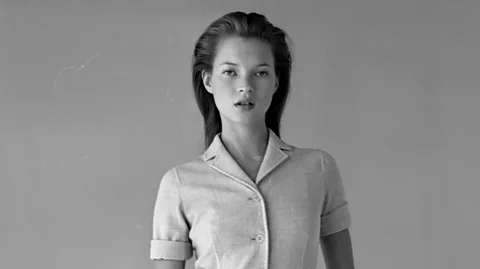
The iconic supermodel Kate Moss has covered numerous magazines, walked thousands of fashion shows and rarely been out of the headlines since she was first scouted as a teenager from the London suburb of Croydon in the late '80s.
Warning: This piece contains language which some readers may find offensive
But how much do we, the general public, really know about her? Beyond all the tabloid stories painting her as a party girl hanging out with various other A-listers, she has managed to remain something of an enigma, and has barely given interviews. In a 2012 piece for Vanity Fair, she revealed she had adopted the mantra "never complain, never explain" from her once-boyfriend Johnny Depp.
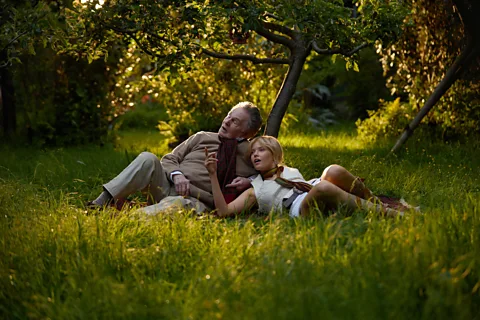
Which is why the new film Moss & Freud – a semi-fictionalised account of when the esteemed artist Lucian Freud painted her portrait in 2002 – might come as a surprise, and a source of fascination to many. Written and directed by the Oscar-winning British-New Zealand film-maker James Lucas, it stars Ellie Bamber as an uncanny double of Moss, as she poses naked for Freud (played by Derek Jacobi) in the early '00s, and charts the unlikely friendship that blossomed between the two of them as a result.
 Sean Gleason
The film is a tender, nuanced look at the private life of a woman in the glare of the celebrity spotlight, which suggests that at this point in her career she was suffering from burn-out. This odd-couple pairing with Freud, regarded as one of the most important British portraitists of the 20th Century, and known for his intimate and visceral paintings of his subjects, appears to lead Moss to re-evaluate herself, and her purpose. As she sits for Freud, every night from 19:00 to 02:00, for nine months, the film shows her simultaneously making some major life decisions.
Moss's involvement in the film
This is all not just conjecture on Lucas's part, as unprecedentedly, Moss not only approved his film – over the years, he says, she's turned down every other documentary and film maker's requests to make a work about her life – but also came on board as an executive producer. She even helped choose Bamber to play her, and spent time with the actor so that she could capture her character as accurately as possible.
"I don't usually want people to see the real me," Bamber-as-Moss says at one point on screen. "To go inside, that's precious, isn't it?"
So what led Moss to greenlight this particular production?
Director Lucas says he first approached Moss about the film "the old-fashioned way" with a letter sent to her through the post. He tells the BBC it "outlined who I was and why I thought this [her sitting for Freud] might have been such a critical, sea-change moment in her life, setting out my artistic, filmic vision for the movie." He adds: "The film gods must have been looking down on to me favourably because she responded very quickly, and before long we were putting things together."
"I pondered what two cultural titans may have talked about," he explains of what drew him to the premise,"and what they found so intriguing and recognisable in each other". He adds that the setting of '00s London, which is evoked in montages of fashion shows, backstage parties and paparazzi pictures from the time, also attracted him to this chapter in Moss's life: "At the time of the painting, London was a place fizzling with creativity, hedonism and a sense of togetherness." The timeline also jumps forward to 2004, to allow the film to include scenes of Moss's legendary "The Beautiful and the Damned" 30th birthday party, inspired by F Scott Fitzgerald's Jazz Age novel – a bash that British Vogue called "a lesson in fashion debauchery".
 Getty Images
Moss & Freud doesn't try to tell Moss's entire backstory. Instead, by focusing mainly on the period where she sat for Freud – during which she also found out she was pregnant – it acts as an intimate snapshot of almost a year in her life.
The film's most fascinating insights
That's not to say that there aren't some surprising revelations in the film. Moss is shown visiting an S&M club in Berlin, but when people start touching her on the dancefloor, she is left distressed, with flashbacks showing how it reminds her of other times she had felt exploited earlier in her career.
Previously, Moss told Joy magazine back in 2008 about how much she liked "Berlin at night, the city has something dark... erotic about it", declaring the city's wild KitKatClub "my favourite". However, whether she was initially refused entry to the club – and told her taxi driver to strip to his underwear for them to gain entry as a couple – as is shown in the film, is not something Moss has spoken about.
And while Moss was reported to have been in a car crash in Essex in 2001 as she was being driven to a photoshoot, the film shows her narrowly avoiding another crash, this time at the wheel, while checking her phone as she speeds about hedonistically in an open-topped car, puffing on a cigarette and with empty mini champagne bottles at her feet.
We also see her falling in love with Jefferson Hack, editor of style magazine Dazed & Confused, who would later become father to their daughter, Lila Grace Moss, after he does an interview with her and goes rogue with personal questions about her taste in men. This tallies with the profile Hack wrote of her for Dazed & Confused in 1999 – not 2002, as the film suggests – in which he asked: "There's been a lot of different men mentioned in your life recently, but no one permanent relationship. Is there no one out there good enough for you?"
Most scandalously, Freud and Moss are shown taking opium together during the painting process, and while this aspect of their relationship has never been reported before, Lucas confirms: "What you find in Moss & Freud is Kate's truth and Lucian's truth. Everything you experience is reality – my embellishments are merely cinematic flourishes." The pair are also pictured having fall-outs during the painting process – Freud is furious when she is late one evening for a sitting.
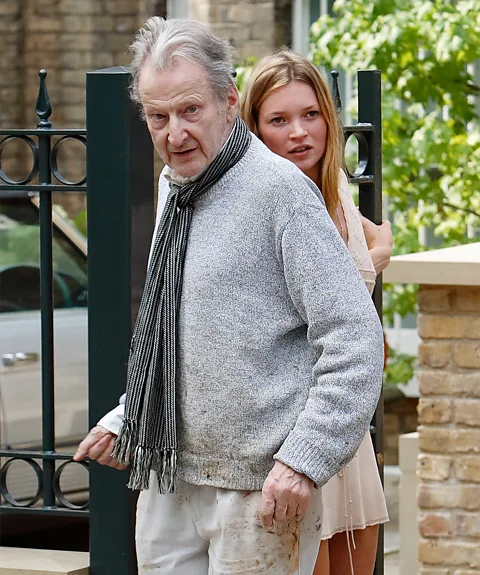
There has been tabloid speculation over the years about the exact nature of their relationship, given Freud's reputation for being a "lothario" who fathered an estimated 14 children. The film does depict Freud – who died in 2011 – as being deeply enamoured with Kate, and jealous when she meets Hack. But the relationship is presented as purely platonic – from Moss's side, anyway. We're also privy to the moment Freud tattoos her, not the pair of swallows on her back, as some people think, but a flock of birds on her thigh, about which she has previously said: "I'm still probably the only living person with a Lucian Freud on my thigh."
 Getty Images
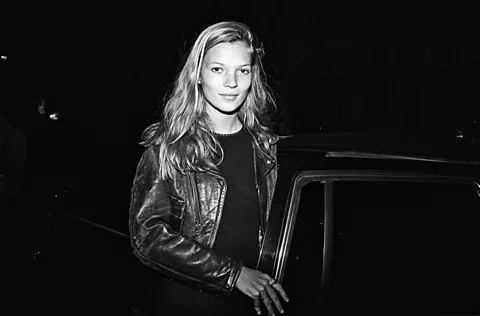
The film's most affecting scene comes when Moss describes to Freud her mistreatment in one of her earliest photoshoots – of which we see a brief glimpse in a flashback. It saw Moss pushed into going topless, and in Moss & Freud she says of her co-star in the shoot: "He was such an arsehole to me, you wouldn't believe. I was 17 years old and shy about my body and I just took it. I stayed in bed for two weeks afterwards."
More like this:
The film includes black-and-white flashbacks of the shoot, and it evidently refers to the famous 1992 Calvin Klein underwear advert which she shot with Mark Wahlberg, then known as rapper Marky Mark. In a rare 2012 interview with Vanity Fair, Moss described how the job had given her a "nervous breakdown", while in a 2022 appearance on BBC Radio's Desert Island Discs, when she recalled that she had felt "completely [objectified]. And vulnerable and scared". In 2020, Wahlberg told The Guardian about the shoot: "I think I was probably a little rough around the edges. Kind of doing my thing. I wasn't very… worldly, let's say that."
Lucas's film suggests her experiences on this shoot were formative in instilling in her a certain emotional guardedness. "That's why I play these roles in front of a camera, I promised myself I'd never feel like that again," she says at one point. It's these kinds of additional insights to the Moss lore that make the film run deeper than the headlines.
How candid is Moss & Freud?
Of course, the fact that Moss is a producer on the film may make people question to what extent Moss & Freud provides a carefully curated image of her. Certainly given the current trend for airbrushed celebrity documentaries – such as Netflix's recent series about David and Victoria Beckham, co-produced by David's production company Studio 99 – audiences are more sceptical than ever about what they are seeing. However, Lucas is keen to stress that Moss & Freud "is far from some slick celebrity advertorial". He adds: "Respectfully, I ran every iteration of the script past her and very little changed but at the same time, her input made everything accurate and, consequentially, enhanced the final film… Everything she said was honest and heartfelt. And usually quite funny."
Certainly too, Moss & Freud only offers a glimpse into one particularly memorable moment of her life, rather than trying to do something more definitive. But while it's far from access-all-areas, it does allow fans more insight into her life than has ever previously been granted.
In fact, fashion and beauty editor Jo Hoare is conflicted about its very existence. "Her fans like the whole legend around her – the bad boyfriends, the big nights out, the carefree attitude – and all this is massively helped by the fact that she is so mysterious and unknowable."
"I do think the film will be popular among people like me who grew up in the 90s/00s," she continues. "But part of me thinks 'do I actually want to know more', or 'do I love her because I don't'?"
Indeed, the elusive appeal of Moss has served her well for her entire career, making something like the Freud painting that much more lucrative: it sold for £3.9m in 2005 (around $7.1m then), despite neither subject nor artist being particularly happy with the finished artwork. Here is an icon who has perfected the art of "giving 'em what they want", as she says in the film, while still managing to remain a figure of intrigue. And despite this film's selective insights, that legacy looks set to continue.
Moss & Freud is in UK cinemas from 29 May, with a US release date yet to be confirmed.
--
If you liked this story, sign up for The Essential List newsletter– a handpicked selection of features, videos and can't-miss news, delivered to your inbox twice a week.
