The Riviera of Ulysses: Italy's stunning coast connected to The Odyssey

 Alamy
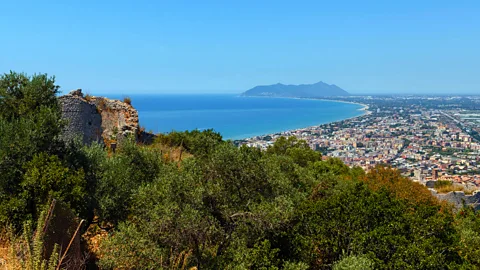
AlamyTucked between Rome and Naples, this beautiful, under-the-radar coastline has deep ties to The Odyssey and is a quieter, more authentic alternative to Italy's overtouristed seasides.
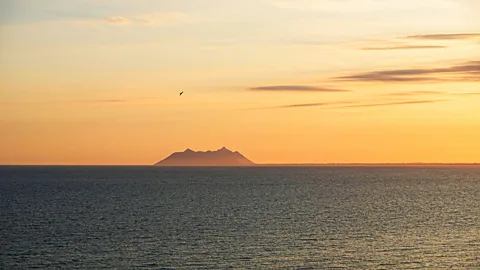
From Terracina, the Italian beach town where my family is from, you can see a mountain promontory that seems to rise from the sea. It is squat and jagged. My father has always said it looks like a witch's profile as she floats on the waves.
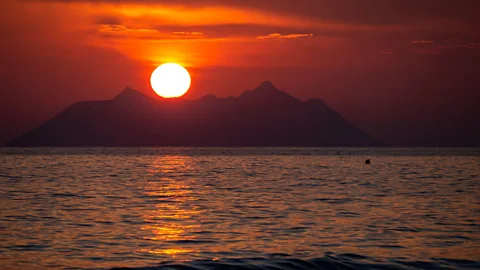
It's visible from various points throughout the coastline, a roughly 43-mile (70km) stretch that hugs the Tyrrhenian Sea and runs between Rome and Naples, threading through several seaside towns. We can see it from mountaintops or from the beach. Each evening, it glows in stark relief against the sunset, no two ever alike.
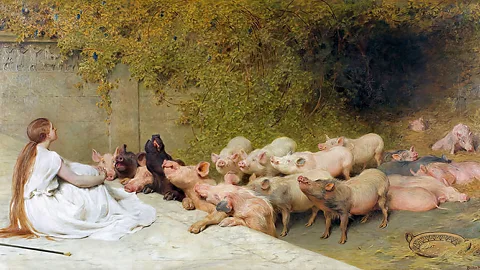
On the map, the mountain is called Monte Circeo (Mount Circeo). But throughout this micro-region of Italy – known as the Riviera di Ulisse (Riviera of Ulysses) – we call it la Maga Circe (Circe the Sorceress). It is, we say, where Circe turned Odysseus's men into pigs.
Homer's ancient Greek epic The Odyssey has fascinated for nearly 3,000 years. Its most recent homage, Christopher Nolan's new film adaptation, is making it the buzz of the season. But on this under-visited Italian coast, we're reminded of the myth every day.
How a myth becomes reality
The Odyssey is so intrinsically Greek, it may surprise travellers that several of its best-known episodes are closely associated with Southern Italy. From Sicily to just south of Rome, numerous city names and geological features have Odyssean backstories.
 Alamy
AlamyIn Book 10, "The Bewitching Queen of Aeaea", Odysseus's ship arrives in the Land of the Laestrygonians before sailing to the isle of Aeaea, where he encounters Circe.
Plan your trip:
When to go: High season (June-August) hums with events and vibrant beach culture, but September-October offer mild, sunny days and fewer crowds.
How to get there: Regional trains arrive from Rome and Naples – shuttles to Terracina depart from Monte San Biagio-Terracina Mare and Priverno-Fossanova. In summer, catch ferries to the Pontine Islands from Terracina and Formia.
Where to stay:Hotel Aurora in Sperlonga, Centosedici in Terracina. Many hotels and restaurants close in off-season (September-May).
There's no evidence that Homer ever visited Italy – or even existed himself. But by the time the Ancient Greeks reached Italian shores in 750BC, his poems were popular among the colonising sailors, says local archaeologist Lorenzo Ceruleo. "All seafarers were afraid of unknown seas. They increasingly associated recently discovered places with these myths. Something they could associate with what they knew reassured them."
Monte Circeo was cast as Aeaea, while Terracina became the Land of the giant, cannibalistic Laestrygonians. Linking Aeaea to Monte Circeo wasn't a leap: in ancient times, much of the promontory was underwater. Plus, the "island" itself was home to a Roman harbour village called Circeii. It was, says Ceruleo, an irresistible conclusion.
 Alamy
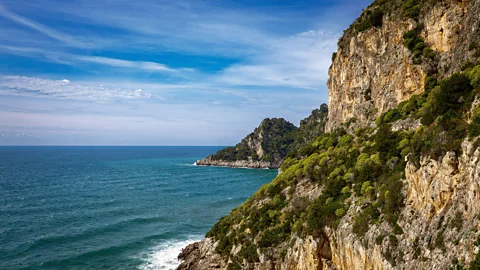
AlamyThe area's turquoise seas and rugged grottos do seem mythical – it's easy to imagine giants hurling rocks from the ochre-coloured cliffs. Such geographical links eventually became political, says Ceruleo, particularly for the Romans. Tying places to Odysseus and other mythical figures helped establish prestigious ancestral connections – useful when legitimising the new Imperial order. The Roman poet Virgil repurposed these identifications in The Aeneid, his epic about the founding of Rome.
Ceruleo emphasises: "The myth of Circe belongs to the poem's literary world. It's not historical reality."
The Riviera of Ulysses today
Although the coast's association with The Odyssey is ancient, the name "Riviera di Ulisse" is a modern invention, adopted in the 20th Century to promote the region. There is some local debate, but the designation typically encompasses the towns between San Felice Circeo on the slopes of Mount Circeo and Scauri, on the Gulf of Gaeta. Other places along the riviera claim Odyssean ties, particularly the nearby Pontine Islands and the coast's southerly towns of Formia and Gaeta, also dubbed the Land of the Laestrygonians.
"Places often compete over myths," explains Ceruleo. "However, the Laestrygonians were always associated, even in the earliest traditions, with Terracina."
 Alamy
AlamyBusinesses bear names like Lido di Penelope and Rive di Ulisse. But local identity more closely embraces the area's historical fishing tradition. In Terracina, we call ourselves sang' d' pesc (fish bloods). Like many Italian coasts, the Riviera of Ulysses now lives on summer tourism.
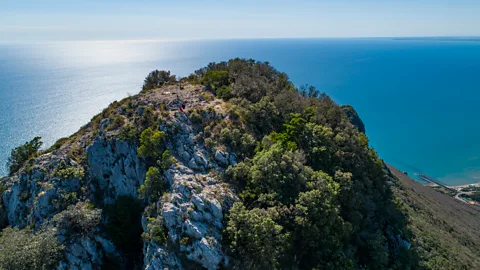
Today, visitors can explore the same breathtaking landscapes that enchanted Ancient Greek sailors. Mount Circeo itself is home to the Parco Nazionale del Circeo, where 9,000 hectares of coastal dunes, lakes and forests are crisscrossed by hiking trails and dotted by artisanal food producers. Scale the promontory's 541m-high (1774ft) witch-faced peaks to find the Roman sanctuary dedicated to Circe and gaze at the crescent curve of the coastline below – beach lidos and the Roman Temple of Jupiter Anxur toy-size in the distance. The park organises guided tours to its Grotta Guattari, where Neanderthal remains were discovered in 1939 and continue to resurface.
 Lorenzo Ceruleo
On the southern end of the coastline, the Parco Regionale Riviera di Ulisse also offers lush hiking experiences, plus "beautiful beaches, extraordinary sea caves and a coastline that's best explored by boat", says Massimo Giovanchelli, the park's president.
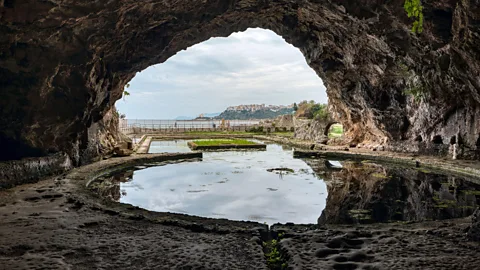
Though not explicitly tied to The Odyssey, the hilltop town of Sperlonga earned Odyssean cache in 1957 when a massive collection of Odyssey-themed marble statues was found inside the grotto of its Roman Villa of Tiberius. In 2019, archaeologist Marina De Franceschini and her collaborators discovered that the grotto had been engineered to illuminate the statues during the solstices. "[The Romans] were enamoured of Greek culture," she says. "It was Tiberius's way of claiming descendancy from Odysseus."
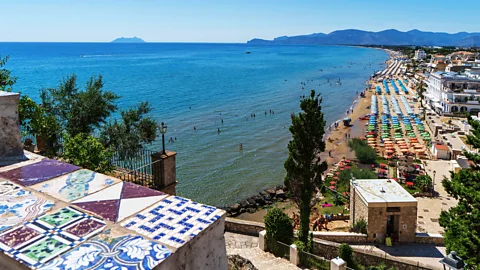
Visitors can explore the villa and admire the statues, currently on display at Sperlonga's National Archaeological Museum, then lounge on Sperlonga's pristine beaches and stroll its bougainvillea-draped Santorini-esque ancient quarter.
 Alamy
AlamyBut despite its natural and historical riches, the area receives relatively little international visitors compared to other Italian cities. "Our location between Rome and Naples [has] worked against us," says Linda Contreras of Gaeta-based tour operator Centro Guide Turistiche. "We're simply somewhere [foreign tourists] pass through."
Italian and Northern European visitors cause the towns' small populations to swell each summer, but tourism here still has yet to reach the theme park-esque levels of Rome or other seaside regions like the Amalfi Coast. "They should go to places like Sperlonga which are wonderful and outside the other tourism that has become a nightmare," says De Franceschini.
Services and hotels are humbler here. But visitors experience modern Italian life amongst ancient ruins. Boutiques line the streets and fishing boats bob in the ports. Nightlife and excellent dining experiences unfold along the shores, in piazzas or in the towns' romantic old quarters, with their layers of Baroque, Medieval and Roman architecture. Summers bloom with beach umbrellas, festivals and concerts, often held inside the Riviera's spectacular Roman monuments. In off-season, locals enjoy mild-weather beach strolls and fiery sunsets. Year-round, we feast on fresh local seafood, buffalo milk mozzarella and pungently floral Muscatel wine.
 Alamy
Alamy"It's a more genuine, authentic, slower tourism," says Giovanchelli.
An unrequited love
Thousands of years after Ancient Greek colonists associated Aeaea with Mount Circeo, residents relate to The Odyssey in different ways. "As people who were born and raised here, we feel very connected to the story and the culture surrounding Odysseus," says Giovanchelli.
Marisa Perroni, owner of beach lido La Sirena del Mare in Terracina, says her late husband felt a profound connection with local myth: "He told the children Odysseus stories every night. They were fascinated, especially [our eldest], Robertino."
 Alamy
AlamyRobertino Della Fornace says his father revered Odysseus's intelligence. "The stories inspired his own life, which was filled with travel and extraordinary adventures – many of which I had the privilege of experiencing alongside him." Together, the pair sailed frequently to the Pontine Islands. "We would go fishing with nets at dawn and live off the land… like Odysseus, he wanted to discover what lay beyond the Pillars of Hercules, driven by an unquenchable thirst for knowledge and virtue."
I first came to Terracina as a child to visit family, and then again as an adult. I planned to stay a month, but thanks to a series of distracting encounters with sweet-singing mermen, I stayed for 14 years. I imagined myself as Odysseus's wife Penelope, pining for love that did not return. Now I realise I was like Odysseus, blown off course.
Some locals are more pragmatic about their mythical pedigree.
"It's all marketing," says Terracina native Manuela Gallinari. Growing up, "people talked about la Maga Circe but not as something extraordinary. She was just there." She shrugs: "When you're born into it, you take it for granted."
More like this:
Only as an adult did Gallinari realise that parts of The Odyssey were set in her region. "It feels strange to think that they're talking about your home."
Regardless, The Odyssey endures, throughout Southern Italy and beyond. And maybe visitors who do venture past Rome will tell about their time in the Riviera of Ulysses, swimming in crystalline seas under the eye of Circe. Tourism branding or no, this is how myth survives.
"Myth is appealing," says Contreras. "It's like a love that never fades. An unrequited love, because you can never know whether it was real."
--
If you liked this story, sign up for The Essential List newsletter – a handpicked selection of features, videos and can't-miss news, delivered to your inbox twice a week.
