'I'm pushing for better paternity rights after my wife nearly died'

 Nathan Barnes
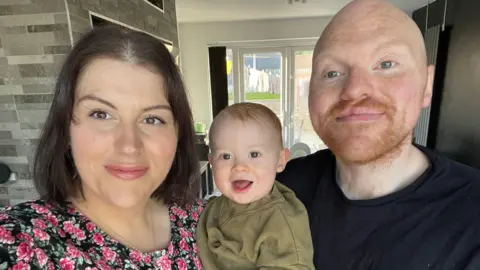
"It was, without a doubt, the worst time of my life," is how Nathan Barnes describes his wife nearly dying during the birth of their son. The college pastoral coach from Leeds said the experience has prompted him to campaign for better rights for new parents and improved paternity leave.
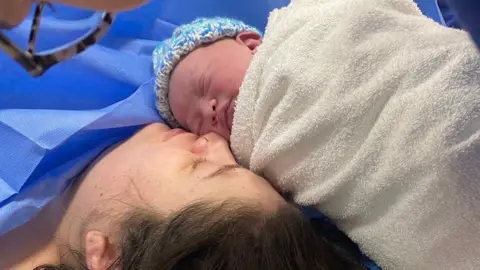
In February 2025, Nathan's wife, Megan, had an emergency caesarean section after attempts to induce the birth were unsuccessful for three days.
"We then proceeded to have the worst fourteen days we've had as a family.
"My wife fainted and almost died twice."
She and their son developed infections so were kept on the ward for two weeks - the entire duration of Nathan's planned paternity leave.
"Going from seeing your partner almost dying to your son catching an infection and having to be prodded with all kinds of needles," the college pastoral coach from Leeds said.
"I was able to go home and she was just constantly on the ward 24/7. That took a toll mentally."
 Nathan Barnes
Nathan was signed off sick for three weeks and went back to work, but neither he nor his family were ready.
"Having to go to work 12 hours a day whilst your wife is still recovering from a C-section and all the while caring for a child... [there was] an immense amount of guilt," he said.
He described the UK's statutory two-week paternity allowance as "ridiculously outdated".
"It hasn't kept pace with the cost of living, it hasn't kept pace with research into healthy family models," he said.
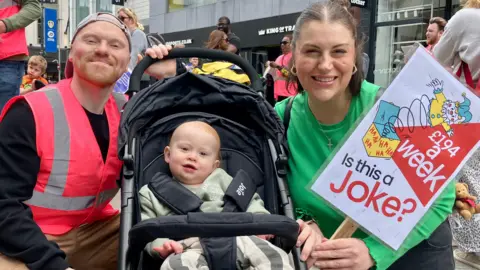
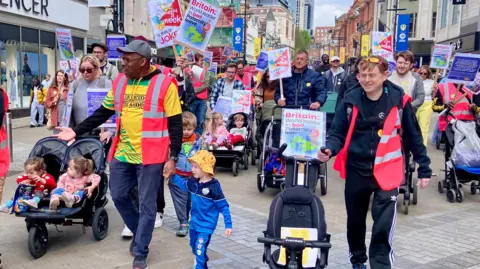
He was one of those pushing decorated prams across Leeds on Saturday to rally for six weeks statutory paternity leave at 90% pay.
 Nicola Rees/BBC
Introduced in 2003, the statutory allowance means partners receive £194.32 a week or 90% of their average earnings, whichever is lower, which works out at less than half of the National Living Wage.
It applies to birth, surrogacy or adoption and includes same-sex couples.
Self-employed dads or those who earn less than £129 a week are ineligible.
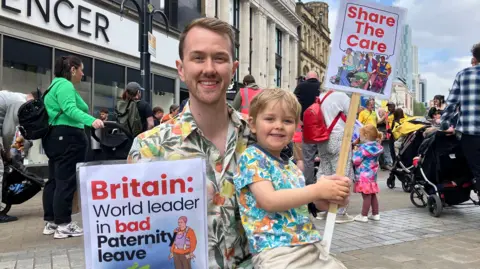
Matthew Bamford attended the Leeds demonstration to support other parents, having had six months paternity leave himself.
"We probably wouldn't have been able to have a second child if we didn't get such good paternity leave as I did," he said.
He said his employer's decision to exceed the statutory allowance had made a "massive" difference to his family and said there needed to be more rights in place to allow both parents to "be there for their kids".
"The first few weeks are really important. We really need it."
 Nicola Rees/BBC
Last year, a committee of cross-party MPs labelled the UK's statutory parental leave system as "one of the worst in the developed world".
New fathers in Spain get 16 weeks at full pay, including those who are self-employed.
Sweden provides two parents with 16 months to split between them, per child.
Findings from the UK government's review of parental leave are due by the end of this year, and campaigners see the months ahead as a vital window to send a message to the government.
Joeli Brearley, from York, is the founder of maternity rights group Pregnant Then Screwed.
She helped organise the Push for Paternity marches which also took place in Manchester, London and Nottingham, and described paternity leave in the UK as a "serious problem".
 Nicola Rees/BBC
"I find it really depressing that we have not managed to move forward and accept that dads are carers as much as women are," Brearley said.
"This has been an opportunity for us to get out on the streets and to say, very loudly and very proudly, 'dads want to care too'.
"All they need is some changes to legislation to enable them to do that."
Employment rights minister Kate Dearden said the government had already changed the law to give 32,000 more partners access to paternity leave.
It was carrying out the parental pay review so parents could "spend as much time doing what matters most – caring for their baby", she said,
"One of the best changes I've seen in my lifetime is men wanting to be more involved in their children's lives," she said.
She said it had been a "huge societal change" and was "having a positive impact on children's lives".
Listen to highlights from West Yorkshire on BBC Sounds, catch up with the latest episode of Look North
