I was pressured into refusing a blood transfusion aged 11. The Jehovah's Witnesses' new policy changes nothing

 BBC
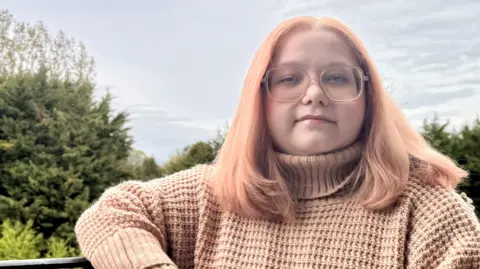
BBCWhen Beatrice Jones was told at the age of 11 she needed a potentially life-saving blood transfusion, she felt "a wave of nausea" as her "whole world suddenly collapsed".
Doctrine forbids Jehovah's Witnesses, as Jones was then, from receiving blood transfusions in almost all circumstances.
In March, the Christian-based movement updated its long-standing policy on receiving blood.
Followers are now allowed to have their own blood removed, stored, and "given back", in a process called autologous donation, but are still forbidden from accepting donations from others.
Former members have told the BBC the new rules are "nonsense" and are still putting lives at risk.
Jehovah's Witnesses spokesman Andrew Basoo disputed that, saying: "Individual Witnesses make informed medical decisions that reflect their understanding of the Bible, while placing great value on the expertise of the medical professionals caring for them."
'Would I lose my chance of entering paradise?'
"I remember that moment, 18 years ago, in the GP surgery as if it happened yesterday," said Jones, 29, who had been suffering with severe anaemia.
She had been taught that "Jehovah must always come first", and that accepting blood was something she must refuse – even if it meant death.
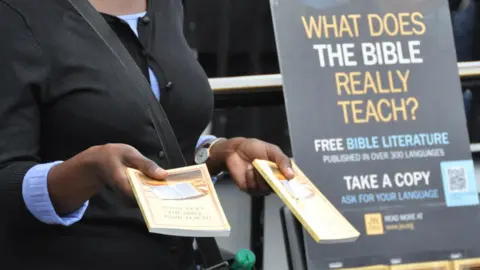
Jones, of Brentwood, Essex, grew up in the Christian-based religious movement, probably best known for its door-to-door evangelism.
It claims about 144,000 active members in the UK and about nine million worldwide.
"When the doctor said I needed a transfusion, I was terrified," she said.
"I hid in my room and cried because I didn't know if I would be strong enough to refuse blood, knowing it could possibly save my life."
She was "overwhelmed by fear" about what would happen if she accepted a transfusion.
Her mind was "racing with questions and fears that were far too heavy for any 11-year-old to carry".
She turned down the transfusion, instead accepting alternative treatment, and has since left the Jehovah's Witnesses.
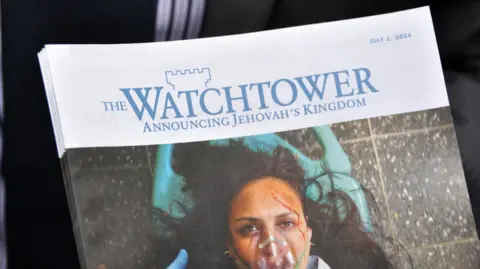
Her health had been on a collision course with doctrine born out of the Old and New Testaments.
According to the organisation's website, Jehovah's Witnesses "avoid taking blood not only in obedience to God, but also out of respect for him as the Giver of life".
The belief stems from the denomination's approach to the Bible, whereby scripture is read literally, but using only the organisation's approved translations.
Alongside Genesis and Deuteronomy, the group puts its views on transfusion down to Leviticus 17:10, 11: "If any man [...] eats any sort of blood, I will certainly set my face against the one who is eating the blood, and I will cut him off from among his people. For the life of the flesh is in the blood."
The punishments for those who accept transfusions can be severe, according to the religion's own rule book.
Guidance issued for religious leaders, seen by BBC News, says that if a follower "unrepentantly" accepts blood, "he has disassociated himself".
Dissociation, similar to disfellowshipping, now known as removal, is a process whereby followers are expelled from the religion, sometimes losing their family and social structures.
It was this "overwhelming pressure" that prompted Jones to ultimately turn down the transfusion.
"Would I lose my family? Would I lose my chance of entering the promised paradise?" she had wondered.
"No one person was pressuring me, but you hear of what happens to other people who get transfusions. It was ingrained," she said.
Despite her doctor's concerns, Jones, who now works in insurance and has left the religion, survived without the transfusion.
But the experience has stayed with her.
"Any mention of transfusions brings me back to being that frightened child, sitting alone in my room, trying to make sense of a choice that felt impossible," she said.
On the recent policy change, she said: "It's diabolical. I don't even have the words. I was so angry when I saw it.
"I was just, like, 'How dare you?' You know, all those people that have suffered and now you're just suddenly, like, 'Oh, actually, no, it's a personal choice and actually we're going to change.' But actually, nothing has really changed and it won't make a difference."
Jones contacted BBC News after reading how North West Cambridgeshire MP Sam Carling had criticised her former religion in Parliament.
Carling, himself an ex-Jehovah's Witness, claimed its teachings had regularly equated homosexuality with paedophilia and that it had covered up child abuse "on a catastrophic level".
Basoo told the BBC that Carling's claims were "demonstrably false."
'I was ready to die'
 Supplied
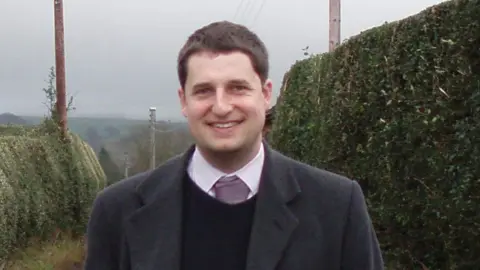
According to Lloyd Evans, 46, a former Jehovah's Witness elder in Manchester who is now a campaigner, the organisation's updated policy is still putting lives at risk.
"Followers will still feel, as a matter of conscience, that they still need to abstain because of the pressure to go above and beyond in showing their loyalty to the organisation," he said.
"I remember when the policy was liberalised in the past, allowing people to receive fractions of blood – things like haemoglobin and albumin – it was still seen as a matter for your conscience," he said.
"I was ready to die then, so I can imagine many Jehovah's Witnesses will feel the same way about this new policy."
Basoo said there had been no change to its "core position that Jehovah's Witnesses abstain from blood".
He added: "The clarification regarding the use of one's own blood is rooted in Scriptural understanding, not medical developments."
 Supplied
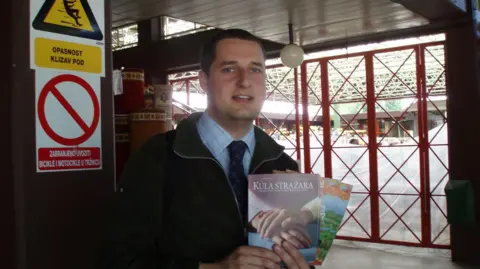
According to Evans, who now lives in Croatia and runs anti-Jehovah's Witnesses social media accounts, fear is the reason that some followers would rather die than be seen as morally corrupt.
"When I was an elder, if a member came to me and expressed a desire for a blood transfusion, the first thing I would do is contact the Hospital Liaison Committee (HLC)," Evans said.
HLCs are groups of elders, responsible for guiding followers as they navigate healthcare.
"The committee would visit the patient's bedside to put that member under considerable pressure to abstain from blood in all cases," Evans said.
"If you ignore the elders, and willingly and unrepentantly accept a blood transfusion, you will be shunned by the organisation and cut off."
He claimed "some hospitals are rolling out the red carpet for the committees, because they assume elders would be there for pastoral care, rather than religious coercion", and wants the law changed to prevent this.
Basoo said: "HLCs do not make medical decisions. Such decisions rest with each individual patient. HLC assistance is only provided upon request."
He said clinicians had spoken positively about their experiences of working with HLCs.
The Department for Health and Social Care was approached for comment.
 Paul Kerley/BBC
Announcing the policy change on blood transfusions last month, Gerrit Losch, part of the Jehovah's Witnesses global leadership, said "each Christian must decide for himself how his blood will be used in medical and surgical care".
But Evans said: "The policy does not make sense. There are any number of medical situations and emergencies where this will be of absolutely no use whatsoever."
He pointed to unexpected circumstances, such as car accidents, and the impracticality of people having a store of their own blood in case of emergency, highlighting the NHS's guidance on donating blood, which says red blood cells only have a shelf life of 35 days.
"It's kind of a Frankenstein's monster of a policy change that's been kind of cobbled together," he said.
"It feels like it's been drawn up on the back of a paper napkin, just so that they can save face and come across as being more reasonable."
BBC News asked the Jehovah's Witnesses to comment directly on this claim, but they declined.
An NHS spokesperson told BBC News it followed guidance from the Joint UK Blood Transfusion and Tissue Transplantation Services Professional Advisory Committee (JPAC).
According to JPAC, autologous donation is only recommended for patients with rare blood groups or who have multiple blood group antibodies.
Basoo said: "Since the Bible does not comment on the use of a person's own blood, each Christian decides before God how their own blood may be used in all medical and surgical procedures.
"It has been clarified that this now includes whether to allow his own blood to be removed, stored, and then given back to him.
"Our core belief regarding the sanctity of blood remains unchanged. Jehovah's Witnesses make informed, conscientious choices that reflect both Scriptural principles and developments in modern medical practice."
Follow East of England news on X, Instagram and Facebook: BBC Beds, Herts & Bucks, BBC Cambridgeshire, BBC Essex, BBC Norfolk, BBC Northamptonshire or BBC Suffolk.
