Exclusive access: Testing London's next-generation Piccadilly line trains
BBC London has been given exclusive access to the testing of the trains on closed sections of the Piccadilly line. Transport bosses say these are in technological terms some of the world's most advanced trains. Does the reality live up to the hype?
As the train pulls into the station, there are about 50 passengers with their phones out taking pictures.
The halo light around the cab gives it a hint of Darth Vader's TIE Fighter in the sci-fi classic Star Wars.
This is the new Piccadilly line train – or officially the 2024 Tube Stock - and it is causing a bit of a stir.
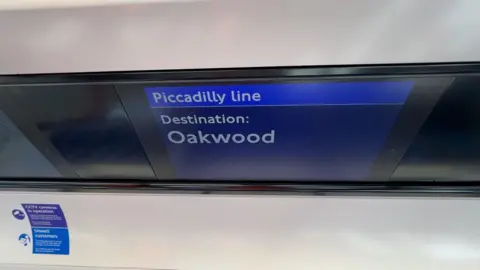
It is early in the morning and a 20-mile stretch of the line is shut, between Northfields in west London and Oakwood in north London. It is one of many weekend closures that may not be going down well with travellers but which Transport for London (TfL) says are necessary to test the new train and modify the infrastructure.

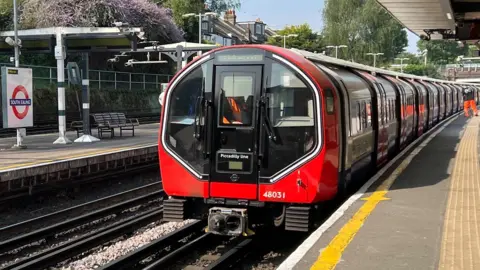
It is only when you see the trains and the surrounding works that you appreciate the scale of the task.
Engineers are essentially building a new railway with new trains, while the existing Piccadilly line is still in operation - and the Piccadilly line accounts for 10% of London's Tube journeys.
Sarita Coultate, senior programme manager, says the upgrade will be transformative.
"This is a state-of-the-art train," she tells me. "It comes with novel technology that's never been seen on a deep tube before."
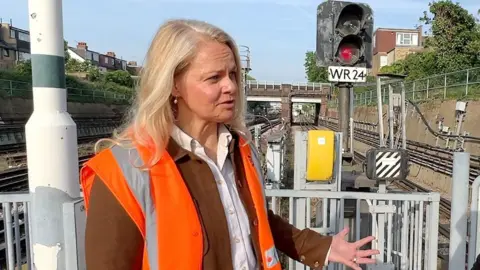
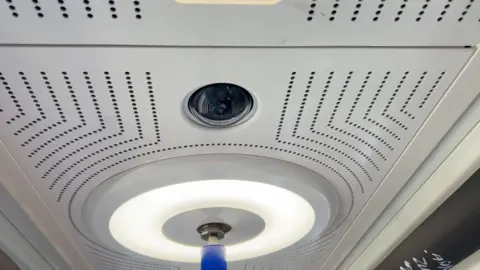
"It'll be air-conditioned, for the first time digital open CCTV on the trains," she adds
"There will be safety benefits, custom accessibility benefits, real-time information, to help work with way-finding, and the trains are bigger, and they carry more passengers.
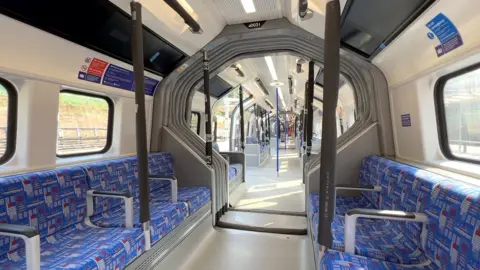
"You could walk from one end to the other, so it'll feel spacious - so lots of customer experience benefits."
'World's furthest-advanced train'
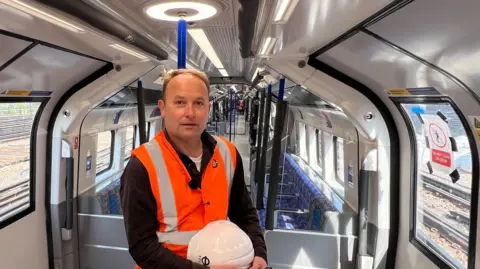
On board the train, first impressions are that the trains are very spacious, very cool temperature wise and you can see from one end of the train to the other. These trains are pushing what can be done with deep tube line trains.
They have squeezed in cooling systems by losing some of the train bogies - the components that link the wagon body to the wheel sets and track - and suspending the carriages between those that remain.
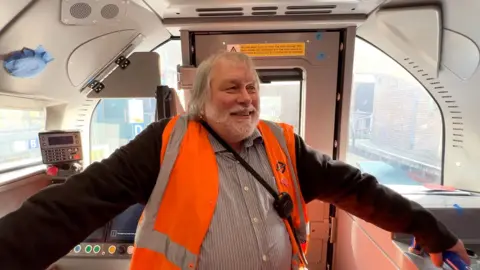
Brendan Sothcott is an engineer on board and in charge of the movements and safety.
"It has been interesting working on the project. It is pushing the limits of innovation on rolling stock," he says.
"I don't think there's a train in the world that's as far advanced.
"There's a lot of teething troubles, I think you'd call them. We are getting over them. Obviously we have to make sure they're right before we let it into service.
"We don't want to put it into service if anything can go wrong. If you push innovation, you are going to get a few little issues - that's what happens when you innovate."
Coultate says the upgrade has had its challenges.
"It's a lot more than just trains. We have to upgrade our ageing infrastructure," she says.
"We're trying to improve and expand our capability in depots, stabling capability, we're modernising our maintenance facilities. We're upgrading track, infrastructure, power etc., all in readiness for this change.
"And on top of that, we need to train hundreds of drivers and maintenance staff to make sure that everybody is ready for this change.
"It's really complex, because it involves changes to people, process, technology, infrastructure. So that's part of the challenges that we're facing."
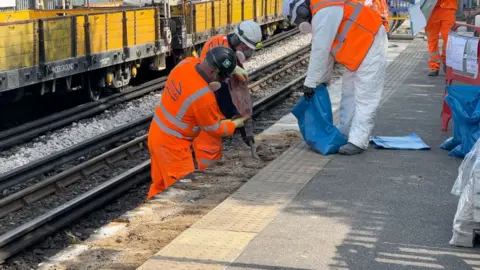
At Hounslow East station we see the engineering work being done to change the line for the new trains. They are re-laying platform slabs so level boarding will be possible.
Geoff Pearce is senior programme manager at Transport for London. He explains a lot of Victorian infrastructure needs changing.
"We need to make sure that the signals, for example, they can be seen from both the old train and the new train when the new train comes in," he says.
"We've got power upgrades at substations dotted all the way along the Piccadilly line that we need to upgrade to make sure the power for the new train is ready, and obviously we need to keep the railway running during the week for our customers.
"Here we're modifying all the nosing stones (the concrete edge on platforms) throughout this platform, so we need to do a full-length change of the nosing stones. It makes the PTI, the platform-train interface, as safe as it possibly can be for when we introduce a new train.
"There will be new markings, safety markings going in for 'Mind the Gap' etc. So the guys will be continuing working all weekend to get this platform into use ready for Monday mornings."
The trains were due in late 2025 but they have been delayed. Transport for London has announced that the trains will be in service at some point between December 2026 and June 2027. But when transport authorities start using windows of time or seasons to describe start dates, commuters get nervous there will be more slippages.
The complexities have also meant the budget was recently increased from £2.9bn to £3.4bn to build new depots and for the extra work across the line.
TfL commissioner Andy Lord is certainly bullish about what passengers will experience when the new trains are running.
"These trains are the latest, highest-tech design we've ever had on the Tube network," he says. "They're extremely complex, particularly because of having to integrate air-conditioning in very tight spaces.
"So there have been some initial design challenges on that. We're working very closely with Siemens, our partner on this, who have done some amazing work to design and deliver these trains.
"The trains were initially late to London, and then, as you've also seen, the line itself, most of it is Victorian.
"We're having to adapt the line in the infrastructure for the new trains.
"We're also having to adapt it so we can run both the new fleet and the existing fleet together for probably two to three years. So that involves a huge amount of engineering construction, and we've got to upgrade the power and various other elements.
"So there's a multitude of factors for why the trains are not coming in as originally planned. But, we're working really hard to get them in sometime between December and next summer."
Listen to the best of BBC Radio London on Sounds and follow BBC London on Facebook, X and Instagram. Send your story ideas to hello.bbclondon@bbc.co.uk
