Untold stories of city's effort to help the blind

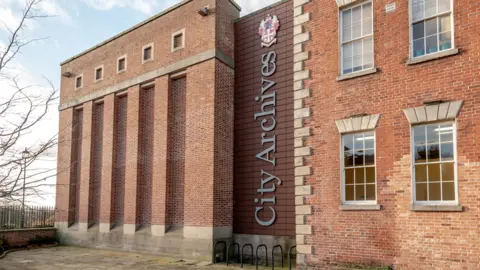 City of Wolverhampton Council
An exhibition in Wolverhampton hopes to explore the history of sight loss in the city, and tell the stories of local people's experiences.
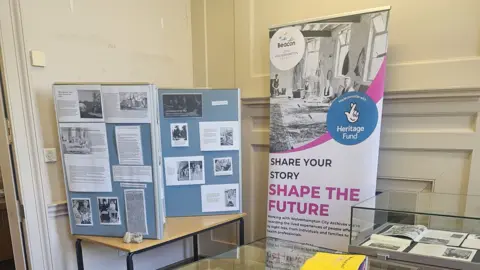
Based in Wolverhampton City Archives, and created in collaboration with The Beacon Centre for the Blind, the exhibition looks back across 150 years of history.
It runs until the end of the month, and is open Wednesdays to Saturdays.
"We started off looking at how to make the archives more accessible for people with sight loss, and from there we've just found an incredible collection of stories, both from individuals and from the actual city itself that just needed to be displayed," said Rhianna Patterson, outreach worker at the archives.
"We've got stories about individuals such as Dorothy Hadley, who lost her eyesight at age three, and she campaigned her entire life for the importance of guide dogs.
"She would go around to primary schools, secondary schools, community groups, and she just became a real known figurehead in her local community with campaigning and fundraising," she said.
 Wolverhampton Archives
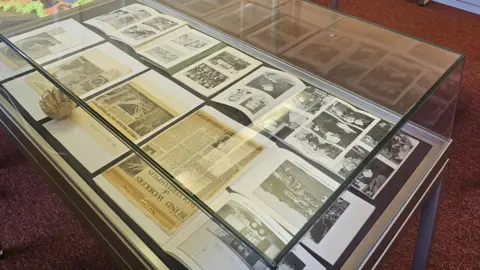
Artefacts, like Braille machines, are on display, which date back from about 90 years ago to more recently.
The exhibition also discusses modern methods like using phones.
"We've also got some ground-breaking moments from the city," said Patterson.
"Wolverhampton itself was one of the trial sites for tactile paving... we even fed back, because initially the paving was installed painted black, but for those who were partially sighted... we actually said that yellow was probably a better colour."
 Wolverhampton Archives
The exhibition also details the work that the Beacon charity did during World War Two.
"Beacon has always had a workshop where it's employed its service users and its residents into making wicker baskets and rugs and various other bits and pieces," said Patterson.
"During the Second World War when it was all hands on deck, a lot of people were redirected into Villiers Engineering Company and they helped with filing aircraft parts and installing fuses for shells."
"There's a really inspirational bit about them and their war effort as well... you're discovering all these wonderful stories that really have gone on untold up until this point."
Patterson added that there was still a lot of stigma around visual impairment.
"These people really have gone above and beyond for the local area, for companies, being able to live a completely normal life like the rest of us - with even more inspiration because they're often doing added bits on top of that."
"It's just important to share those stories and really make sure that their voices are heard."
Follow BBC Wolverhampton & Black Country on BBC Sounds, Facebook, X and Instagram.
