EU calls emergency meeting to discuss Ceuta migrant crossings
The European Union will hold emergency talks on Tuesday to discuss the migration crisis in Ceuta after tense exchanges between Spain and other member states.
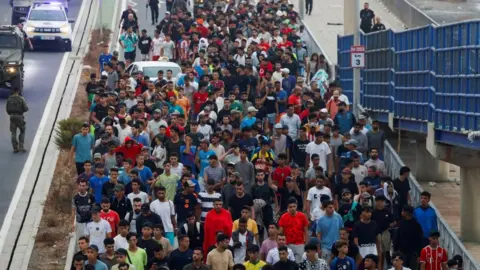
Twenty-two member states issued a joint letter calling for co-ordinated action and the strengthening of the EU's external borders, after some 60,000 migrants entered the Spanish enclave from Morocco.
Spain condemned "selfish, polarising and unlawful" reaction to the crisis after Italy suspended the EU's border-free Schengen arrangement with Spain - a move backed by Finland and Denmark.
Officials say almost all those who reached Ceuta on 30 July have returned, while deaths from the surge in crossings had risen to at least 67.
The EU members' letter addresses concerns around "hybrid threats to create the perception that illegal entry into the European Union is possible," adding that the perception "would encourage further attempts, undermine confidence in our common migration policy and have repercussions for all Member States".
Leaders of the Netherlands, Finland and Belgium are among 22 signatures on the letter, addressed to EU President Antonio Costa, president of the European Commission Ursula von der Leyen and Taoiseach Michael Martin, as Ireland currently holds the presidency of the Council of the European Union.
In a separate letter to von der Leyen, Spanish Prime Minister Pedro Sánchez said he had "serious concerns" about some European governments.
He said the Spanish government had fully restored control over the border and prevented any "unauthorised onward movement towards continental Europe" in less than 48 hours.
While most had shown "support and solidarity", Sánchez said other European governments had chosen to attack Spain, "driven by prejudice, fake news, ignorance, or political interest", and pointed out that Ceuta was not part of the Schengen area.

 Reuters
On Friday, Sánchez accused migrant traffickers of exploiting a decision recently made by the country's supreme court which constrained the government's right to immediately deport people who had arrived by sea.
The country's Interior Minister, Fernando Grande-Marlaska, said in a news conference on Saturday that the situation had almost returned to normal and the country was working on inflatable barrier to prevent illegal migration via the water.
"Almost all of [the migrants] have already left Ceuta," he said adding that businesses there had now reopened.
Some criticism of the situation has involved concerns over the Schengen Area - an agreement which eliminates border checks and now encompasses more than 450 million people and 29 countries in Europe.
In addition to Italian Prime Minister Giorgia Meloni suspending Italy's Schengen agreement with Spain for a month, Finland, France and Portugal have all said they were either looking at, or considering, border checks.
Danish Prime Minister Mette Frederiksen urged the EU to "consider all options, including a suspension of Schengen co-operation".
Von der Leyen said the images from Ceuta were "unacceptable". Writing on social media, she said: "We cannot allow anyone to come to our Union without abiding by our rules."
German Chancellor Friedrich Merz demanded that Morocco "take back illegal migrants immediately", while on Saturday, UK Prime Minister Andy Burnham said he had spoken to Sánchez and the UK was "providing what help we can".
Morocco witnessed several Gen Z anti-government protests last year, with young people demanding better opportunities and improvements to public services.
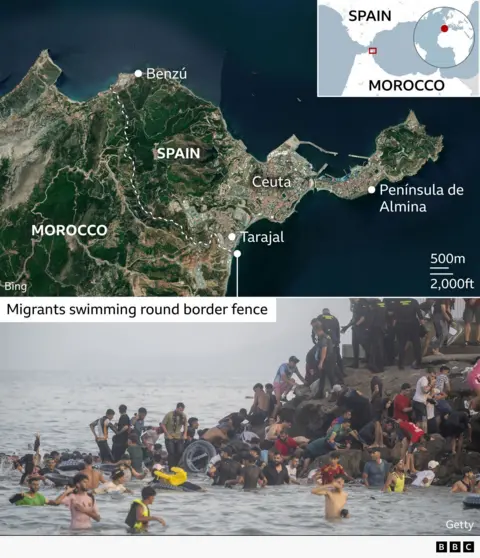
Together with Melilla, Ceuta forms the European Union's only land borders with Africa. Migrants can enter the enclave by swimming several kilometres.
While the surge of migrants this year is extraordinary, Ceuta has long been a focal point for migrants attempting to reach Europe. During the summer months, there is often a big push to reach Ceuta, typically organised over social media.
In 2021, about 8,000 people entered Ceuta over a matter of days, exacerbating Spain's diplomatic tensions with Morocco.
Spain has a relatively friendly approach to immigration. In April, the government approved plans to give legal status to 500,000 undocumented migrants, allowing them to be formally integrated into the workforce.
Are you in Ceuta? Have you been affected? Get in touch here.
Please include a contact number if you are willing to speak to a BBC journalist.
You can also get in touch in the following ways:
Email: yourvoice@bbc.co.uk
WhatsApp: +44 7756 165803
