Closure order for shops linked to people smuggler

 BBC
BBCA court has granted a closure order on two mini-marts in Leicestershire that have been linked to a convicted people smuggler due to fears over disorder.
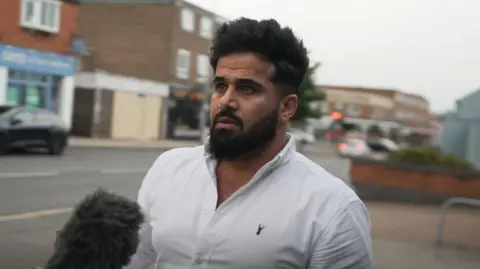
A BBC investigation traced Twana Jamal, once described as "the godfather" of the French migrant camps, to Blaby where reporters witnessed him working illegally in two shops in the village.
Blaby District Council temporarily shut down the premises - Candy Corner and Candy Corner1 - on 3 July using a 72-hour emergency closure notice.
On Monday at Leicester Magistrates' Court, a three-month closure order applied for by the district council was granted after the case was adjourned on 6 July.
The court heard the closure orders would remain in place for the premises at 8A Lutterworth Road and Forge Corner until 20 October.

Louisa Horton, representing Blaby District Council, told the court as a result of media interest there was a "massive increase" in community tensions.
She added there were posts online "inciting hatred" towards the premises, and neighbouring businesses.
Horton told the court due to the "high-profile nature" of reporting and social media activity, there was a "considerable risk of disorder" if the premises were to reopen.
She said the closure orders applied for were designed to be "preventative and protective" in nature.
Following the emergency closure notice issued on 3 July, new firms were registered to the properties on 4 and 5 July under a new director, who is an Iraqi national.
On 7 July, workers arrived at one of the shops, next to the office of South Leicestershire MP Alberto Costa, and changed the sign above the door to M&M Express Ltd.
A council spokesperson previously said it was "aware" two new companies had been registered at 8 Forge Corner and 8A Lutterworth Road - namely MM Blaby Ltd and MM1 Blaby Ltd.
Horton told the court the erection of signage at the store in Lutterworth Road "increased community tensions" and "exacerbated" the potential for disorder.
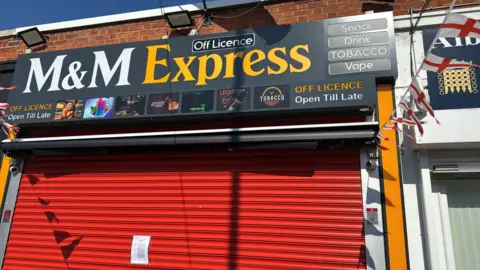 Office of Alberto Costa
Manizja Latifi, the barrister representing the Candy Corner stores, told the court Twana Jamal, was not an owner, director or employee at either shop, and said he had "no control whatsoever" at the mini-marts.
She told the court Jamal was a "distant relative" of the owner and on the day BBC News visited the store, he was assisting the owner due to "childcare responsibilities".
Latifi said the "online hostility" which followed the BBC News coverage was "shocking" and "very distressing".
"We are looking at dozens and dozens of threats being made on Facebook," she said.
The hearing was told the owner had received phone calls and messages from people threatening to "burn the shop down" if it were to reopen.
"We say that if a closure order is made, it simply delays risk we are facing, it does not address it," Latifi said.
Latifi added those making threats "cannot be given power" over whether a business traded or did not.
She suggested a two-week closure order as well as ensuring Jamal never attends or is employed at either premises would address the risk posed.
Magistrate Miss Clifton told the court there was "consensus about this unfortunate disorder" which included personal threats and there was "a risk" to residents who lived locally.
She said on the "balance of probability" it was necessary for the premises to remain closed.
A BBC investigation found Jamal is believed to have been seeking asylum in the UK. He told us he had applied and was "still waiting". It is not known what name he used on any application.
UK law says anyone who has spent 12 months or more in prison overseas should be refused asylum.
The Iraqi Kurd was given a five-year jail sentence in France in 2016, where authorities described him as one of the most successful people smugglers ever caught - earning up to £100,000 a week from moving illegal immigrants across the Channel.
At that time, the mode of travel preferred by cross-channel smugglers was freight lorries rather than small boats.
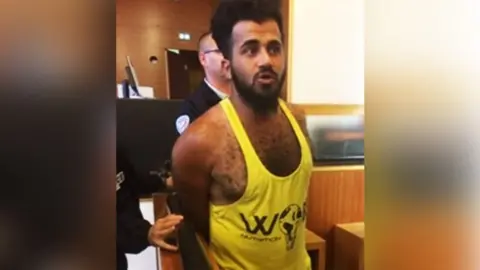
After Jamal told the BBC investigation team he was now based in Leicester, reporters looked at companies in the area that might be linked to him and found the two mini-marts in Blaby.
Reporters witnessed him working, driving a car without a licence and apparently using a false name.
When the team confronted Jamal, he said he had never had any involvement in people smuggling, had not been jailed in France and claimed to have been in the UK since 2009.
But when shown a picture of him in a French courtroom in 2016, he did not deny it was him.
Jamal denied he was working at the mini-mart despite having been seen by reporters behind the till, as well as moving stock in and out of the store.
Listen to BBC Radio Leicester on Sounds and follow BBC Leicester on Facebook, on X, or on Instagram. Send your story ideas to eastmidsnews@bbc.co.uk or via WhatsApp on 0808 100 2210.
