First Ghanaians evacuated from South Africa over immigration protests land in Accra

 BBC
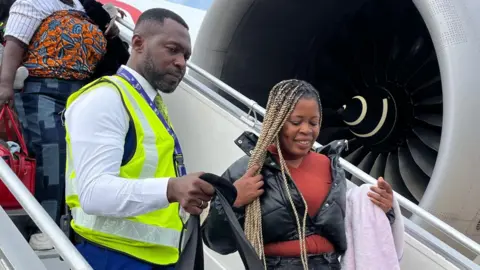
BBCA flight carrying nearly 300 Ghanaians, repatriated from South Africa amid fears there could be a resurgence of xenophobic violence there, has landed in Ghana's capital city, Accra.
Ghana's government chartered a flight from Johannesburg following a wave of protests against illegal immigration in South Africa.
Further departures are expected in the coming days - roughly 800 Ghanaians registered for repatriation.
The country's foreign minister, Samuel Okudzeto Ablakwa, joined other officials at the airport in Accra on Wednesday in order to welcome the first set of arrivals.
A total of 297 Ghanaian citizens arrived on Wednesday, Ghana's High Commissioner in South Africa, Benjamin Quashie told the BBC.
He added that a mother and her two children were not permitted to leave as she did not have the children's birth certificates.
But the Border Management Authority said the the two minors were "understood to belong to [the woman's] sister" and she did not have documents to prove her relationship or consent from "the alleged sister".
Few of the departing passengers wanted to speak to journalists in Johannesburg but Rudolph, who has lived in South Africa for 10 years and runs a salon, told the BBC he was leaving because of the recent protests.
"It's not comfortable for us to stay here anymore, so we have to go. I think we will find peace at home," he said.
There are an estimated 25,000 Ghanaians living in South Africa.
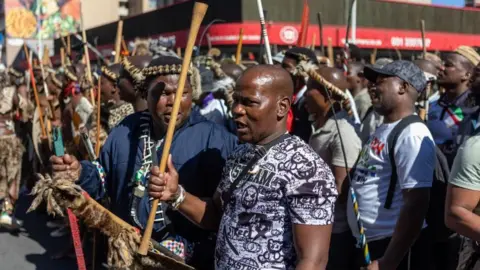
Demonstrators say illegal migrants are putting pressure on public services and have asked the South African government to do more to stop it.
The demonstrations have been organised by a group called March and March, which describes itself as a citizen-led movement for immigration reform.
It has set a 30 June deadline for illegal immigrants to leave the country.
Rudolph worries that deadline could lead to violence.
"The protests started in Durban, and they've escalated to other provinces. So definitely something bad could happen," he said, adding that he would never return to South Africa.
 EPA
EPAQuashie told the BBC his government had a duty to ensure the safety of its citizens.
"The Ghanaian government listened to the plight of its citizens in South Africa, who felt that their lives were in danger, who felt like the economic activity that they were engaging in had come to a standstill, who felt unwelcome in this country," he said.
"It is the responsibility of every government to ensure that its citizens are taken care of both home and abroad."
When asked what they were doing to ensure illegal migrants from Ghana did not come to South Africa, he said they had a reintegration strategy in place for those returning.
"The government is willing to establish them into whatever business they were doing in South Africa. In a way, we're also helping the South African economy, because it's clear that some of them are undocumented," the diplomat said.
"So taking them out of here will let them know that we are not people who condone undocumented people in countries."
The South African authorities said that on inspection of documents most of the returnees "were found to have overstayed with more than 30 days whilst some overstayed by a year or more". Quashie though disputed this saying that 80% of the those who flew back to Ghana had legal status in South Africa.
Some analysts have suggested the resurgence of anti-migrant sentiment in South Africa could be linked to local elections scheduled for November.
In 2019, at least 12 people were killed and in 2008, 62 foreign nationals died in attacks on foreigners across the country.
But the organisers of recent protests have said they have been peaceful.
Earlier this month, the South African government condemned criminal acts directed at foreigners, whilst conceding the country needed to deal with illegal immigration.
In recent days, scores of foreigners have been camping outside South Africa's home affairs department in Durban, saying they fear for their lives.
The group of more than 300 immigrants first sought refuge at the local police station but were moved to another location before ending up outside the office that deals with refugees and asylum seekers.
A Congolese national told local online publication IOL News they were "asking for protection".
"We are being told repeatedly that on 30 June, we will be killed and that no foreigner will remain in South Africa," the woman said.
Additional reporting by Khanyisile Ngcobo in Johannesburg
 Getty Images/BBC
Go to BBCAfrica.com for more news from the African continent.
Follow us on Twitter @BBCAfrica, on Facebook at BBC Africa or on Instagram at bbcafrica
