British expertise helps harness the power of a star

 UKAEA
UKAEAOverwhelming interest in part of the UK's world-leading research into near-unlimited clean energy has led to the creation of the first ever technical support centre.
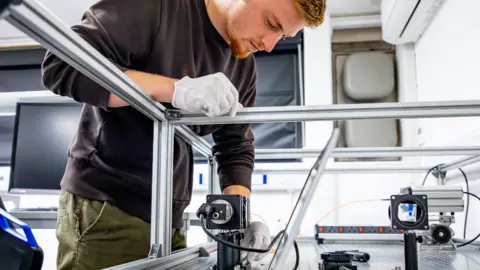
The Diagnostics Innovation Centre of Excellence (DICE) specialises in live analysis of plasma - a hot gas that enables small particles involved in nuclear fusion to join together.
The new facility in Culham, Oxfordshire, which has been at the cutting-edge of global research into fusion - the same energy process that powers stars - for the past six decades.
It has been created in response to the number of external contracts the UK Atomic Energy Agency's (UKAEA) diagnostics team was already earning from firm's across the globe.
The centre's creation was primarily funded by these contracts, which are already valued at more than £10m.
It is the first time a dedicated facility specialising in diagnostic technology has been established anywhere in the world.
 UKAEA
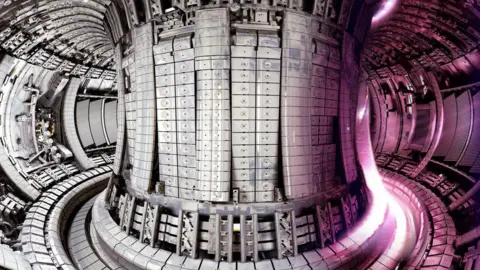
UKAEAScientists say nuclear fusion has the potential of virtually unlimited supplies of low-carbon, low-radiation energy.
It works by heating and forcing tiny particles, in plasma, together to make a heavier one - releasing large amounts of clean energy.
To control the process, scientists need to be able to constantly watch and analyse the temperature, density, shape and stability of the plasma throughout the reaction.
This is where the Culham diagnostic scientists come in.
The team is made up of experts who have decades of experience working in British fusion facilities - including Oxfordshire's JET fusion reactor, which was the world's largest until it was decommissioned in 2024.
David Croft, head of DICE, said the centre's "greatest strength" was "our people".
"With decades of experience spanning diagnostics design, build, installation, analysis and operation, the DICE team provides expertise which is second to none," he added.
The UKAEA currently employs 20 people at the DICE facility, and said it was also being used by "apprentices and PhD students to build essential skills and gain hands-on experience in a laboratory setting".
"We have aspirations for the facility to grow in both capability and capacity to further develop skills and train the next generation," the agency added.
