Unlikely unit will reopen after teenager's death

 Family handout
It is unlikely an adolescent mental health unit will ever reopen following the death of a 17-year-old girl, an inquest has been told.
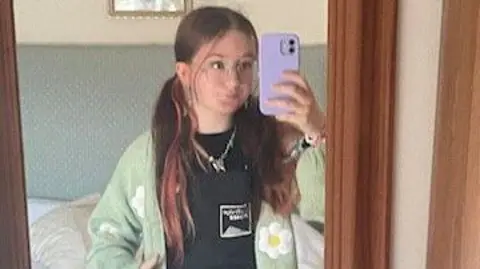
Lucy Curtis died in hospital on 1 January 2024, five days after she was found unresponsive at the Riverside Adolescent Unit at Blackberry Hill Hospital in Bristol.
Dr Michelle Cox, a senior leader at Avon and Wiltshire Mental Health Partnership NHS Trust (AWP), told Lucy's inquest even with significant investment, AWP did not feel confident it would be safe enough to reopen.
"Following Lucy's tragic death we did internal reviews and there were other patient safety incidents and we could not be confident we could continue high-quality and safe care," Dr Cox said.
Dr Cox, a clinical director for Child and Adolescent Mental Health Services (CAMHS) at AWP, said: "We made the difficult decision to close the unit on the grounds of safety and quality."
Asked about plans to provide a replacement adolescent inpatient service in the region, Dr Cox said there was a commitment to establish a new unit but no confirmed timetable.
As a result of the closure, young people requiring an inpatient admission are currently placed elsewhere across the south west.
Dr Cox said children from the Bristol area could now be admitted to units in places such as Dorset, Cornwall or Plymouth, depending on clinical need and bed availability.
The hearing also examined recommendations arising from a Patient Safety Incident Investigation (PSII), which was launched after Lucy's death under the NHS national framework for serious incidents.
Dr Cox said governance arrangements were in place to monitor progress and that findings were reported to the trust board.
One recommendation related to staffing arrangements at Riverside.
Jurors previously heard that on 27 December 2023 three healthcare assistants arrived at the unit to shadow staff, despite frontline workers being unaware they were coming.
Dr Cox said changes had since been implemented.
"These shifts can no longer be booked without prior authorisation from the nurse in charge and they have authority to turn people away on the day they arrive," she said.
She added that nurses leading a shift should be empowered to make operational decisions and said having three shadow staff on a ward at the same time would now be considered highly unusual.
"Looking forward, you would expect no more than one member of shadow staff," she said.
The trust has also introduced changes to clarify staff responsibilities and strengthen induction processes.
 Family handout
Questioned about communication between inpatient units and community CAMHS teams, Dr Cox acknowledged there had been longstanding challenges.
She said work was taking place through regional NHS forums to improve collaboration.
Dr Cox said AWP carried out leadership and team development work after the unit closed, including workshops focused on culture and staff behaviours.
She acknowledged that some concerns only became fully apparent after external reviews had been completed.
"We reflected after the review that our appraisal was not entirely full," she said.
Asked whether staff had felt able to raise concerns, Dr Cox said the trust reviewed records relating to freedom-to-speak-up processes and patient safety reporting.
"The feedback we got did not ring any alarm bells," she said.
"But later, for some staff, they experienced a culture where it was not easy for them to speak up."
Coroner, Dr Peter Harrowing, noted that a number of reviews had taken place since Lucy's death, including an independent review of Riverside commissioned by NHS England's South West Provider Collaborative and a separate investigation by consultant psychiatrist Dr Catherine Lavell, which examined Lucy's care pathway.
The inquest also heard evidence about changes made to CAMHS access arrangements following Dr Lavell's recommendations.
One criticism examined during the hearing concerned the process by which children and families could obtain specialist mental health support.
Dr Cox denied formal referral thresholds had been lowered but said the way referrals are assessed had changed significantly.
Previously, referrals relied heavily on paperwork.
Now, she said, clinicians routinely speak directly to families to gather additional information before deciding what support may be required.
"There is only so much you can write on paper," she said.
"It can be very different if you speak to a parent or young person."
She said audits suggested the revised process was being applied consistently.
The trust has also introduced new arrangements allowing GPs to seek psychiatric advice more easily.
"We have effectively taken away the red tape," Dr Cox told the court.
"Monday to Friday GPs can call seeking medical advice, but it is a way of getting psychiatric advice. That is quite different from the time Lucy was trying to get care."
Dr Cox said communication with schools had also improved and about 72% were now covered by dedicated mental health support teams, with a target of reaching full coverage within three years.
The inquest continues.
Follow BBC Bristol on Facebook, X and Instagram. Send your story ideas to us on email or via WhatsApp on 0800 313 4630.
