The kelp producer who wants to get Americans eating seaweed

 Elizabeth Ellenwood
Suzie Flores left a Manhattan career to farm sugar kelp off the Connecticut coast. Now she's trying to convince the US that the future of sustainable food is growing under the waves.
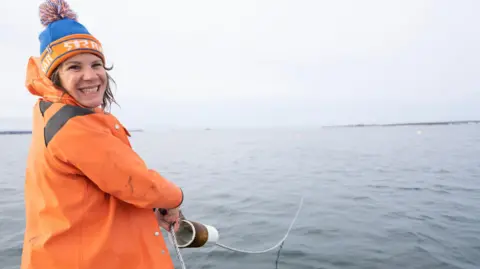
On a February morning, when most of coastal New England is braced against the cold, Suzie Flores is frequently out on the water. The sea has to be calm enough, ice cleared from the boat, GPS buoys still where she left them.
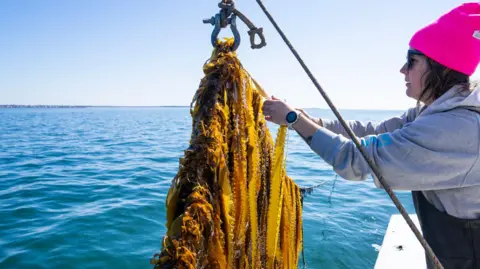
If the conditions line up, she will head out from the marina in Stonington, Connecticut - one of the last remaining commercial fishing ports in the state - to lift a line of sugar kelp, a type of seaweed, from the Atlantic.
In February there is not much to see yet, just thin fronds that will become metre-long blades by spring. She measures, photographs, and sometimes takes water samples for marine scientists. Then she heads back in.
A decade ago, Flores had an English degree, a desk in a Manhattan academic publishing firm, and a commute from Jersey City. Today she runs Stonington Kelp Company from a marina she and her husband bought and now live on, harvesting a crop unfamiliar enough in the US that she has spent years persuading people to eat it.
Her husband Jay, a former combat photographer in Iraq and Afghanistan, came home, in her words, unsettled, and he retrained as an engineer. Around the same time, Flores had three children in quick succession and began questioning the life she was building.
What, she wondered, would she want them to say about her at her funeral? The answer was not market research for higher education software.
The family moved north, found a run-down marina on the Connecticut–Rhode Island border, and bought it. Flores went back to school to study environmental science, and emailed Charlie Yarish, a University of Connecticut biologist credited with pioneering seaweed farming in the US.
He replied the same day and pointed her to GreenWave, a non-profit helping new farmers navigate permits.
"I have like my newborn baby strapped to my chest when we're having these phone calls," she says, "trying to figure out if all of this could work."
She felt the stars were aligning "1000%". There was one problem - the market didn't materialise.
 Elizabeth Ellenwood
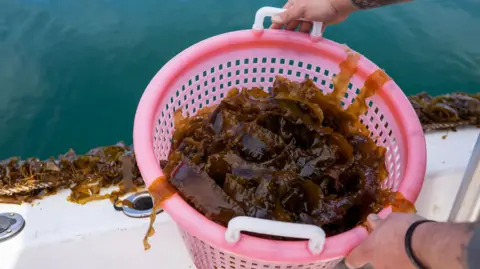
When Flores harvested her first crop, she had thousands of pounds of seaweed and nowhere to sell it.
"Had Jay and I known about that element of work," she says, "I don't know if we would have gone into it."
So she created a demand herself. She cold-called farm-to-table restaurants, talking chefs through sugar kelp's mild, briny flavour. People assume it's rubbery, but that's Pacific kelp - Japanese kombu. East Coast sugar kelp is very delicate.
That pitch has worked. Her farm now sells out every season, supplying high-end kitchens where chefs prize both its versatility and its sense of place
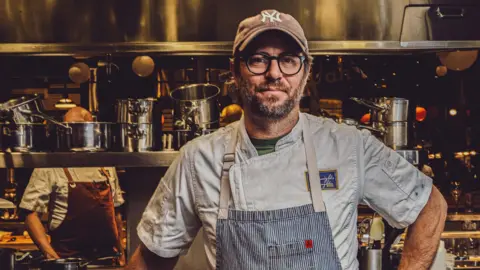
David Standridge, chef at The Shipwright's Daughter in Mystic, Connecticut – a 2026 James Beard finalist for Outstanding Chef of the Year – is one of them.
For him, the appeal is partly seasonal - in New England, it is the first fresh "vegetable" of the year, arriving weeks before anything grows on land, giving him something green and local to put on the plate when almost nothing else is growing.
"It's just crunchy and light and salty and briny," says Standridge. "It doesn't carry a lot of difficult flavours to pair. It kind of goes with a lot of things."
What draws him most is subtler than that. Kelp, he says, carries the character of the water it grew in - the same quality that wine people call terroir and oyster people call merroir.
"There's a lot of dishes where you might not taste the kelp," he says, "but it'll just taste more like the ocean."
 The Shipwright's Daughter
Still, Flores' experience reflects a broader constraint. The US imports more than 90% of its seaweed, mostly from Asia, where cultivation has centuries of history. North America produces only a small fraction of global supply, and while the number of farms has grown steadily, infrastructure has not kept pace.
The challenge is no longer simply growing kelp, but processing it, distributing it, and building enough demand to sustain farmers at scale.
On the water, the risks are more immediate. This winter brought repeated storms with 70mph winds and deep freezes that locked surface gear in ice, while currents below kept moving, tearing lines apart. Flores estimates she lost 40–50% of her crop - on top of the roughly 30% loss farmers are now advised to expect.
She sold out anyway, because there was less to sell. Next year, she says, she will plan for winters like this.
The environmental case for kelp is part of what sustains her. As it grows, sugar kelp absorbs nitrogen pollution, improving water quality and providing habitat for marine life. Blue mussels have begun colonising her lines, and fish cluster beneath them, drawing seabirds overhead.
For Flores, the work is also about what happens on shore.
Stonington's fleet is ageing, and the lobster industry that once defined this coastline has largely collapsed. "That fishery never came back," she says.
Her vision is not a single large company, but a network of small family farms - something closer to the quiet expansion of oyster aquaculture along the New England coast. Kelp can be grown in the off-season by fishermen who already have boats and gear, with relatively low upfront costs.
"It hasn't grown at a massively rapid rate," she says of her own business. "But it's always growth. We're always going in the right direction."
 Elizabeth Ellenwood
She also spends time as a guest speaker at Yale University and in local schools, where she runs seaweed units in culinary programmes. The youngest students are the most sceptical, she says, until kelp is folded into something familiar like macaroni and cheese. Then they tend to love it.
Her three children take this life largely for granted - going to lunch by boat, the farm as background. What she wants for them is not necessarily the business, but options - the ability to choose work that feels meaningful.
"There is nothing worse," she says, "than not listening to yourself about what brings you joy."
She learned that in a Manhattan office. She would rather they didn't have to.
"Kelp is the lobster roll of the future," she says, then stops. "The lobster roll is gone. In large part because of us."
Out on the Long Island Sound, the water is still there. Flores hopes seaweed can help build a more sustainable future from it, for the ocean and the towns along its edge.
