Labour has 'no coherent plan' for country, says Blair
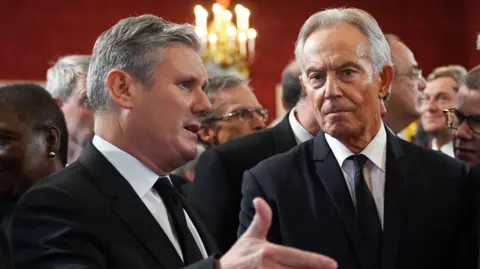
Sir Tony Blair has accused Sir Keir Starmer's government of having no "coherent plan" for the country and introducing policies that have held back business.
In a highly critical essay, the former Labour prime minister singled out measures including new workers' rights laws, the phasing out of the British oil and gas industry and the above-inflation uplift to the minimum wage.
However, he warned that whether there was a change of leader was "irrelevant if it doesn't start with a policy debate".
In a response, Pensions Minister Torsten Bell said: "Awkwardly for an essay that argues that policy not politics must come first, is that this is an essay that puts politics not serious policy first."
The essay of more than 5,600 words is Sir Tony's first in-depth critique of Sir Keir's government.
He served as prime minister from 1997 to 2007, winning three general elections in a row during that period.
His essay comes as the prime minister is under severe pressure, following a disastrous set of election results earlier this month and five ministerial resignations, with a leadership challenge widely expected.
In an interview with BBC Radio 4's Today programme, Sir Tony said he did not think Labour won the last general election "because people read the manifesto and said, this is what we want".
He suggested Labour should have dropped some of its manifesto commitments when it came into office and prioritised economic growth instead.
"If we carry on like this with these large increases in incapacity benefit, with the triple lock on pensions, we're going to create a situation where economically we're not able to grow," Sir Tony said.
In his essay, Sir Tony said the government's "principal problem" was not "Keir's personality" or "a failure to communicate 'our achievements'", which have often been pointed to as weaknesses of the PM.
He wrote: "It is because we don't have a worked-out coherent plan for the country in a fast-changing world and are in the wrong political position from which we can devise one and win a second term".
However, he added: "Trying to force the prime minister out before we know what policy direction we're bringing in, is not a serious way of conducting ourselves."
While Sir Tony said he agreed with some of the government's policies, including investment in infrastructure, reform of the planning system and reducing trade friction with Europe, the former PM said other commitments were "unwise to proceed with" given the current economic circumstances.
He pointed to new workers' rights laws, which have faced criticism from some business groups who argue they will discourage companies from hiring and hit economic growth.
Sir Tony also criticised the decision to increase National Insurance for employers, which he said had undermined business confidence.

 PA Media
"Then, in the last Budget, it appeared as if we were increasing tax to pay for additional welfare spending, when the public already thinks welfare bills are too high," he said.
"Taken together, these measures have given headwinds not tailwinds to British business despite the macroeconomic gains for which the chancellor is rightly praised."
He called on the government to try and limit the effect of these changes and remove parts of the net-zero agenda "which prioritise clean energy over cheaper energy".
On the UK's relationship with the European Union, Sir Tony said "Britain has lost from Brexit" and "at some point it is ripe to enter a debate about 'going back'."
Wes Streeting, who resigned as health secretary earlier this month in protest at Sir Keir's leadership and has confirmed he would stand in any contest, recently argued that the UK should rejoin the EU one day.
However, Sir Tony said: "Just as Brexit was never the answer to Britain's challenges back in 2016, reversing it isn't the answer to the country's far worse situation in 2026."
He added: "If we want to go back into some sort of structured relationship with Europe, we can only do so from a position of economic strength."
He also appeared to take a swipe at Andy Burnham, the Greater Manchester mayor who is seeking a return to Westminster as Labour's candidate in the Makerfield by-election.
Burnham has repeatedly said Britain had been "on the wrong path for 40 years".
In his essay, Sir Tony scoffed at those who voiced "a rehash of the far-left critique about nothing good coming out of the last '40 years' of 'neo-liberalism', which presumably includes the last Labour government".
He added: "It is one thing when in opposition to indulge this perennial delusion that when we lose seats to the right the country is really signalling it wants Labour to move left; it is dangerous to do it in government."
Setting out his own vision for change, Sir Tony said Labour must become the "Radical Centre", putting "policy first and politics last".
He said this could include removing obstacles to business growth, welfare reform, action to tackle illegal immigration and a harnessing of artificial intelligence.
In his BBC interview, Sir Tony was asked about the sources of funding for his think tank, the Tony Blair Institute, and the influence of donors, including Larry Ellison, the founder of software company Oracle.
Sir Tony said he was happy to work with Ellison because "we share the same view about this technology revolution".
He said working and accepting money from such people was "honestly to do with looking at the world and asking what the right answer is".
In a detailed rebuttal of Sir Tony's essay, Bell, the former head of the Resolution Foundation think tank, who is now the pensions minister, said it was an "impressive attempt to engage with some of the big forces shaping our future".
But, he argued, "it doesn't have a project that remotely fits the time and place we are living in".
"Saying 'AI' is not the same as having a plan for Britain," he added.
Chris Curtis, Labour MP for Milton Keynes North, told BBC Radio 4's The World Tonight that he found Sir Tony's essay "quite refreshing to read" as it sought to "actually start to grapple with the very big issues that we're facing".
But Labour MP Rachael Maskell said she did not believe Sir Tony's analysis was correct, telling the same programme: "Tony Blair won an election nearly three decades ago and it seems he's continuing the argument from back then rather than looking at the situation today."
The York Central MP also described the timing of the intervention as "incredibly unhelpful" due to three parliamentary by-elections next month.
This includes the contest in Makerfield, which will be crucial for the future direction of the Labour Party.
Labour is facing a challenge from Reform UK, which performed strongly in the area in May's council elections.
Burnham is expected to challenge Sir Keir for the Labour leadership if he wins.

Sign up for our Politics Essential newsletter to keep up with the inner workings of Westminster and beyond.
