Mayor 'emotional' as role cut under council shake-up

 BBC
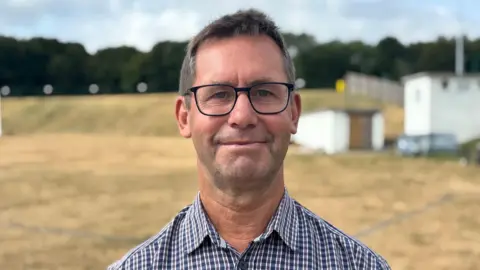
BBCMansfield is unique among local councils in Nottinghamshire by having a directly elected mayor.
As part of government plans to reorganise councils, however, the role is set to be scrapped.
It means the incumbent executive mayor, Labour's Andy Abrahams, will be the town's last.
"It's quite emotional when I think about it," he said. "Knowing that you've played your part through that closeness with the community and policies you've set up, it really hurts to know I'm no longer going to be in the position to do that."
Abrahams said he was broadly supportive of local government reorganisation (LGR), and the need to reform services outweighs any "personal considerations."
"I'm always pragmatic and I'll always look for the logic and reasoning and try and be totally impartial," he said.
He had supported "Option 1E" - a north-south split along existing council boundaries - rather than the city expansion model which the government eventually chose.
He said, however, he would "take the positives" and "make it work for our residents."
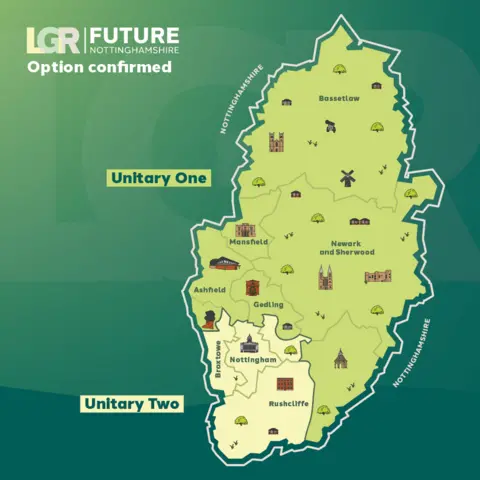
The district council is one of only 13 local authorities in England to operate under the executive mayor model.
Most others use either a "leader and cabinet" or "committee" system.
The new local authorities created as a result of LGR will be formally established in 2028 but will not be permitted to have directly-elected mayors.
The regional mayor for the East Midlands will remain in place, with the next election scheduled for 2028.
The role in Mansfield was established after a local referendum in 2002 following a campaign by local businessman and former Mansfield Independent Forum councillor, Stewart Rickersey.
Rickersey said he was disappointed to see the role scrapped and while he does not disagree with LGR in general, it would have been better to hold another referendum on the plans.
"If there were a referendum, then that's the opportunity for people to speak and to vote, so there are some weaknesses in the local democratic process," he said.
"Those involved will be able to prove there was consultation. The reality is when you get down to the meat and potatoes of it, very few people will have voiced an opinion."
He acknowledged, however, that a county-wide referendum would be costly.
The government has consistently opposed referendums as part of the LGR process.
Abrahams agreed it may have been "fairer" to hold one "if the time could have allowed it".
He added he intends to stand in the shadow elections for the new unitary council, scheduled for next May, and would like to be the authority's leader.
"We've done so many things for the community, so I want to see this project through," he said.
Listen to BBC Radio Nottingham on Sounds and follow BBC Nottingham on Facebook, on X, or on Instagram. Send your story ideas to eastmidsnews@bbc.co.uk or via WhatsApp on 0808 100 2210.
