Rail commuters face tough winter, MPs warn

 Weather Watchers/AstroPostie
The south-west of England is bracing itself for a winter of possible disruption on the railways, MPs have warned.
The vulnerability of the coastal line between Exeter and Plymouth, ongoing delays on the line between Exeter and Waterloo and disruption due to be caused by work on the HS2 super station at Old Oak Common are all causing concern.
There are also calls for money to be spent on the wi-fi service to allow travellers to work on the trains.
The government said more than £165m had been spent on protecting the coastal line and investigatory work was being carried out on the final phase which has not been funded.
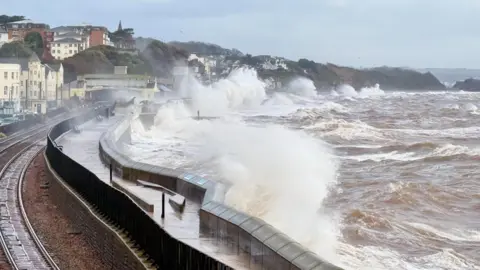
Speaking in a parliamentary debate on train services and extreme weather, Jayne Kirkham, Labour MP for Truro and Falmouth, said: "The line through Devon and into Cornwall sits right on the sea wall at Dawlish and Teignmouth - it is exposed and exceptionally vulnerable to heavy seas.
"When bad weather hits, this section frequently breaks down, leaving us one million people effectively cut off from the rest of the country."
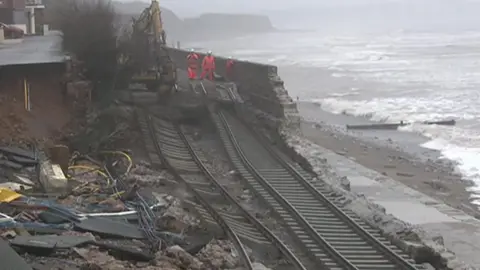
The first four phases of work to protect the line, including rebuilding the sea wall, have been completed, but the fifth phase has stalled.
Kirkham said: "Testing is occurring, but funds are simply not there. There is a very real risk that a cliff could fall on a train."
The government said more than £165m had been spent on measures including a new sea wall and work to stabilise the cliffs but the fifth and final phase of the work to protect the line between Parson's Tunnel and Teignmouth has not been funded, with investigative work ongoing.
Simon Lightwood, Parliamentary Under Secretary of State for Transport, said: "All endeavours are being made and a great deal of funding has gone in to make that track as resilient as possible."

Richard Foord, the Liberal Democrat MP for Honiton and Sidmouth, said it was unacceptable train travellers were facing an ongoing reduced South Western Railway service between Exeter and Waterloo.
Trains have been running every two hours rather than hourly with problems stretching back intermittently to August 2025.
In the debate on 3 November, Foord said the delays were affecting "students, workers and the vulnerable".
"People I represent are right to ask why a line of such importance for the network as a whole remains so vulnerable," he said.
"This is no longer a temporary measure - it is the second year in a row that a schedule has been introduced for months at a time meaning that trains are only running once every two hours."
A spokesman for South Western Railway said the line between Exeter and Salisbury was "still recovering from the driest conditions ever recorded on the southern region of Britain's railways".
He said: "We are making every effort to improve track conditions, so that we can remove the speed restrictions and return to the normal timetable as soon as it is safe to do so."
Caroline Voaden, the Liberal Democrat MP for South Devon, said passengers were going to be affected "for two years or possibly more by the works at Old Oak Common" on the HS2 super station.
"For the tiny sum of £12m, which is just over half of what is being spent every day on HS2, high speed wi-fi could be put on every one of the 94 trains on the Great Western Railway network," she said.
A trial of new technology for wi-fi took place on one train in 2025.
Speaking to the BBC, Rebecca Smith, Conservative MP for South West Devon, said: "Ultimately you're going to end up with one train shuttling around the entire South West that's wi-fi enabled - what about the rest?"

The unreliability of train services poses a problem for businesses, according to the chief executive of Devon Chamber of Commerce, Helen Wylde-Archibald.
"You'll have pretty important meetings where you've designed a day of three or four things to make sure you can actually get out and do those things on that day and come back," she said.
"When you miss them you have a hit on productivity, you have a hit on cost, and you have to replan which can take some time."
A Great Western Railway spokesman said the feedback from customers following the trial was "extremely encouraging".
The spokesman said: "We are now reviewing the results of the trial and hope to discuss options for the fitment of GWR trains over the next few months, taking advantage of potential funding opportunities."
The train company will go into public ownership from December.
Follow BBC Devon on X, Facebook and Instagram. Send your story ideas to spotlight@bbc.co.uk.
