Inside football founder's seaside house

 BBC
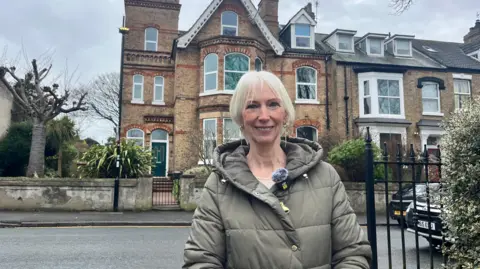
BBCFrom the founding father of the FA to a fascinating role in World War Two, a "unique" house on the East Yorkshire coast boasts a history few others can match.
But the story of Southfield House also reflects the rise of a seaside town, from quiet 19th Century backwater to thriving 20th Century resort.
Author Sue Fraser, otherwise known as S.F. Taylor, has restored the house, in Hornsea, to its former glory and uncovered some fascinating tales along the way.
"This house is recognised by everyone in Hornsea," she tells the Hidden East Yorkshire podcast. "The house with the tower.
"It was a high school for girls. It was a convalescent home for soldiers during the Second World War. It's got an air raid shelter. I found out it had a Bren gun up the tower."
From the very beginning, the house was associated with colourful characters, none more so than the "King of Hornsea".
"Joseph Armitage Wade was very, very influential," Sue explains.
"He was a shrewd businessman. He was a property developer. He bought and sold land. He was very instrumental in the railway coming to Hornsea.
"He could see that this area was ripe for development. The seaside was up and coming.
"It was a place to come to improve your health, because at that time, you know, people were dying of cholera, tuberculosis."
Charlotte Bronte was among those who stayed in Hornsea, spending a holiday with her former teacher, in 1853.
"Rich people used to come originally, and they would take a place for up to six weeks in the summer and bring their families and servants," Sue says.
When the railway opened in 1864, it opened up the resort to many more people.
"It meant that people from very poor backgrounds could maybe come for a day trip."
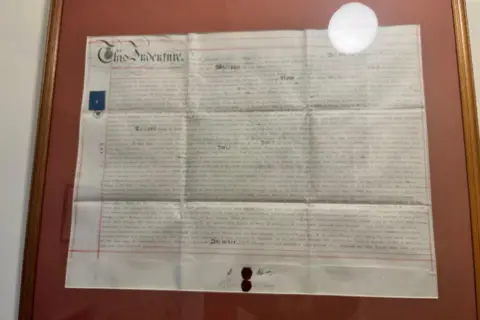
Sue has traced the history of the house from 1875 to the present day.
In 1876, Wade sold the property to Ebenezer Cobb Morley, a solicitor and founder of the FA, who wrote the association's first rules of the game.
"His first notes on the FA rules and his suggestions sold for almost £900,000 pounds," says Sue.
"It's the most valuable piece of sport memorabilia there is. Nowadays, I think it's worth somewhere in the region of £2.6 million."
Although Morley was a Hull man, he eventually moved to London and gave the house to his sister, Hannah Boden. It remained in the family until 1925.
"She didn't have any children and Morley didn't have any children, so they just disappeared from the line.
"But it was while Hannah owned the house, that's when it became a school, taken on by Miss Mary Skinner."
Despite the Education Act of 1870, which laid the foundations for the modern schooling system, Girls typically had fewer educational opportunities than boys and were often limited to learning domestic skills.
"I think Mary Skinner, she was quite advanced for her time," Sue explains.
"If a girl wanted to get a career, she would either take in sewing, she would become a companion, or she would teach.
"But as time went on, Mary Skinner expanded her curriculum. She was introducing a lot more subjects. So I like to think she was up there for her time."
During World War Two, Hornsea was an important location for the Free French army, acting as a garrison and training ground before the soldiers were deployed to Normandy for the D-Day landings in 1944.
Southfield House was taken over by officers, Sue says.
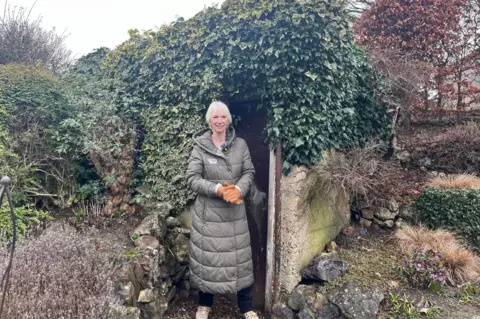
"There was a Bren gun put on the tower, facing the sea, they built an air raid shelter in the garden, which is still there.
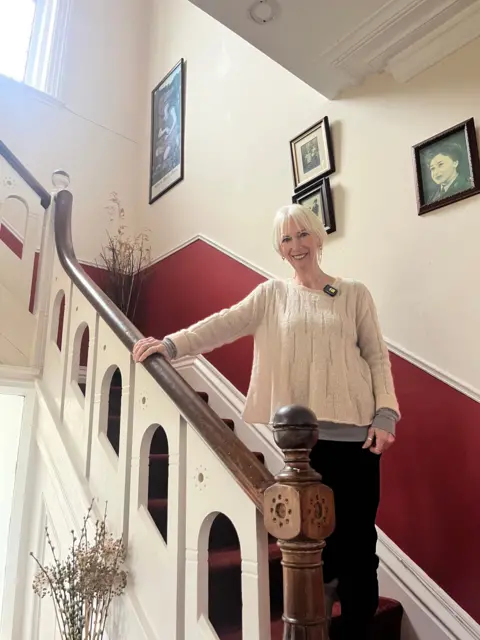
"And on the door of the snug, which is the room we're sitting in now, I could just see the name "Waiting Room".
"I think it was probably from the time when they were using this house as a convalescent home for the soldiers."
Another door, to the air raid shelter, has what look like bullet holes in it.
"There were bullets in it when we first moved in, but they've disappeared over the years. Probably children, friends, I don't know, souvenirs."
In 1940, the east coast was primed for a potential German invasion. Roads in the town were narrowed with concrete blocks and guarded by pillboxes.
In that same year, a German airman parachuted from an enemy aircraft near the town. He was disarmed and taken into custody by a local woman who was later given the British Empire Medal.
Fortunately, an invasion never came and the Bren gun was eventually removed.
After the war, the house, like many other large properties that were now expensive to run, was converted into flats.
"When we first moved here, it was four flats," Sue recalls. "We were shown round and it was horrendous.
"But I could see what it had been.
"I thought, yeah, I'm sure I can do something with that."
For the past 30 years, she has been restoring the house to its Victorian splendour.
"I've done as much as I can. There's probably a lot more that can be done.
"But restoring a place like this, you can only go so far. Money will only stretch so far.
"But it's become a home, a real home."
Listen to highlights fromHull and East Yorkshire on BBC Sounds, watch the latest episode of Look North.
Download the BBC News app from the App Storefor iPhone and iPad orGoogle Play for Android devices
