'We don't look at the sky any more': The Air India crash victims who were not on the plane

 Zoya Mateen
Warning: The story contains details some readers might find distressing
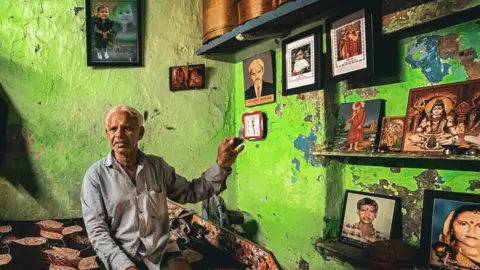
The photographs are the first thing Prahlod Thakur sees when he wakes up.
They hang on the bright green peeling walls of his small Ahmedabad home, among religious icons, brass vessels and fading family portraits. One frame holds the face of his wife, Sarlaben. Another shows his granddaughter, Aadhya, wearing a white dress and smiling.
Both of them were in the BJ Medical College hostel complex, less than 2km (1.2 miles) from the Ahmedabad airport, when an Air India plane crashed into it in June last year. There were 260 victims - 241 were on the plane. Sarlaben and Aadhya were among the 19 killed on the ground.
A year later, the loss still feels fresh.
"I just miss them," says Thakur. "I see the photos and feel like crying."
Investigators are soon expected to release a report on the crash. Much of the attention over the past year has focused on the passengers aboard the London-bound flight and the unanswered questions surrounding its final moments.
In Ahmedabad, another question lingers: what happens to a place after a catastrophe becomes part of its daily life?
Unlike most disaster sites, where the scars eventually disappear, at BJ Medical College grief has become a permanent resident.
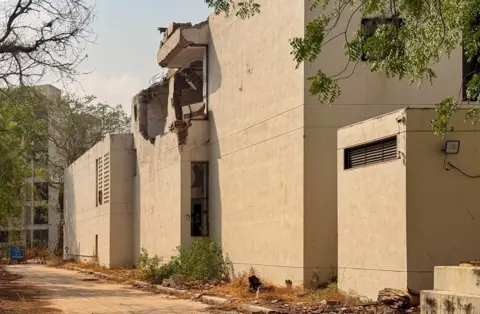
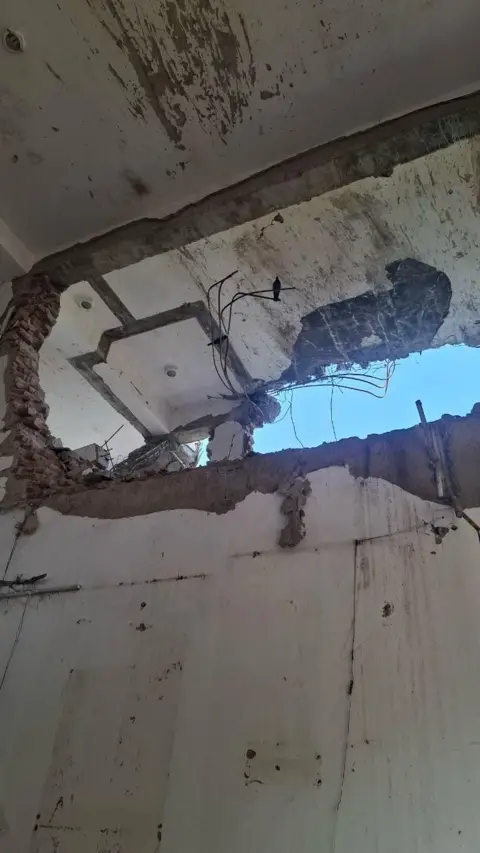
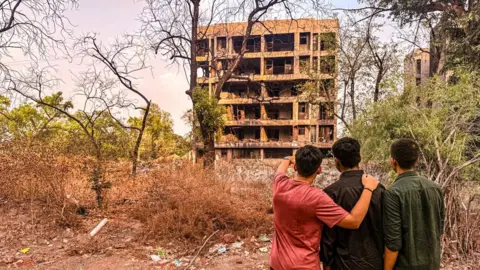
A year on, the hostel struck by the plane still stands like an open wound. Its upper floors stand ripped open to the sky, concrete hangs in jagged slabs and a smoke-blackened staircase disappears into darkness. Soot streaks the walls, while suitcases and clothes remain buried beneath dust, rubble and twisted steel.
Officials have approved plans to demolish the damaged complex and build a new hostel. For now, though, the wreckage remains.
Students pass the hostel on their way to lectures as aeroplanes rumble overhead every few minutes. For decades, the sound blended into the city's background noise, as familiar and unremarkable as the traffic on the roads.
Since the crash, Thakur says, it carries a very different meaning.
"Whenever a plane passes by, we feel the same pain," he says. "We don't even look at the sky."
 Zoya Mateen
 Aditya Dayal
For 15 years, the family ran a tiffin service for doctors at the adjoining hospitals, cooking and delivering meals across the medical campus. Their two-year-old granddaughter spent much of her time there, rarely leaving her grandmother's side.
Lunch was being served at the mess when the plane crashed. Sarlaben was working there and, when Aadhya needed the washroom, she took her upstairs. Moments later, the aircraft came crashing in.
Thakur, who was working in another building, dropped everything and ran towards the smoke. He only remembers fragments now: the explosion, heat, gas cylinders strewn across the kitchen and his desperate search from room to room, calling his wife's name: "Sarla, Sarla."
Around him, survivors staggered out from the wreckage while others remained trapped inside as rescue teams battled through smoke and debris. For nearly a week, the family searched hospitals, wards and relief camps across Ahmedabad, chasing rumours and repeatedly asking the same questions. Six days later, they found Sarlaben and Aadhya in a hospital mortuary.
Today, when Thakur thinks of Aadhya, he remembers the biscuits he brought home and the way she ran into his arms. When he speaks of Sarlaben, he remembers a woman who spent much of her life feeding others.
"Everyone got along with her," he says. "She was a very good woman."
At almost the same moment that Thakur was running towards the smoke, students inside the mess were trying to understand what had happened.
Arman Khan Pathan was late for lunch. His best friend, Aditya Dayal, was later still.
Those few minutes would separate their experiences of the crash, but not their memories of it.
Pathan had just sat down to eat when a deafening sound erupted. Moments later, part of the building had collapsed around him, and a table pinned his legs down. As cylinders exploded and dust filled the room, rescuers were forced back by fresh blasts. Trapped and struggling to breathe, Pathan smashed a window with his bare fist.
"It was pitch black," he recalls. "I was suffocating."
By the time rescue workers pulled him free, Dayal had reached the scene.
He remembers smoke rising above the building where he and his friends had eaten almost every day. Students ran in every direction, trying to understand what had happened.
Together with others, Dayal helped carry Pathan out on a mattress and into an ambulance.
A year later, sitting in their hostel room, the two friends still recall the bodies that arrived that afternoon. As trainee doctors, they were no strangers to death, but nothing had prepared them for this.
Many victims were so badly charred they were unrecognisable. The smell, Dayal says, lingered long after he left - and still returns unexpectedly.
"It made me want to throw up," he recalls.
 Zoya Mateen
The conversation drifts to the friends they lost. Pathan mentions a classmate who was the only brother to several sisters, the child on whom a family had pinned its hopes. Like so many others, he had spent years working towards a future that vanished in a matter of seconds.
For some, the crash lingers in a different way.
Brijesh, who was riding a scooter to the mess with two friends when the plane came down, still undergoes physiotherapy for burn injuries. He wears pressure garments through Ahmedabad's heat and struggles to turn the pages of textbooks. "It happened," he says. "What can be done?"
He passes the ruins sometimes. Like many students, he has developed a habit of looking away, as if the building might disappear if he refuses to acknowledge it.
The people who live around the college have less choice.
On the afternoon of the crash, Vijay was at home, about 200m away, when he heard an explosion. He jumped on his bike and headed towards the source. By the time he arrived, the aircraft had disintegrated and fire was racing through the buildings.
For several hours, the neighbourhood became a rescue zone as residents joined firefighters, soldiers and emergency workers, carrying blankets and water, covering bodies and helping survivors.
The images still haunt him.
"Wherever I look, there is fire," Vijay says. "Someone's head, someone's hands."
 Zoya Mateen
In the weeks that followed, the city's attention slowly moved on. The ambulances left. The television crews did too. The urgency that had consumed the campus gave way to the harder job of the aftermath.
At BJ Medical College, life had to resume.
And much of the burden fell on Meenakshi Parikh, the dean, who had to keep the medical college functioning even as it grappled with overwhelming grief.
Looking back, she remembers not one tragedy but many folded into one: parents searching for children, students healing from injuries, her overworked staff and families awaiting DNA results.
"One part of me was occupied with what needed to be done," she says. "Another was trying to understand what had happened."
One conversation has remained with her.
A man who lost his son, daughter-in-law and granddaughter refused to leave until he saw their bodies. Officials explained that DNA testing was needed to confirm their identities.
"My eyes are the DNA test," he told them, insisting he would recognise his family no matter what condition they were in.
Parikh pauses when she recalls it. "I could see where he was coming from."
Over time, the rhythms of college life returned. Classes resumed, exams were held and new students arrived.
As the anniversary, 12 June, approaches, the college has planned a prayer meeting, a blood donation drive and the planting of trees in memory of those who died.
Yet moving forward, Parikh says, is not the same as moving on.
"There wasn't one moment when I felt I had processed it," she says. "It was a gradual process of settling back into life."
Back at his house, Thakur is trying to do the same.
He reaches for his phone. There is a video he often watches, recorded the day before the crash.
In it, Aadhya carefully feeds her grandmother a morsel of food. Sarlaben smiles.
Outside, another aircraft crosses the Ahmedabad sky.
Thakur does not look up.
