Roads chief sorry for congestion charge data errors

 BBC
BBCThe man in charge of Oxford's roads has apologised for incorrect data being used to report on the city's temporary congestion charge.
Cllr Andrew Gant, Oxfordshire County Council's transport chief, said the authority had been "let down" by a company contracted to compile the figures on how the charge had impacted small businesses, including footfall and monthly spend.
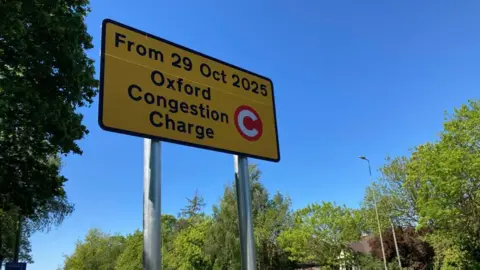
Oxford's temporary congestion charge was introduced in October. It involves motorists paying a £5 fee to travel through one of six points in the city centre.
Bernadette Evans, spokesperson for Oxford Business Action Group, said shop owners felt "fobbed off" by the council.
Gant also apologised for delays to a promised survey, designed to better understand how the policy has affected businesses.
Before it began, the local authority said it would release monthly data about the programme, including traffic movements, how much money was being collected and specific information on business.
The council has now confirmed that the footfall and spend figures were inaccurate, citing failures by a company contracted to supply the data.
Taking responsibility for the errors, Gant said: "All of this data is commissioned from external suppliers and in this case they let us down.
"That's bad. I do accept that. We intended to have that data and it turned out to be unreliable.
"But we are trying to be responsible about making sure we get it and when we do get it and we do use it, that it is accurate."
The highways chief confirmed the council was now "committed to establishing a reliable source of footfall and spend data," as well as publishing a survey of business owners by the end of May.
Evans said the council was doing "really well" out of the congestion charge, but it was "at the expense of a lot of small business owners".
Highlighting shops away from the city centre, including those on the Cowely Road, St Clement's and Temple Cowley, Evans said footfall data was down and that the congestion charge was impacting hundreds of businesses "never mentioned by the council".
Describing the congestion charge as "reckless" during a cost of living crisis, Evans added there was a "huge divide between the councillors and council officers behind their desks at county hall and Oxford's small business owners".
"They just don't understand how tough it is," she said.
