Political donors could face tougher residency rules

 EPA/Shutterstock
The government is planning to tighten residency rules for political donors to ensure that those giving significant amounts of money reside in the UK.
The announcement follows a row over two donations totalling £72m to Reform UK from two British crypto-billionaires who have both recently lived abroad.
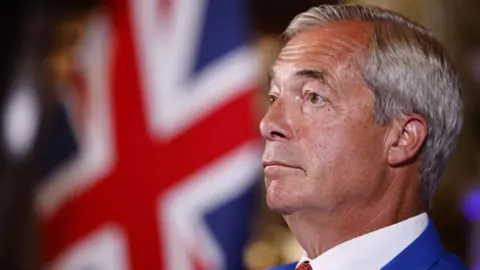
Reform leader Nigel Farage said the donations from Ben Delo and Christopher Harborne are "100% compliant with the law today" but he was unable to say they would be permissible under proposed rule changes.
The government wants to change the law on donations to UK political parties from British voters living overseas, including a £100,000 cap backdated to 25 March.
It also wants to introduce a minimum residency period of at least 12 months in which the cap would still apply for those who move back to the UK.
It is not currently clear exactly when Delo and Harborne returned to the UK.
Under the current rules, foreign donations are illegal in the UK, but British voters living abroad can give as much as they want to political parties.
MPs have supported the government's proposals by approving amendments to the Representation of the People Bill. The bill is currently being scrutinised in the House of Lords.
Speaking as the bill was debated by peers, Communities Minister Baroness Taylor of Stevenage said: "We are considering how we will strengthen the residency requirements, including ensuring that the length of time spent in the UK aligns with broader government policy."
Baroness Taylor said this was "in addition to introducing a robust regime that ensures that donors contributing above the £100,000 annual cap must demonstrate a genuine and ongoing connection" to the UK.
Tax is one area that already has residency requirements. The criteria includes someone being declared resident for tax purposes if they have lived in the UK for at least 183 days in the tax year.
Challenged on whether the government was targeting Reform donors, Business Secretary Jonathan Reynolds said policy on donations is "never about one political party or one particular set of issues".
He told BBC Radio 4's Today programme: "Fundamentally we need to make sure that people who want to influence British politics, who want a say in British politics have a stake in Britain.
"That should apply to everyone and will apply to everyone, so I wouldn't make it about any particular donations or anything that's been in the public domain."
Liberal Democrat Cabinet Office spokeswoman Lisa Smart accused the government of "playing whack-a-mole", as she said Labour's residency requirements "aren't good enough".
She said: "We must urgently go further and introduce a universal donation cap to stop Trump's America becoming Farage's Britain."
On Monday, Farage criticised the government's attempts to retrospectively declare some donations illegal.
He told the BBC: "If the government was allowed to do this, you know what would happen? There would be a response the other way.
"We or the Conservatives would say 'if you're going to stop legitimate donors like this, we would say to the trade unions, you can't give money'."
Farage argued such a move would "collapse" the system of political funding and lead to taxpayers having to fund political parties, a system he said would be opposed by the British public.
Since 2020, Labour has received almost £43m from trade unions, who raise their money through individual workers' membership fees.

Union leaders agreed a statement on political donations on Tuesday, following discussions at the Trades Union Congress in Brighton.
It called on the government to "protect our democracy from being captured by the super-rich" and pledged to work with policymakers to "clean up our politics".
They also argued that trade union funding is the "cleanest money in politics" which is "heavily regulated".
But there was no explicit call for a cap on individual donations in the UK.
There are currently no restrictions on the amount of money UK-based donors can give to political parties.
The government has previously said it was "determined to tackle" the issue of "mega-donors", and has established a new taskforce to do this.
Unite - the country's second biggest union - has called for a cap of between £500,000 and £1m on individual donations but this would not apply to trade union donations.
Other smaller unions favour a cap across the board but some bigger unions are wary in case this would threaten donations to Labour.
Before the joint statement was issued, Unite general secretary Sharon Graham told the BBC that "we're talking about apples and pears" when asked about the donations to Reform and those from trade unions.
She told Today: "Individual donations from very, very wealthy people, from billionaires, the Americanisation of our democracy is very, very different from everyday people, workers putting 10p-a-week into a political fund that fights on a whole range of things."
Graham added: "If there's an ick feeling, a yucky feeling about something then it's probably wrong.
"I think most people will think two crypto billionaires giving £72m to Reform in two days is a problem for British politics and if it's wrong then deal with it."
Delo and Harborne each gave £36m to Reform in two days and now share the record for the largest ever donation given to a UK political party.
Both men had already donated millions of pounds to Reform ahead of the announcement of their latest contributions.

Sign up for our Politics Essential newsletter to keep up with the inner workings of Westminster and beyond.
