Oxfam in 'race against time' after Venezuela earthquake

 EPA
EPAIt is now "a race against time" to get the required help to Venezuela after the South American country was hit by two "immense" earthquakes last week, Oxfam has said.
Two strong earthquakes struck Venezuela within seconds of one another on Wednesday, causing untold damage in several parts of the country.
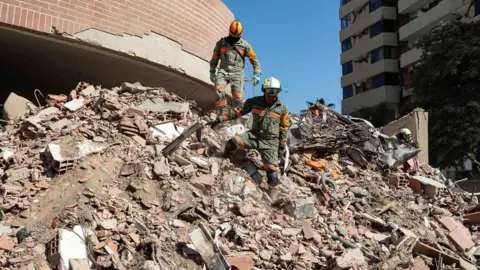
At least 1,700 people are so far known to have died in the 7.2 and 7.5-magnitude quakes, which caused hundreds of buildings to collapse and leaving many trapped in the rubble.
Magnus Corfixen, the humanitarian lead for Oxford-based Oxfam GB, said the charity's "first priority" was establishing an "overview of the situation" with its partners on the ground.
The charity has launched an emergency appeal for those affected.
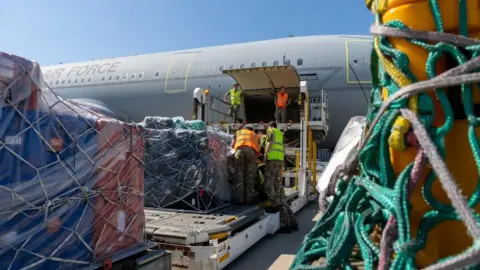
It comes days after specialist British search and rescue teams flew from RAF Brize Norton to Venezuela to assist with recovery operations in the region.
Among those on the ground is a 68-strong contingent from UK Fire and Rescue Services, including some from Hampshire and the Isle of Wight.
 Ministry of Defence
Corfixen said the "immense" earthquakes happened in the evening of a national holiday when "most people were at home".
"That meant that due to the strength of these earthquakes, sadly many of the buildings and many homes basically perished in a matter of seconds," he said.
Before the earthquakes, Corfixen said there had already been an estimated eight million people in Venezuela who were requiring humanitarian assistance.
"So these two earthquakes came at the worst possible time," he added.
 UK ISAR
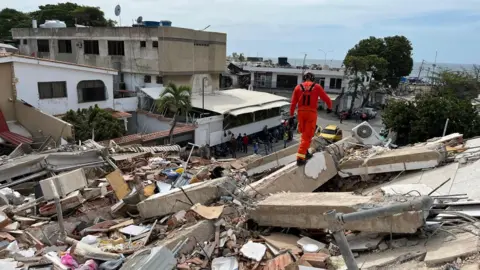
The quakes left many trapped under rubble, with the 96-hour window during which survivors were most likely to be found passing on Sunday evening.
Rescue teams - including those from UK International Search and Rescue - working on the ground are still hopeful of finding survivors and continue to conduct searches.
"The priority right now is to find those who are who are still buried under the rubble, and that's a race against time," Corfixen said.
"Then there's the layer that we will be focusing on which is how we support covering some of those most basic needs that we're seeing right now - and that's anything from distribution of food to essentials like water."
"There will be a massive trauma from this, both physically as well as mentally and that's where we're also looking at services around psychological first aid, psychosocial support and trying to support communities."
