'I found a gold Viking sword pommel in a field'

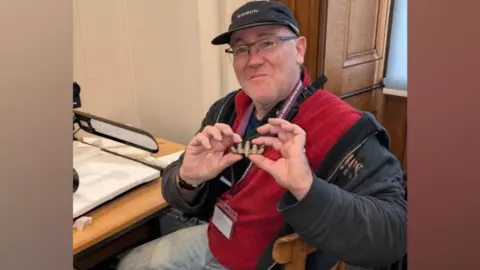 Andy Green
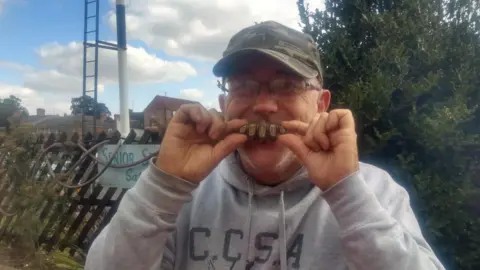
"I started to see the gold through the earth and that's when my hands started shaking," said Andy Green.
The electrician had discovered a gold and silver Viking-era sword pommel when out with a group of metal detectorists, having taken up the hobby six weeks earlier.
Green, 56, said the others realised he might have found something unusually fine when they saw him "sitting on the floor and giggling; I completely lost the plot."
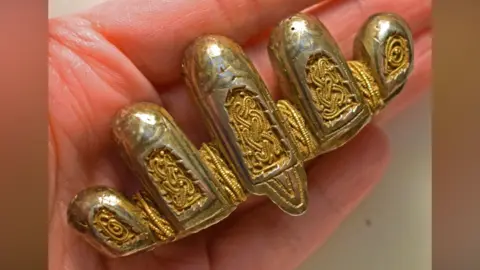
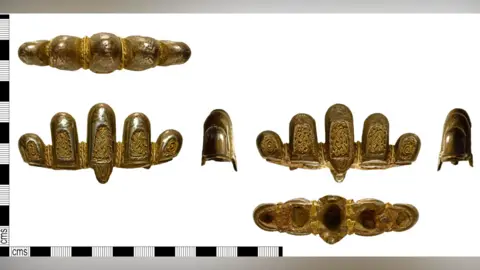
His "absolutely stunning" find was unearthed in fields near Brigstock, outside Corby, Northamptonshire, in 2019 and was recently declared treasure by a coroner.
 The Portable Antiquities Scheme
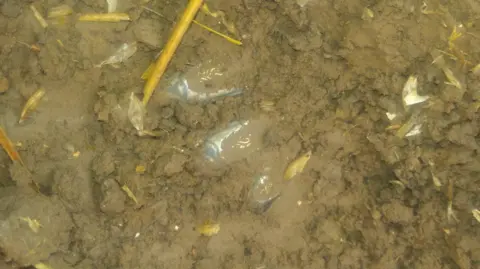
Green, who lives in a narrowboat on the Grand Union Canal, said: "There weren't many people around me in the field and I was just wandering around when the machine beeped, so I just dug a hole.
"When I started digging it out, I saw the tips of the lobes coming through and thought it might be a bullet case."
The gleam of gold soon put paid to that thought.
The unusual pommel was reported to Northamptonshire's finds liaison officer Eleanore Cox, who described it as "absolutely stunning".
"People have been detecting for many years and not found anything this magnificent - it's a once-in-a-lifetime find," she said.
 Andy Green/BBC
Cox called in a Viking sword expert from Glasgow, who visited her to see it in person.
"She told me this the sort of stuff came from Gotland in Sweden, so it was either made there or a metal worker came over from Gotland and made it here," the archaeologist said.
"Every last bit is decorated: it either belonged to someone with a great deal of money or it was presented to them by someone very high up."
By AD900, the Scandinavian raiders and traders had begun to colonise parts of England, in an area known as the Danelaw.
The area included Corby, which was first settled by the Danish invaders.
The Brigstock pommel has been dated to between AD900 and 1120.
 The Portable Antiquities Scheme
In a further twist, another expert got in touch with Cox after the coroner's inquest into the pommel.
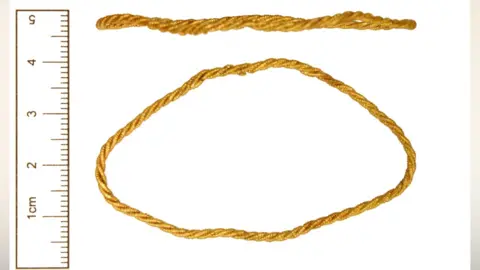
Cox said: "His metal detecting son had found a gold loop, made from three strands of beaded wire twisted together, near Brigstock in 2018 and he asked me 'do you think the two are connected?'
"An expert on Viking swords had a look and believes it's the fitting from further down the hilt."
The loop's details had already been added to the Portable Antiquities database and disclaimed, meaning no museum wanted to acquire it.
 Andy Green
Green said he continues to enjoy metal detecting, which combines his love of long walks and history.
He is delighted that a Northamptonshire museum hopes to acquire it.
"My thought from day one of detecting was when you find something, it's not a question of ownership, it's that you're going to save it from the plough and become the tiniest little moment in its timeline," he said.
 The Portable Antiquities Scheme
Do you have a story suggestion for Northamptonshire? Contact us below.
Follow Northamptonshire news on BBC Sounds, Facebook, Instagram and X.
