The history and charm of our 'proud' village

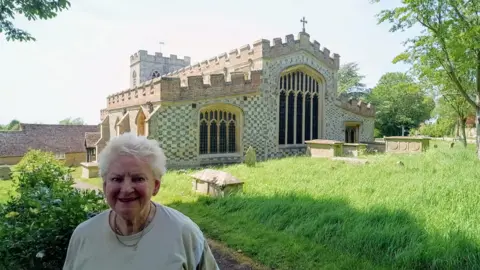 Carol Sawbridge
Nestled in the Chiltern Hills, the Oxfordshire village of Ewelme counts a medieval royal power broker and a famous Victorian writer among its notable former residents.
Add in its centuries-old watercress beds and an appearance in a blockbuster Hollywood movie.
As a local historian put it: "Ewelme is indeed a village with a past and is proud of it."
So much so, residents have created a history trail through the village. We took a step back in time for a snapshot of its historical highlights.
'Incredible' watercress
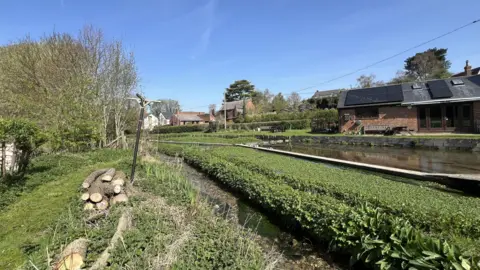
In the centre of the village, the bridge that crosses the Ewelme Brook is surrounded by leafy green rows in its flowing "sweet waters".
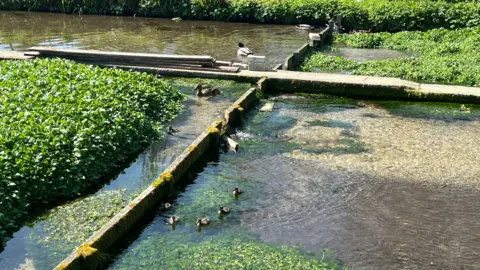
Watercress has been grown by villagers in the chalk stream for centuries, with the stable water temperature creating the perfect conditions for what is now known as a superfood.
Commercial production began in the 1800s when beds were constructed by the Smith family, transporting the watercress to London on the newly-arrived railways.
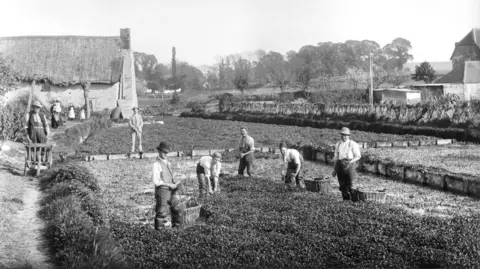 Friends of the Ewelme Watercress Beds
David Solomon, chairman of the Friends of the Ewelme Watercress Beds, lives in a house overlooking the 6.5-acre (26,304 sq m) site.
He said: "It's just an incredible facility for the village and the region.
"Every morning you open the curtains and look out and you see little egrets, grey wagtails, kingfishers, herons, and it's just marvellous."
Thomas Chaucer, lord of Ewelme Manor
Medieval poet Geoffrey Chaucer reputedly called the waters of Ewelme Brook "ever freshe and newe".
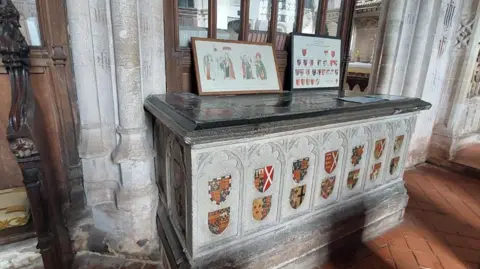
Chaucer's son, Thomas - a politician and soldier - came into possession of Ewelme Manor through his marriage with Matilda, or Maud, Burghersh, a daughter of a wealthy and well-connected Lincoln dynasty.
Local historian Prister Cruttwell wrote in her book - Ewelme, A Romantic Village - that the couple "appear to have lived happily" at the Manor.
Chaucer was High Sheriff of Oxfordshire in 1400 and 1403, and five times Speaker to the House of Commons.
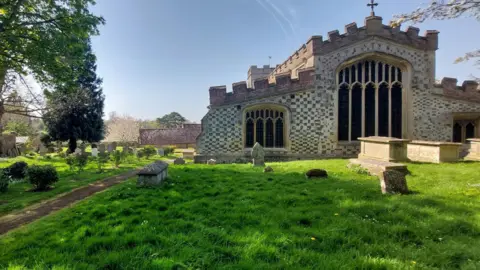
He also began enlarging Ewelme Church, St Mary the Virgin, in 1420, where he and his wife were later buried.
The de la Pole connection
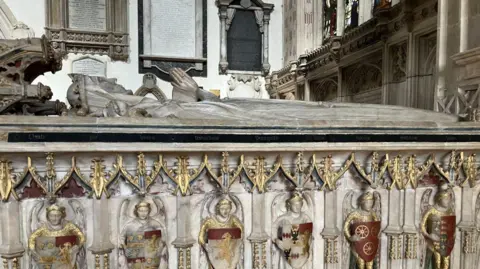
In 1430, the Chaucers' daughter Alice married the then Earl of Suffolk, William de la Pole, a descendant of wealthy wool merchants.
Their role in arranging Henry VI's marriage to French princess Margaret of Anjou made them a very powerful couple and in 1448 the king awarded William the Dukedom of Suffolk.
But William's title also earned him many enemies and he was impeached on charges of treason, corruption, extortion and bribery and was banished from the realm.
While trying to cross to France on a small boat, he was seized by the crew of a "great ship" and brutally killed with a rusty sword.
According to village archivist Carol Sawbridge, Alice was "a shrewd woman" and sought protection from the king for her and her son.
She was allowed to keep all their properties and lands and Sawbridge says she returned to Ewelme "and hid away".
"She was a celibate lady of society ... and that's why she's buried here," Sawbridge says.
Jerome's 'precious' river
 Universal History Archive/Getty Images
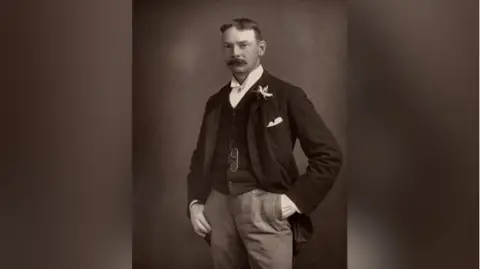
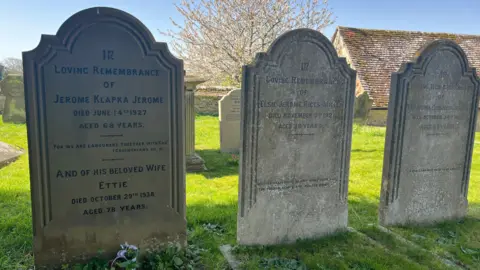
Humorist Jerome K Jerome was known to love Ewelme and lived in a large house called Troy.
His 1889book Three Men in a Boat captures the joys of rowing on Thames on sunny summer days.
In her book, Cruttwell remembered him being "a very quiet man", although "one felt that his little twinkling blue eyes missed nothing, and that he was storing up incidents for his next book".
The book lead to a surge in popularity of boating on the Thames at the time.
"He had these friends on the skiff and they'd hire a rowing boat on at Kingston, and they'd wear boaters and striped blazers, take a hamper and row for their Sunday afternoon amusement there.
"It was very precious to him," she said.
Jerome died in 1927, his ashes were brought back to Ewelme and were buried in the churchyard.
Hollywood comes to town
 Margaret Blake
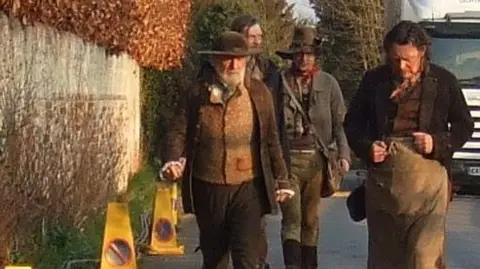
Just like Jerome, TV and film productions have also been attracted to the village's quaint charm.
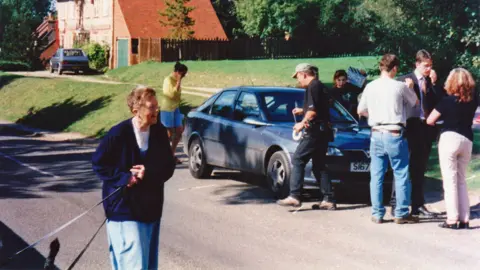
Villagers were extras in the 1986 TV mini-series Paradise Postponed and in 1998, it was the location for an episode of ITV's Midsomer Murders entitled Beyond the Grave.
Sawbridge says Daniel Casey, who played Sgt Troy, was "sweet" and showed her that the murder weapon was hidden in a skip outside the school.
"His girlfriend had a dachshund and I used to walk my dachshunds down and he'd talk to me," she recalled.
Villagers also remember seeing guest star Prunella Scales coming down Burrows Hill "on a bicycle going quite fast".
 Carol Sawbridge
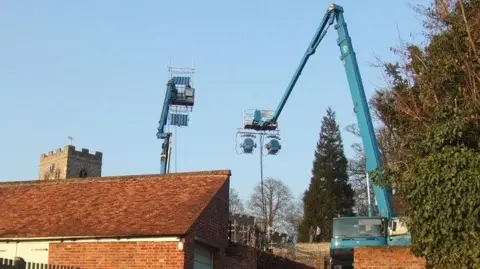
Sawbridge also remembers tight security around the filming of the 2012 film version of Les Misérables.
"All we saw were all these trucks and cars parked on the Common and the big crane above the church."
She was told the old church tower had been made into an inn and the churchyard had been altered.
"They put up a lot of wooden crosses, apparently, looking at some of the photographs in the press, and then even the stone ones had to be covered up."
 Carol Sawbridge