Endangered crayfish survive 'major incident'

 DEFRA
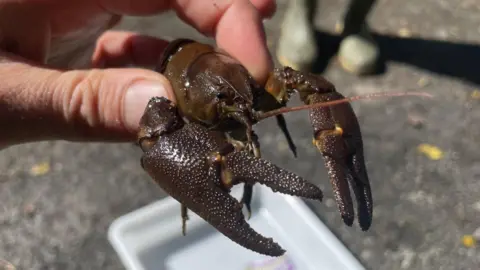
DEFRAA native white-clawed crayfish population has survived a "major incident" in which 100 of the species were found dead.
Unusual symptoms were discovered in populations around the north-east of England in the Tyne and Blyth catchments following the deaths in the River Wansbeck in Northumberland in autumn 2024.
The Environment Agency (EA) and National Trust (NT) have carried out 76 surveys since the deaths were reported to try to identify the cause of the symptoms and impact they are having on crayfish populations.
EA area manager Sarah Jennings said while it is too early to tell what long term implications are for the Wansbeck population "there are hopeful signs".
"Our studies show that not all crayfish in the population are affected, and some can recover from or live with the symptoms," she said.
"There's still some research ongoing to try to understand what it is that's causing the issue, but it could be something we never fully understand."
 Environment Agency
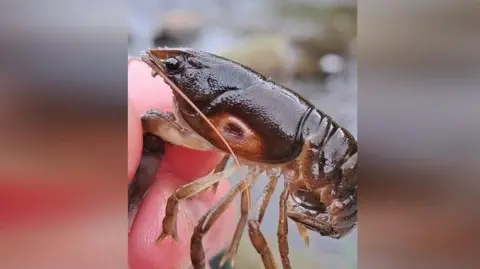
The symptoms do not appear to be fatal to the entire population and it appears some, particularly younger crayfish, can recover via the normal moulting process.
There have been no further reports of native crayfish deaths in any North East catchment since autumn 2024.
Healthy crayfish were rescued from the River Wansbeck after the incident by the EA, the NT and Northumberland Zoo.
Females carrying eggs were kept in tanks at the zoo where there were facilities to rear the young.
The offspring will be released into "ark" sites, bodies of water that are isolated from the risks commonly affecting white-clawed crayfish, later this year.
