'On the pitch I forget I've got Parkinson's'

 Simon Thurlow
A woman with Parkinson's disease has been picked to represent England in a walking football competition.
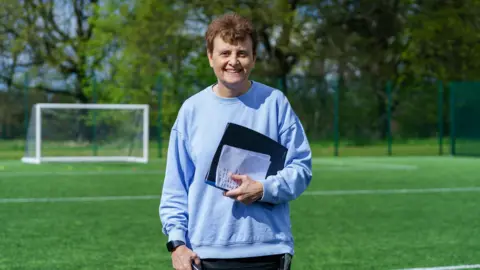
Julie Norris, 56, from Guisborough, was diagnosed with the condition five years ago and now travels more than 170 miles (274 km) each month to train with an all-female team for women with Parkinson's.
In September, two years after joining the Parkinson's Pioneers, she will play for the Parkinson's women's walking football national team against Canada.
"I just have to be more aware of my footwork so I don't fall over," she said. "When I am on the pitch I forget I've got Parkinson's, I just play football."
The left-back and goalkeeper said as a child she played football "in the back field" because it was "the only way" she could get to play. The lifelong fan said "girls weren't allowed to play" the sport.
After initially joining an "able-bodied" walking football team in Stokesley through North East regional manager Janette Hynes, Norris said she felt "accepted" and found out she was "quite a decent footballer".
 Simon Thurlow
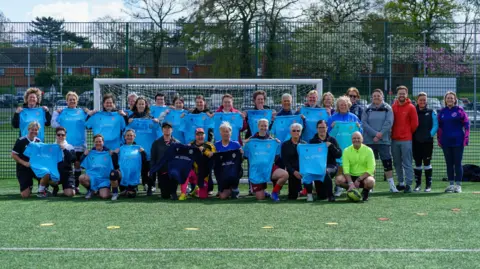
Hynes introduced Norris to Parkinson's Pioneers, based in Solihull, a women's walking football community made up of players from across the country living with the condition.
The former teacher helps coach the over-40s able-bodied walking football team, as well as playing for Parkinson's Pioneers.
"It's not just about football, it's mentally brilliant and you build friendships," she said.
 Annie Booth
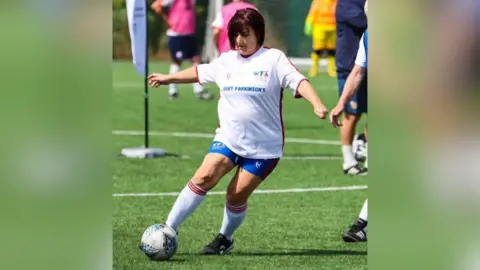
Before setting up the national Parkinson's team, Annie Booth, 58, set up the Pioneers as she wanted "to create a support network" for women diagnosed with the condition. Previously, women had to play in a mixed team with men.
The team has more than 30 active members from across the country, aged between 42 and 73.
Booth was diagnosed with Parkinson's 11 years ago and said while playing football does not stop the disease, it was important to find support.
"It's more than football, our aim was to positively contribute to building a safe environment for women to come together to support each other with their Parkinson's."
She said like all the Pioneers, Norris was an "incredible" support for the other members and a "sublime" player.
 Stuart Langworthy
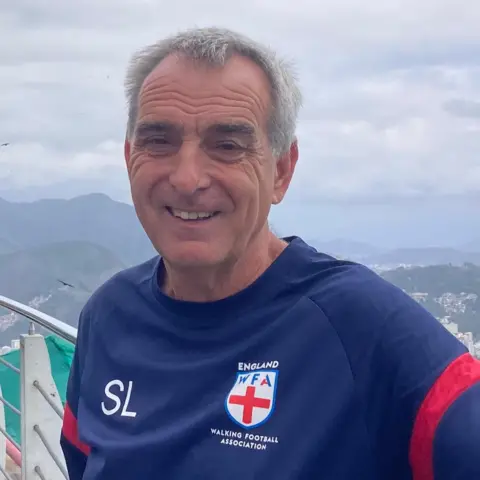
Over-60s walking football England manager Stuart Langworthy said people with Parkinson's "transformed" when they had a ball at their feet, from not being able to walk to being able to play.
The 65-year-old said the national team would take on the able-bodied Canadian walking football team because of a lack of awareness of the abilities of people living with Parkinson's.
"We're going to show other countries what can be achieved," he said.
He said the "team do struggle" with balancing their medication and symptoms with playing football but "they will demonstrate the benefits".
The team, he said, described having Parkinson's as "not the end of the world but instead a new beginning".
