Indonesian students protest in against state spending, fuel price hike

 Getty Images
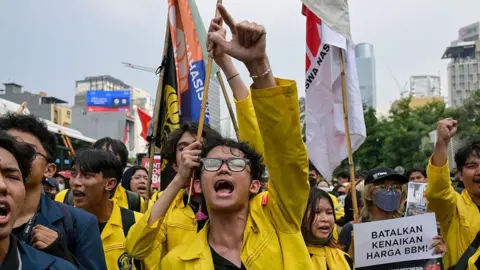
Hundreds of students took to the streets of Indonesia's capital on Friday to protest government policies they said could "bankrupt" the country.
The students were demanding President Prabowo Subianto stop what they called wasteful state spending and scrap his flagship free meals programme, which has been dogged by mass poisonings and allegations of corruption.
They were also protesting the government's decision to raise fuel prices, which will hurt the middle class.
Friday's protest comes amid rising public anger which has simmered for months over perceived mismanagement of the country. The local currency, the rupiah, has also recently slid to fresh lows.
"Fuel prices are going up, and our lives are getting harder," university student Zaki was heard shouting at police officers.
"Why are you afraid of student voices? They say demonstrations are guaranteed by the constitution? That's not happening today," he continued.
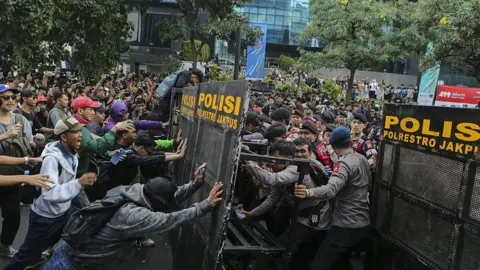
Pictures from the protest show policemen holding shields trying to stop the students as they marched towards the Hotel Indonesia roundabout, a Jakarta landmark.
Video from BBC Indonesian shows people then trying to push and kick their way through the police barricade. Some objects can also be seen being thrown into the air.
There were no immediate reports of injuries.
On social media, the protesters posted under the hashtag #MenujuIndonesiaBangkrut, which means "Towards Bankrupt Indonesia".
The protest comes less than a year after last August's violent anti-government protests, when the death of a delivery rider sparked anger over elite rule and alleged state mismanagement.
 Getty Images
Earlier this week, state-run Pertamina raised prices of two widely-used types of fuel, known as Pertamax, by more than 30%. Indonesia has largely kept fuel prices steady, but Prabowo's programs, like free meals, has put pressure on the budget.
Free meals is the centrepiece of Prabowo's agenda and it figured heavily in his 2024 presidential campaign.
But university student Rina said it had "been unclear from the start".
"There have been incidents like mass food poisoning, and now corruption. The public has been calling for it to stop, but those demands have been ignored," she said.
At an annual cost of $28bn (£20.8bn), it aims to tackle child malnutrition, improve education outcomes and stimulate the economy. Officials have described it as "an investment in Indonesia's future".
But last week, Prabowo fired the head of the agency responsible for the free meals programme, following mass poisonings and allegations of corruption.
