Inspirational mother who shared brain cancer battle will be 'forever missed'

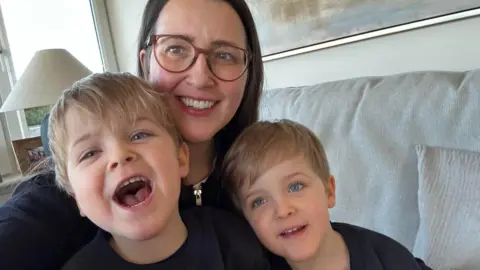 Kim Borthwick
Tributes have been paid to a mother who has died nine months after she was diagnosed with incurable brain cancer.
Kim Borthwick, 36, from Glasgow, was told the devastating news on 18 January, just a week after she began experiencing symptoms.
She later shared her experiences of living with the condition on social media, and spoke of the clarity she gained to appreciate the special moments with her husband and twin four-year-old sons during the time she had left.
Following her diagnosis, she also became an active campaigner for more research and better medical treatment for those living with rare cancers.
Kim previously told the BBC's Radio Scotland Breakfast that when she developed a headache - after a busy festive period with her husband Ross and four-year-old sons Max and Freddie - she initially thought she had just "overdone it".
But following several visits to her GP and a trip to A&E for an urgent CT scan, she was diagnosed with a glioblastoma – a type of highly aggressive brain tumour.
A statement, posted on her Instagram account, read: "On behalf of Kim's family it is with a heavy heart that we share of her passing.
"Kim slipped away peacefully, surrounded by her loving family.
"She was her brave, fighting self right to the very end.
"Kim meant so much to so many people and she will be forever missed.
"We wish to thank you all for the incredible support you've shown over the past eight months. It meant the world to Kim, and to us."
Sarra Hoy, wife of Olympic champion cyclist Sir Chris, was among those who posted words of tribute.
She wrote: "I'm so very very sorry to read this news. Kim made such an impact on social media since her diagnosis and had such a fierce love for her family and of life. Thinking of her loved ones."
Commonwealth Games swimmer Archie Goodburn, who has spoken about living with brain cancer, posted: "Rest peacefully Kim. She was an incredible woman - a true inspiration. Thinking of you all."
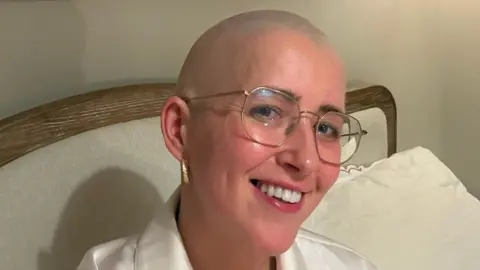 Kim Borthwick
In July Kim told Radio Scotland Breakfast she was initially prescribed migraine medication but after a few days the pain had not subsided and she went to A&E.
She described her first headache as "unbearable".
"I remember saying, 'I need to lie down'," Kim recalled.
"Then my hand started tingling and I lost feeling down one side. I was being sick.
"I just knew something wasn't right, but I'd never experienced migraines before so I put it down to that and thought it had been triggered by overdoing it during the festivities."
Kim also told how she treasured every moment with her sons and did not know if she would see them start school.
She told the programme: "You take those little moments for granted until you realise they could be taken away.
"My diagnosis has given me the clarity to enjoy every moment I have with my boys."
She added: "I know I would have made a bloody good granny."
Kim said her experience had also brought home the lack of attention and resource given to tackling brain cancer, where survival rates in the UK have not changed for decades.
She said this felt like an "injustice" given that survival rates for many other cancers had improved "dramatically" over the same period.
Kim joined the Brain Cancer Justice (BCJ) campaign group, which is urging politicians to provide greater support and funding for rare cancers.
The group is also calling for a dedicated minister for rare cancers to ensure continuity in research, funding and policy.
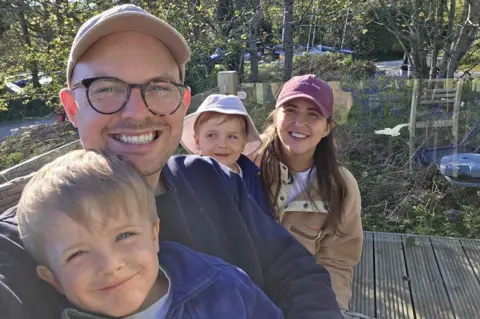 Kim Borthwick
Kim said: "I have a fire in my belly to affect change for people diagnosed with brain cancer in Scotland.
"It is difficult to accept, but it's unlikely I will benefit from these changes.
"I can't accept this diagnosis knowing we could be doing so much more in Scotland to support people with brain cancer."
She added: "There's been no change to outcomes for people diagnosed with brain cancer in 30 years, and brain tumours remain the biggest cancer killer of children and adults under 40.
"To me, that is scandalous."
'I want to make a difference'
Kim pointed out that patients in other G8 countries routinely receive surgery, radiotherapy and chemotherapy as standard treatment, along with treatment using the Optune device, which slows the growth of cancer cells.
She was able to receive the treatment through her private healthcare but she said this combination was not routinely available in Scotland, leaving many families having to navigate treatment options, clinical trials and additional support on their own.
She also said tumour samples in Scotland were not routinely "fresh-frozen" during surgery, which she said meant patients in Scotland became ineligible for clinical trials and emerging genomic treatments that require preserved tissue samples.
"These aren't cures," she said. "Nobody is pretending they are. But they give people more time with the people they love and, ultimately, that's what matters."
Kim is shared her story during Glioblastoma Awareness Week in the hope that future families might be offered more options and face a different outcome.
She wants "kinder and more effective treatment".
"It's too late for me," she said. "But I want to make a difference for those who come after me."
