Tyrone boy critically ill after Monaghan lake incident

 RTE
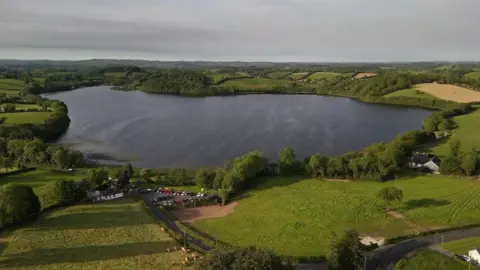
RTEA teenager from County Tyrone is critically ill after he got into difficulty in a lake in County Monaghan.
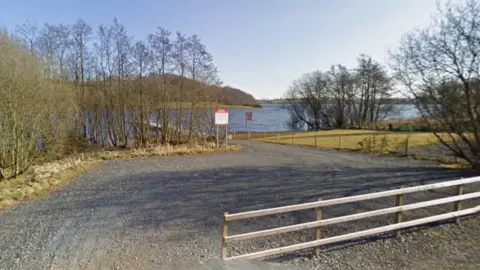
It happened at Emy Lough near Emyvale at about 17:00 local time on Monday.
Irish broadcaster RTÉ is reporting that the boy is 16 years old.
Gardaí (Irish police) said the boy received treatment from the emergency services at the scene before being airlifted to the Mater Hospital in Dublin.
Local swimmers Dzintra McConnon and Johnny McConnell spotted the boy and took him from the water.
They performed CPR on him until emergency services arrived.
Speaking to RTÉ News, McConnon said she saw the boy "go under the water" for "longer than usual".
"I said 'something is wrong' and I said to my friend 'let's swim there'," McConnon said.
She said she began to shout for help.
"We got him eventually and lifted him out and started CPR until the ambulance arrived."
 Google Maps
"I believe he is just from across the border in County Tyrone," local Fine Gael councillor for Monaghan Pauric Clerkin told RTÉ News.
He said said there was a "sense of devastation" in the local community.
"We just wanted to send our thoughts to the family of that young boy, hoping that he will make a full recovery," Clerkin said.
Sinn Féin councillor for the area Bronagh McAree said: "I would like to offer my thoughts and prayers to the young boy who remains seriously ill in hospital."
She added that the "entire Emyvale community is heartbroken and thinking of his family, friends and everyone affected by this awful tragedy".
McAree said her daughter was also at the lough and hearing what happened "really brought home how quickly lives can change, and how every parent's worst nightmare can become reality in an instant".
There have been a series of water-related deaths across the UK and Ireland in recent days.
The incident at Emy Lake happened just one day after 15-year-old Abbie Carmody-Pepper died during a day out at a County Dublin beach on Sunday.
Elsewhere, a body has been found in a search for a 12-year-old boy who went missing while swimming in a river in Lancashire.
Three teenagers died in open water in West Yorkshire, South Yorkshire and Warwickshire on Bank Holiday Monday, and a 15-year-old boy drowned in a lake near Lincoln on Sunday.
Water safety
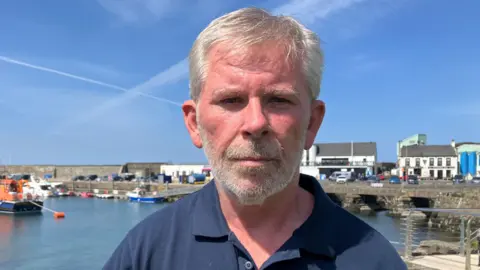
Carl Kennedy, a water safety officer in Portrush RNLI, said the water along the north coast of Northern Ireland is about 11C at the moment.
"If you're going into water from 25C to 30C air temperature to 11C, that will create quite a bit of cold water shock in the body," he told the BBC's Good Morning Ulster programme.
Kennedy said that if people do get into water and feel a "gasping reaction for air" it is "not a good time to try swim your way out of it".
"Your breathing is erratic, your blood flow has been disrupted."
"The best thing for people to do if they find themselves in that position is to first and foremost not to panic - and float to live," Kennedy said.
"That involves putting your head right back, getting your ears in the water, spreading your arms out and trying to maintain just a regular breathing pattern," he said.
"That can take maybe 60 to 90 seconds to allow your body to recover from that cold water shock. Once that happens, then you can look towards maybe swimming your way out of difficulty or shouting for help."
'Stop, think and look around'
Kennedy said that if you witness someone in trouble in the water to call for help on 999 or 112 and request the Coast Guard.
He said lots of waterways have throw bags or life rings that can be thrown into the water to assist the person.
"If the person is in any depth of water over three or four feet, people should not really be going into that water because they will experience the exact same thing. Quite often, in our experience, that can end up with two casualties instead of one," Kennedy said.
The best way to stay safe at a beach is to go to one with a lifeguard, according to Kennedy.
He said when there isn't a lifeguard "you really have to make your own assessments".
"We would encourage people, if they are going an un-lifeguarded beach or a body of water, you need to stop, think, have a look around when you arrive, look for potential risks, look for warning signage, look for throw bags and so on, and so forth," Kennedy said.
"Make sure you've got a good phone signal just in case you do get involved in an emergency.
"We would normally recommend, particularly for kids, to stay together, don't go off on your own."
