London display reveals scale of Nazi slave labour

 Mike Stone
A new exhibition in London is shedding light on the vast scale of the Nazi regime's slave labour programme.
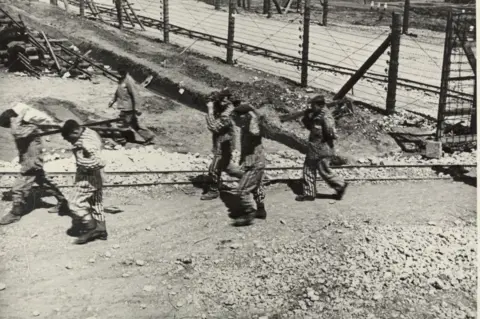
Nazi Slave Labour: Perpetrators & Victims opened at The Wiener Holocaust Library and examines how forced labour became central to the German war economy between 1939 and 1945.
It is estimated that 20 million people were exploited during the course of World War II.
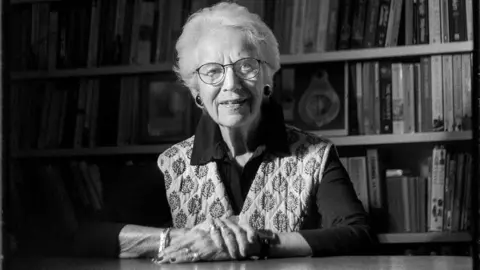
Among those whose family's story is referenced in the exhibition is Eva Clarke, who was born at a concentration camp just days before liberation in 1945.
Addressing the opening of the exhibition, Eva shared her family's story. Her mother, Anka Bergman, was deported with her husband, Bernd Nathan, to the Theresienstadt ghetto in 1941.
She said that after her mother became pregnant in 1943, her parents were forced to sign a document stating the baby would be killed after birth.
"But they didn't use the word kill," she said. "They used the word euthanasia. My mother had never heard the word euthanasia."
After surviving Auschwitz while pregnant with Eva, Anka was transferred to Freiburg in Germany, where she was forced to work in an armaments factory manufacturing parts for V1 flying bombs.
"My mother's job in Freiburg was to rivet on the tail fin of the V1, the unmanned flying bomb, very heavy labour for pregnant women," Eva said.
As Allied forces advanced in 1945, prisoners were evacuated in open coal wagons to Mauthausen concentration camp in Austria, where Eva was born on 29 April.
"There are three reasons why we survived," she said. "The first is a very chilling one. On the 28th of April 1945, the Nazis had run out of gas. Well, my birthday is the 29th."
Eva and her mother were eventually among those liberated by American forces.
 The Wiener Holocaust Library
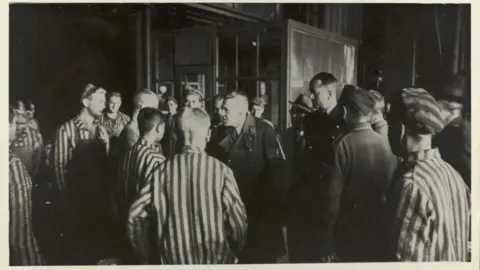
Drawing on eyewitness testimony, photographs and war crimes trial documents from the library's archives, the exhibition explores how the Nazi labour system extended far beyond concentration camps into factories, farms and major German companies.
Organisers say around two and a half million slave labourers died during the war.
Victims included concentration camp prisoners, prisoners of war and civilians deported from occupied countries.
By 1944, one in four workers in Germany was a slave labourer, according to the exhibition's curators.
 Mike Stone
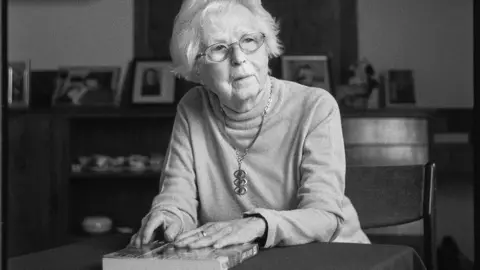
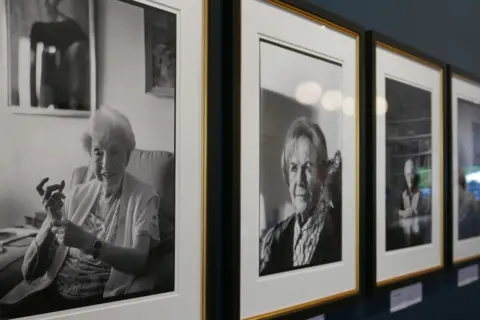
The final section of the exhibition features portraits of UK-based survivors photographed by documentary photographer Mike Stone using a Leica camera made in Germany in 1937.
Among them is Hungarian-born Agnes Kaposi, who was about 11 when she worked on a state farm in Austria before later being forced to labour at an armaments factory producing anti-aircraft guns.
Another survivor featured is Polish-born Mala Tribich, who endured deportations in cattle trucks, camp selections and compulsory labour clearing rubble from bombsites.
 Mike Stone
Among the documents on display are records from the Nuremberg "Farben Case", which prosecuted executives from the chemical conglomerate I.G. Farben over the use of forced labour during the Holocaust.
Thirteen officials and directors were found guilty, although all had been released from prison by 1951.
The exhibition also examines the role of civilian businesses during the war. It highlights how the Leica camera company, whose owners helped some Jewish employees flee Germany during the 1930s, later used up to 1,000 forced labourers, mainly young Ukrainian women, in wartime production.
 The Wiener Holocaust Library
Dr Barbara Warnock, co-director of the library, said the exhibition addressed a subject often overlooked in Holocaust remembrance.
"The Nazis' complex wartime economic system and its huge reliance on forced and slave labour has not always received attention in wider remembrance and commemoration," she said.
She described the exhibition as "the first ever in Britain that focuses solely on the use of slave and forced labour, its role in the Nazi war economy and its significance in the Holocaust and the Nazi camp system".
Listen to the best of BBC Radio London on Sounds and follow BBC London on Facebook, X and Instagram. Send your story ideas to hello.bbclondon@bbc.co.uk
