Marooned Lord Byron statue returns to Hyde Park

 Lord Byron Society
A statue of the 19th-century poet Lord Byron has been returned to Hyde Park, nearly 70 years after it was isolated on a traffic island when new roads were built through the area in the early 1960s.
The Grade II-listed statue was erected as a national memorial in 1880 after receiving special permission from Queen Victoria. Changes to the Park Lane road layout 80 years later left it inaccessible, leading it to become isolated, neglected and dirty.
The Lord Byron Society launched a campaign to relocate the statue six years ago, arguing it had become neglected.
The move cost more than £400,000, funded by a £230,000 grant from The National Lottery Heritage Fund and additional donations.
"We are all extremely grateful that our plea to rescue Byron and put him back into full public view was met with so much support by everyone involved," said Lord Robin Byron, the president of the society.
 Getty Images & Lord Byron Society
The campaign to have the statue moved back into the park faced a number of administrative hurdles, and required permission from the Royal Parks and Westminster City Council.
Once granted, a large-scale project, involving conservation specialists, stone masons and architects, was initiated to restore and then move the statue.
At the statue's final unveiling this month, Lord Robin Byron said: "Our sincere hope is that the statue will encourage people to explore Byron's poetry and also his letters, which are so accessible and give a brilliant insight into his engaging personality and fascinating inner life."
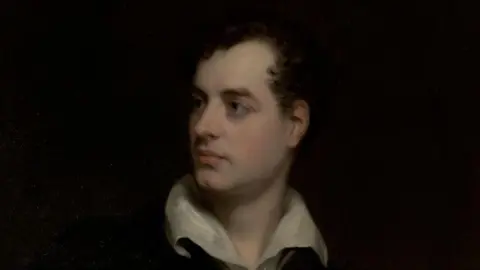 Nottingham City Museums and Galleries
The poet was a popular Romantic figure in Victorian Britain, described as "mad, bad and dangerous to know" by one of his lovers, Lady Caroline Lamb.
He was born in London's Holles Street, off Oxford Street, in 1788.
He died from a fever in 1824 in Missolonghi, in modern day Greece, after joining Greek insurgents the year prior to fight a war of independence against the Ottoman Empire.
Listen to the best of BBC Radio London on Sounds and follow BBC London on Facebook, X and Instagram. Send your story ideas to hello.bbclondon@bbc.co.uk
