Rare frogs arrive at London Zoo in conservation bid

 ZSL
ZSLLondon Zoo has taken in two critically endangered frog species from Ghana as conservationists attempt to save them from extinction.
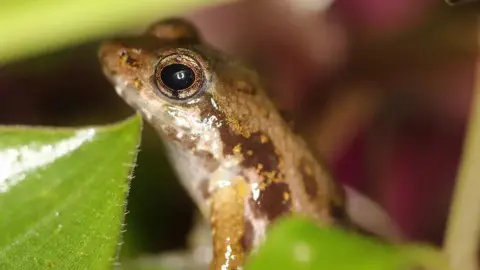
The Atewa slippery frog and Afia Birago's puddle frog, both native to Ghana's Atewa Hills Forest Reserve, are now being cared for at the zoo's Secret Life of Reptiles and Amphibians exhibit.
Scientists say both species are under growing threat from habitat destruction caused by mining in the forest reserve.
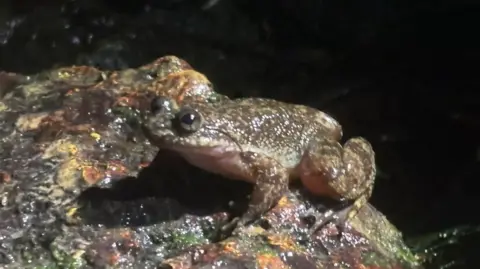
The Atewa slippery frog was only identified by scientists in 2021 and is believed to have fewer than 1,500 individuals remaining in the wild. The species is known for its unusual fish-like swimming ability and distinctive "whistling" call.
Afia Birago's puddle frog, first described in 2018, is small enough to sit on a £1 coin and is now thought to survive in just two pools within the reserve.
The frogs were brought to London in September 2025 through a partnership between the Zoological Society of London (ZSL), Herp Conservation Ghana and the Forestry Research Institute of Ghana.
Zoo officials said all 20 Atewa slippery frog tadpoles survived the 4,500-mile journey to the UK and later developed successfully into adults.
 ZSL
ZSLIn November 2025, London Zoo also became the first institution in the world to breed the Atewa slippery frog in human care.
Ben Tapley, the zoo's curator of reptiles and amphibians, said: "With both frog species facing an imminent risk of extinction, but limited experience in amphibian care and difficulties obtaining specialist equipment locally, it was decided that a population of the frogs should be moved to ZSL's London Zoo to learn as much as possible about these species while we still have the time.
Amphibian keeper Unnar Aevarsson also travelled to Ghana to help establish what conservationists say is West Africa's first dedicated amphibian conservation facility.
Researchers collected water samples and images of local vegetation to recreate the frogs' natural environment in both Ghana and London.
Conservationists hope the programme will eventually allow captive-bred frogs to be reintroduced into protected habitats in the wild.
The frogs went on public display at London Zoo on Friday.
Listen to the best of BBC Radio London on Sounds and follow BBC London on Facebook, X and Instagram. Send your story ideas to hello.bbclondon@bbc.co.uk
