'Extremely significant' bomb in car intercepted on way to NI, Irish police say

 PA Media
A car containing an "extremely significant" bomb has been intercepted in the Republic of Ireland as it was being driven across the border for an attack in Northern Ireland, gardaí (Irish police) have said.
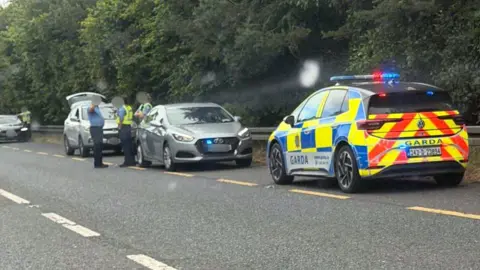
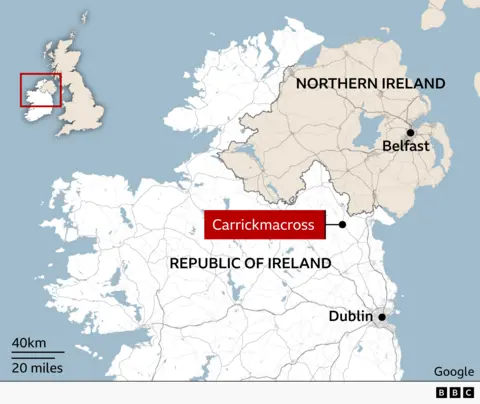
The vehicle was stopped in County Monaghan on Wednesday during an operation targeting dissident republican activities.
BBC News NI understands police in Northern Ireland's main theory is that the bomb was set to be used to attack a police station north of the border.
A woman in her 20s has been charged and is due to appear in court in County Meath on Friday evening, while a man in his 40s remains in custody.
Police sources in Northern Ireland believe the New IRA was likely responsible.
The vehicle was stopped on the N2 near Carrickmacross at about 15:00 on Wednesday.
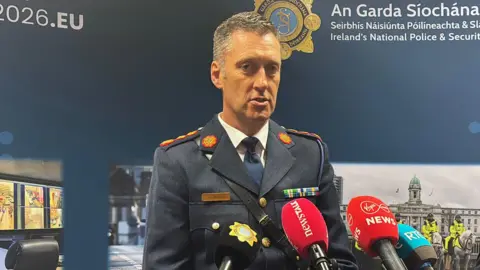
Garda Commissioner Justin Kelly confirmed on Friday that officers had found an explosive device.
Irish broadcaster RTÉ reported that gardaí sources said the bomb contained a power unit, a detonator and military grade explosives.
 Philip Fitzpatrick
Speaking to reporters in County Tipperary, Kelly said any incident such as this one was concerning.
"However, we certainly know that there are a small minority of dissident republicans who did not agree with the Good Friday Agreement, they did not put weapons and explosives [out of use], they didn't, you know, go through with the proper process in relation to decommissioning," he said.
"So that is something that we continue to deal with.
"There's a small minority of these individuals, I would describe them as radicalised republicans, and this is a threat that we're going to continue to face for some time."
Kelly said that the bomb was "not just components or pieces," but was "extremely significant".
"This was an explosive device and it would have or could have potentially caused significant damage," he said.
"This is an intelligence-led operation, so we certainly do have information in relation to the individuals involved."
Ireland's Minister for Justice Jim O'Callaghan described the incident as "very worrying".
"I think it evidences the fact that there is an ongoing threat in respect of dissident republican activity," he said.
"I suppose what I'm encouraged about is that the gardaí were able to apprehend the suspect.
"The device has been defused. I want to commend the gardaí for the work they did in ensuring that this didn't become a real threat to the public."
O'Callaghan said it was "obvious" that "a very serious criminal act" would have occurred if police had not intercepted the suspects.
Northern Ireland Secretary Sir Chris Bryant thanked gardaí for their "quick, decisive action".
"Intercepting a dangerous device like this undoubtedly saved lives and kept communities safe on both sides of the border," he said.
"Strong cross-border security cooperation remains as vital as ever."
Police Service of Northern Ireland (PSNI) Assistant Chief Constable Davy Beck said he welcomed the "significant seizure and the arrests" made by gardaí, which he said the PSNI worked with "very closely on a daily basis".
"This underlines our joint commitment to address the threat posed by violent dissident republican groups and keep communities safe," Beck said.
"We will continue to liaise closely with An Garda Síochána in relation to their investigation, and provide any support as required," he said.
How have political parties reacted?
Northern Ireland's First Minister Michelle O'Neill posted on X that the bomb served "only a wreckers' agenda".
"Those responsible have no support and no vision for our island and our communities," she wrote.
Democratic Unionist Party leader Gavin Robinson said the incident "raises serious questions" about how the Irish government was "assessing the threat posed by dissident republican terrorism and whether the response is keeping pace with the danger".
Northern Ireland's Justice Minister Naomi Long, from Alliance, "unequivocally" condemned those responsible for the bomb and said there could be no justification for actions designed to endanger lives.
Ulster Unionist Party deputy leader Diana Armstrong said her party "wishes to place on record its sincere thanks and gratitude to An Garda Síochána for their professionalism and swift action in intercepting this vehicle".
"This latest incident is a further reminder of the continued threat posed by dissident republican terrorism," she added.
Social Democratic and Labour Party (SDLP) MP Colum Eastwood said the incident would "bring back dark memories of our past for many".
"The SDLP has always been clear that violence of this nature is futile and achieves nothing except harming communities and tearing families apart," he said.
Fine Gael's David Maxwell, who represents the Cavan-Monaghan constituency, thanked gardaí for stopping the bomb from travelling across the border and the Irish Defence Forces for their "brave work in making the device safe".
"It is disappointing that as we approach the 30th anniversary of the Good Friday Agreement that we have a small group of people who want to bring destruction and death back to this island with no mandate and no support," Maxwell said.
Who are dissident republicans?
The term "dissident republicans" describes a range of individuals who do not accept the Good Friday Agreement - the 1998 peace deal which ended the worst of the Troubles in Northern Ireland.
The Provisional IRA - the main armed republican paramilitary group for most of the Troubles - declared a ceasefire in the run up to the agreement and officially ended its violent campaign in 2005.
Dissident republicanism is made up of various groups which broke away from the Provisional IRA in the 1980s, 1990s and 2000s, including the Continuity IRA and New IRA.
The groups are much smaller than the Provisional IRA, although they have access to high-calibre weapons and have used improvised explosive devices and mortars in attacks and attempted attacks.
