Artist recreates city's past to help discover family history

 Other
OtherA Coventry artist has been retracing the footsteps of his great, great-uncle, recreating scenes of the city first captured more than a century ago.
Christopher Sidwell's project, After Bunney, combines family history, local heritage and contemporary art.
For his book he revisited locations painted by his relative, Sydney Bunney, comparing the city of today with the one his ancestor knew.
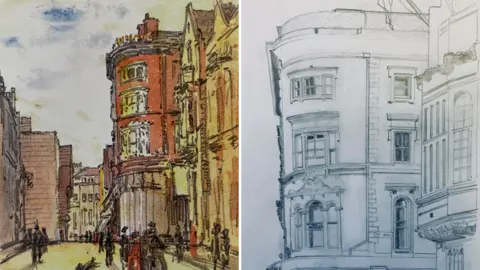
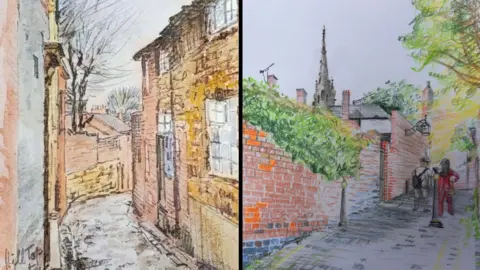
Using Bunney's watercolours and sketches as a historical blueprint, Sidwell returned to the exact locations to produce his own interpretations.
The artworks reveal how some parts of Coventry have changed, while others have remained "frozen in time," said the artist.
 CC, CCBY, Coventry Archives/ Christopher Sidwell
"This project began as research into my family tree but ended as a book about my mysterious great, great-uncle, the artist Sydney John Bunney," Sidwell said.
His grandmother, Carrie Bunney, was the artist's niece but the family knew little about him.
"I couldn't understand why there wasn't even a photograph," he said.
"You know how you're drawn to mysteries? Well, this was a mystery in my own family.
"It started as a hunt for some photographs because our family didn't have any, but then it grew into the book."
 CC, CCBY, Coventry Archives/Christopher Sidwell
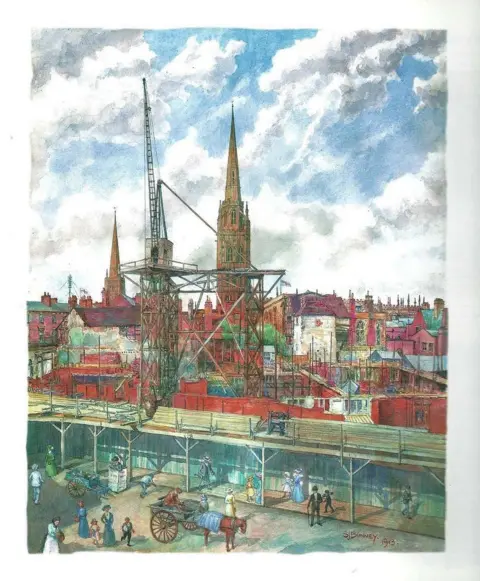
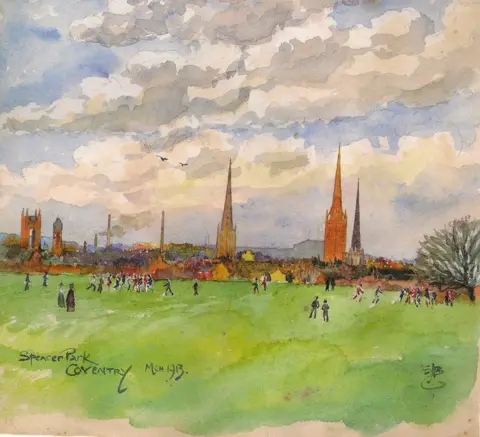
Although Bunney produced hundreds of miniature watercolours of the city, he was not recognised as an artist in his lifetime.
Born in 1877, he studied at the Coventry School of Art, then became secretary of the art school's sketch club.
He only showed his art in public twice, Sidwell explained, working as a clerk at ball bearing factory Auto Machinery most his life, and only painting in his spare time.
A 1999 book produced by the Herbert Art Gallery & Museum, Sydney Bunney's Coventry: Impressions of a Graceful City, helped spark renewed interest in his work.
"His paintings don't actually come up for sale very often, but they are fetching huge sums," Sidwell said. "He is a popular artist."
"I'd always loved his artwork, but I wanted to find out something about the man.
"He was considered a late impressionist, although we don't actually agree with that assessment and during the course of the book come to other conclusions about what style he was."
 CC, CCBY, Coventry Archives
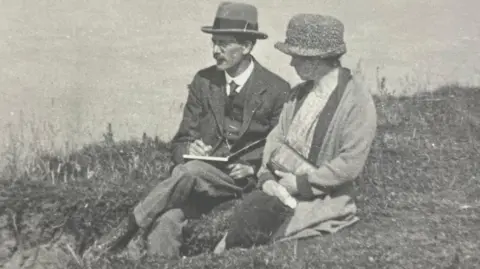
The artist also managed to track down a photograph of Bunney and locate his grave "which was very, very exciting", he explained.
"We also found out that he had attempted at various times to make a living as an artist, but sadly failed," he said.
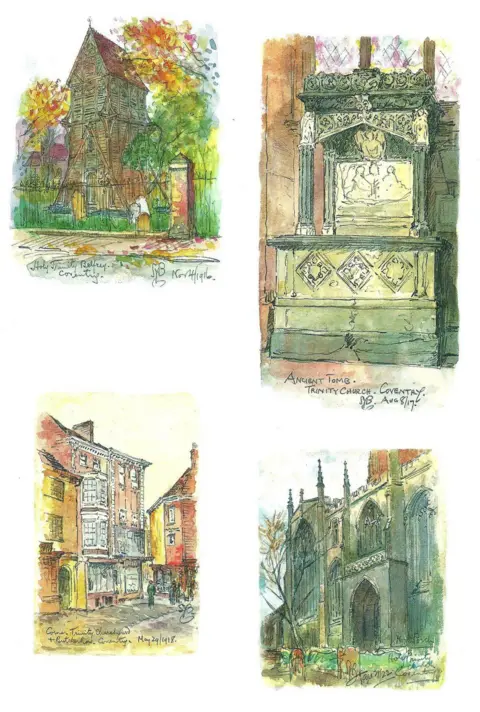
In 1964 the Herbert Art Gallery and Museum purchased a collection of more than 500 miniature watercolours of the city.
These included panoramic views, glimpses of streets, details of doorways and records of buildings.
 CC, CCBY, Coventry Archives
For Sidwell, recreating the scenes also highlighted the scale of change in Coventry over the last century.
"Sadly, a lot of the views are actually lost to us now," he said.
"If the bombs of the Second World War didn't destroy a lot of the buildings, then the planners did during the redevelopment of the city centre."
Bunney spent his later life living in Albany Road, Earlsdon, with his wife Eliza and two children. He died, aged 51, in June 1928.
 CC, CCBY, Coventry Archives
After Bunney by Christopher John Sidwell with Stephen John Mayo is published by Hutch Bucks and available from the author's website.
Follow BBC Coventry & Warwickshire on BBC Sounds, Facebook, X and Instagram.
