Rescued one-armed gorilla becomes mum in her 30s

 Tony King/Aspinall Foundation
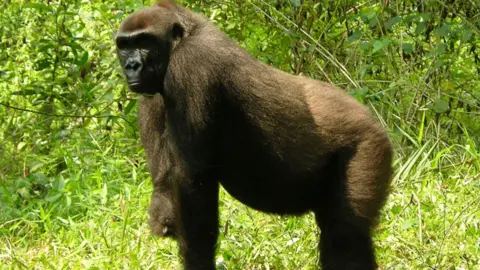
A wildlife charity in Kent is celebrating as a one-armed gorilla, twice rescued from snares in central Africa, has become a mother again in her 30s.
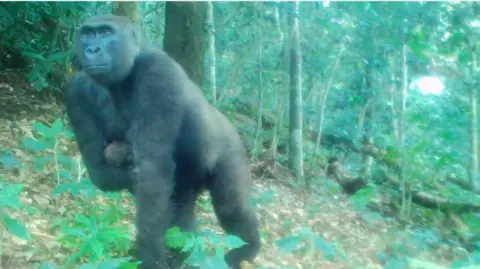
Aspinall Foundation, in Hythe, said the mother Lengui was "doing well" and believed the baby was born in Congo-Brazzaville around Valentine's Day.
Rescue coordinator Tony King, who helped rewild Lengui, said the charity was "absolutely delighted" with the birth.
"Having endured such trauma in her early life, we're pleased to see Lengui is continuing to live life to the full," he said.
The charity have only discovered the birth recently as the team in the Republic of Congo checks the cameras at the reserve every six weeks.
They examine footage from more than 20 cameras, categorise them, and add each wildlife observation to a database, which is a long process.
King said motherhood "would not be easy" for Lengui, who lives in the Lesio-Louna Reserve, which the charity co-manages.
"Lengui is a mature mum and babies are dependent on their mothers for up to four years," he explains.
'Will to survive'
King said Lengui has a "remarkable" backstory that proved her "incredible will" to survive.
At 18-months-old, her own mother was caught in a snare, leaving Lengui as "helpless as an orphan".
King added Lengui was "too small to be eaten by humans or sell as smoked meat", so hunters tied her to a stake and brought fruit to keep her alive.
"They were possibly hoping to sell Lengui as a pet," he said.
 Aspinall Foundation
Lengui was rescued by a Odzala National Park team in Congo-Brazzaville.
She was rehabilitated in Brazzaville Gorilla Orphanage, run by The Aspinall Foundation, in April 1994 before being rewilded.
However, Lengui was caught in a snare in April 2002.
When vets arrived, they discovered the snare had cut through her palm to the bone and an infection had spread to her wrist.
To save her life, vets amputated her arm below the elbow.
According to the Gorilla Organization, western lowland gorillas are critically-endangered, with about 150,000 left in the wild.
Follow BBC Kent on Facebook, on X, and on Instagram and listen to BBC Radio Kent on Sounds. Send your story ideas to southeasttoday@bbc.co.uk or WhatsApp us on 08081 002250.
