Hedgehogs 'covered in toxic paint' rescued
 Dottie’s Little Hog Hospital
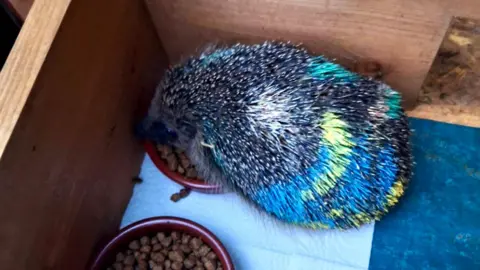
An increasing number of hedgehogs covered in what is believed to be paint or nail varnish are being rescued, a Kent wildlife charity has said.
Dottie's Little Hog Hospital in Herne Bay said it had seen five cases in the past month.
"It's really worrying. We've had it a few times in the past, but nothing like the regularity we're getting at the moment," volunteer rescuer Rosie Fisher said.
Paint can be toxic for the animals, and the bright colours make them more vulnerable to predators, she added.
Most recently, the charity rescued a female hedgehog, which Rosie said was "marked in at least nine places with four different colours".
She said that she believed that the paint covering was deliberate.
"We think it's probably people seeing hedgehogs in their garden and thinking that it's their hedgehog and marking it," she said.
After finding the fifth painted hedgehog in a month, the charity reached out to other wildlife charities to see if they had noticed a similar trend.
"They've said they found it too, in certain places," Fisher added.
'Toxic fumes'
Dottie's Little Hog Hospital has released its most recent rescued hedgehog.
However, Fisher has urged the public not to mark hedgehogs with paint or varnish.
"It will be toxic to the hedgehog, the fumes will affect the hedgehog," she said.
She said that the fumes could also confuse mothers, leading them to reject their babies.
"There's nothing we can do," she said. "We can't use white spirit or nail varnish remover or anything like that."
She explained that hedgehog spines eventually fall out, similar to human hair.
Until then, she said that the paint can be painful on their skin.
"Don't do it. They're wild animals," Fisher said.
If anyone wanted to monitor the animals in their garden, she said that wildlife cameras were a minimally invasive alternative.
Follow BBC Kent on Facebook, on X, and on Instagram and listen to BBC Radio Kent on Sounds. Send your story ideas to southeasttoday@bbc.co.uk or WhatsApp us on 08081 002250.
