Postal pigeons secretly accompany daily deliveries

 Curious Critters
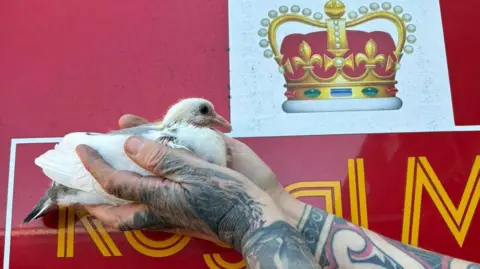
A family of pigeons has been rescued from beneath a postal van after secretly accompanying daily deliveries for more than three weeks.
Louise Thomas, a Royal Mail worker in Nailsea, north Somerset, said the birds had gone undetected until Saturday when the mother was spotted trying to climb underneath.
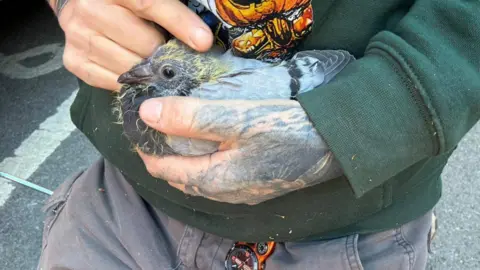
Local rescue team Curious Critters was called to retrieve two babies, known as squabs, and an adult female. A spokesperson said all three birds were "in good health".
"Given pigeons sit on their eggs for around 18 days, and the squabs are at least three weeks old, they have been under there a long time," they added.
The birds have been transported to the charity's rehabilitation aviary in Backwell where they will be safely released together once ready.
 Louise Thomas
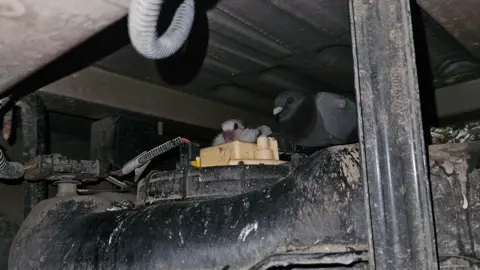
Two volunteers from Curious Critters, Sarah and Emma, said they had to lift the van with an A-frame to get underneath it before they found the birds peering out from behind the machinery.
"The gap they had nestled into was extremely narrow and right at the back of the chassis," they said.
The trio were carefully removed and put into a carrier to be transported to the aviary together where they have continued to be fed by the mother.
"Surprisingly all three were clean and in excellent health," Emma said.
"The squabs' crops [storage pouches] were full so the parents have been feeding them well."
A Royal Mail spokesperson said the birds must have made the 3.5-mile (5km) postal van journey between the Nailsea delivery office and Flax Bourton every day.
"A colleague at our Nailsea delivery office spotted a bird trying to get underneath one of our vans and, after taking a closer look, realised a small nest had been tucked away there for a while," the spokesperson said.
"It's not something we see every day but we're really glad it was spotted and that the birds could be safely rehomed."
 Curious Critters
The rescue team described pigeons as "resourceful".
They said they thought the nest had been made on the internal framework because it was "warm, dry and safe from predators".
A spokesperson said: "We've heard of many animals nesting or getting trapped in or under vehicles but never for this amount of time and not only surviving but thriving.
"Once the juveniles are fully independent and flying well they will all be released and will hopefully find a better place to nest in the future."
Follow BBC Bristol on Facebook, X and Instagram. Send your story ideas to us on email or via WhatsApp on 0800 313 4630.
